
Bybit Futures Trading Tutorial is a practical guide for traders who want to understand how perpetual contracts, leverage, margin, order types, and risk controls work on the Bybit platform. Futures can be useful for expressing a bullish or bearish market view, but they are high-risk instruments: leverage can magnify losses just as quickly as potential gains.

- 20% trading fee discount
- $100 signup bonus
- $10,000 futures bonus

- 20% fee cashback
- $60,000 futures bonus

- 20% fee cashback
- $8,000 bonus

- 20% fee cashback
- $10,000 bonus

- 50% trading fee discount
- 20% fee cashback
- $6,200 futures bonus

- 20% trading fee discount
- $30,050 signup bonus
Promotion: New eligible users can register through Bybit with referral code CRYPTONEWER to access a 20% trading fee discount and up to $30,050 in benefits, subject to Bybit’s current campaign terms, eligibility rules, and regional availability. Always review the offer details on the platform before depositing or trading.
What Is Bybit Futures Trading?
Bybit futures trading lets you trade a contract that follows the price of an underlying asset, such as BTC or ETH, rather than buying the asset itself. The most commonly used products are perpetual contracts, which do not have a fixed expiry date. You can open a long position if you expect price to rise or a short position if you expect it to fall.
For example, if Bitcoin trades at $60,000 and you believe it may decline, a BTC perpetual short can potentially profit if the market falls. If Bitcoin instead rises, the position loses value. This is why a reliable Bybit futures trading strategy starts with position sizing and invalidation—not simply choosing long or short.
Create and Secure Your Bybit Account
- Register through this Bybit referral link.
- Enter the referral code CRYPTONEWER if it is not automatically populated.
- Complete any identity verification required in your jurisdiction.
- Enable two-factor authentication (2FA), set a strong unique password, and review withdrawal security settings.
- Check the Rewards Hub or promotion page for the available 20% fee discount and up to $30,050 benefits. Offers can change, so treat displayed platform terms as the source of truth.
Account security matters particularly in derivatives trading. A compromised account with open leveraged positions can create a time-sensitive problem, so avoid sharing codes, API keys, or login credentials.
Transfer Funds to the Derivatives Account
Before placing a Bybit futures order, move collateral into the appropriate derivatives wallet or account area. Depending on the contract, collateral may be held in a stablecoin such as USDT or in the underlying cryptocurrency for inverse products.
From the Assets section, use Transfer to move available funds internally. This is generally different from an on-chain withdrawal and normally does not require a blockchain transaction. Once the balance appears in the trading interface, choose a market such as BTCUSDT Perpetual or ETHUSDT Perpetual.
Start with an amount you can afford to lose. Even experienced traders should avoid allocating their full balance to a single position, because volatile price moves, funding payments, and liquidation thresholds can affect the account quickly.
Choose Isolated or Cross Margin Carefully
The margin mode is one of the most important settings in this Bybit Futures Trading Tutorial.
- Isolated margin: Margin is allocated to one position. If that position approaches liquidation, the loss is generally limited to the margin assigned to it, unless you manually add more.
- Cross margin: Available account balance can support open positions. This can reduce the chance of immediate liquidation for one trade, but it may put more of your derivatives balance at risk.
New futures traders often find isolated margin easier to control because the risk allocation is more visible. Cross margin is not inherently wrong; it simply requires a clearer understanding of total account exposure.
Set Leverage Before Entering a Trade
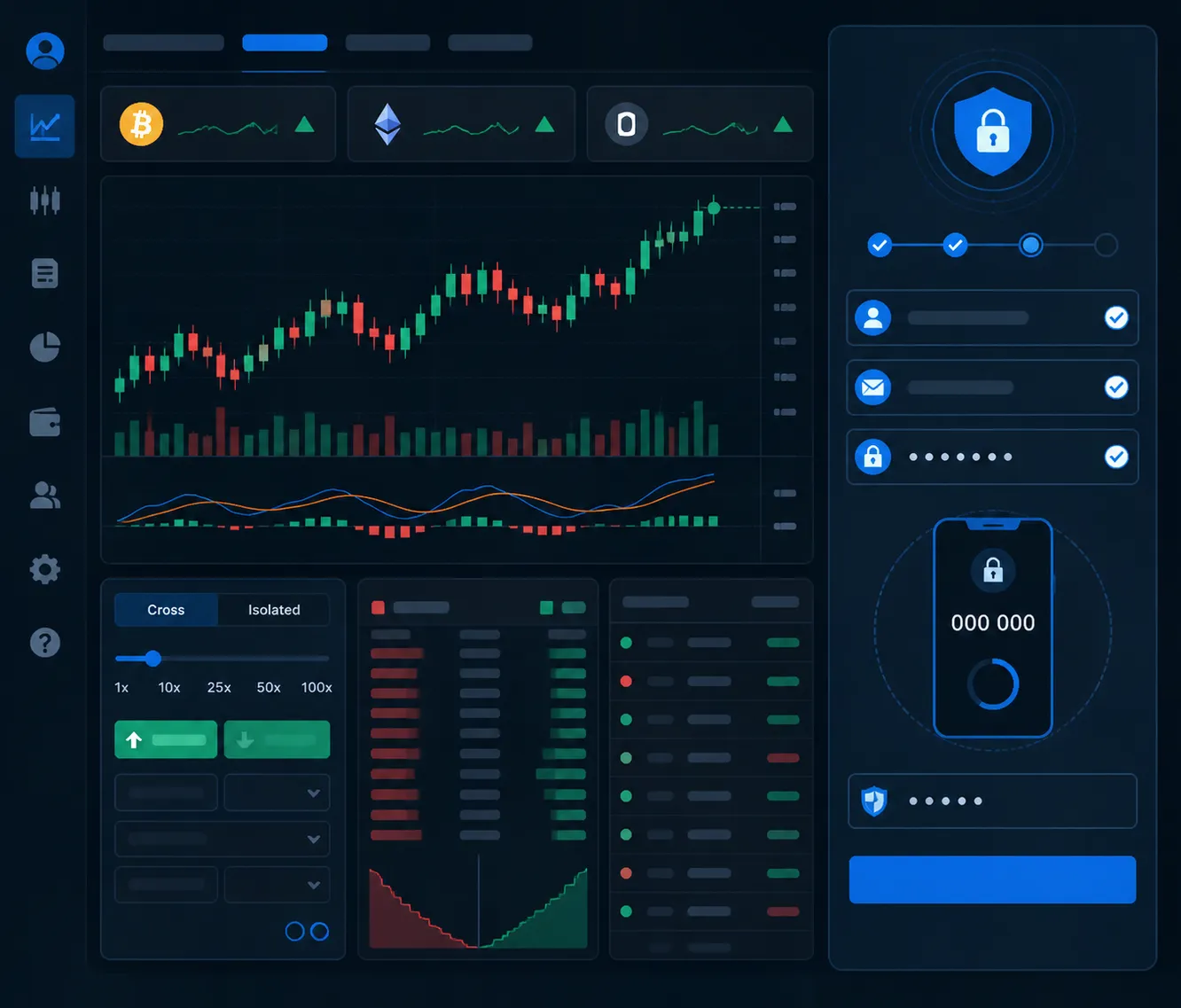
Leverage controls how much market exposure you receive relative to margin posted. At 5x leverage, $100 of margin can control roughly $500 of notional exposure. A 1% adverse move on that $500 position is about $5 before fees and funding, which is 5% of the $100 margin.
Higher leverage narrows the distance between entry price and liquidation price. While maximum leverage can look attractive, it often leaves little room for normal market volatility. For a first how to trade futures on Bybit session, low leverage—or no live trade at all while using a demo environment—can be a more disciplined choice.
Place a Long or Short Order
On the order panel, select the contract, margin mode, and leverage. Then choose the order type:
- Market order: Attempts to execute immediately at the best available price. It is fast but may experience slippage in fast markets.
- Limit order: Executes only at your selected price or better. It offers price control but may never fill.
- Conditional or trigger order: Activates when a specified trigger price is reached. It can be used for planned entries, stop losses, or take-profit orders.
To open a position, enter the order size and select Buy/Long or Sell/Short. Review estimated liquidation price, fees, and order details before confirming. Do not confuse order size with margin: leverage means a relatively small margin amount may represent a much larger position.
Add Stop Loss and Take Profit From the Start
A stop loss is an instruction intended to close or reduce a position when price moves against your setup. A take-profit order is intended to realize gains at a predetermined target. Neither guarantees a perfect execution price during extreme volatility, but both are essential tools for defining a trade plan.
A simple risk framework is to decide your loss before entering. For instance, if your account is $1,000 and you limit risk to 1% per trade, the planned loss is $10. Your position size should be calculated from the distance between entry and stop—not from the maximum leverage available.
Use the position panel to verify that your stop loss and take profit are active. Also check whether the trigger uses Last Price, Mark Price, or Index Price, because this affects when conditional orders activate.
Understand Mark Price, Funding, and Liquidation
Three concepts often surprise newer Bybit futures users:
- Mark price: A fair-price mechanism commonly used to calculate unrealized profit and loss and liquidation. It can differ from the latest traded price.
- Funding rate: Periodic payments exchanged between longs and shorts in perpetual markets. Depending on the rate and your position direction, you may pay or receive funding. Holding a trade for a long period can therefore have a meaningful cost.
- Liquidation: If the position’s margin can no longer support losses, the exchange may close it. Liquidation is not a risk-management plan; it is a last-resort mechanism that traders should seek to avoid.
Before holding any perpetual trade, inspect the displayed funding countdown, funding rate, liquidation estimate, and maintenance-margin information. These figures can vary by market and conditions.
Practical Bybit Futures Trading Checklist
Use this checklist before pressing the confirmation button:
- Is the market direction based on a defined setup rather than emotion?
- Is the position using isolated or cross margin intentionally?
- Is leverage low enough to tolerate ordinary market movement?
- Is the stop loss placed at a logical invalidation level?
- Does the loss at the stop fit your pre-set risk limit?
- Have you checked funding, fees, and liquidation price?
- Are you avoiding major news releases if your plan does not account for volatility?
Keeping a trading journal improves this process. Record the asset, entry, leverage, stop, target, reason for the trade, result, and whether you followed your own rules. After several trades, patterns in impulsive entries, oversized positions, or poorly placed stops become easier to spot.
Common Mistakes to Avoid on Bybit Futures
The most expensive mistake is treating leverage as extra capital. It is exposure, and more exposure increases sensitivity to every price move. Other common errors include moving a stop farther away after entry, averaging into a losing leveraged trade without a plan, opening several highly correlated positions, and ignoring funding costs.
Avoid entering solely because a candle is moving quickly. Wait for a level, define the invalidation point, and calculate size. If the required stop is too wide for your planned risk, reduce the position size or skip the trade. There will always be another opportunity.
For traders who want to explore the platform’s futures tools and current promotional eligibility, join Bybit using code CRYPTONEWER. The referral offer advertises a 20% fee discount and up to $30,050 in benefits; read all applicable terms and trade responsibly. This guide is educational information, not financial advice.