Focus keyword: What is the GNS (Gains Network) Coin, and how to buy
Short-tail keywords: GNS coin, Gains Network, buy GNS
Long-tail keywords: how to buy GNS on Binance, what is Gains Network token, GNS token utility and tokenomics

- 20% fee cashback
- $10,000 bonus

- 20% trading fee discount
- $30,050 signup bonus

- 50% trading fee discount
- 20% fee cashback
- $6,200 futures bonus

- 20% fee cashback
- $60,000 futures bonus

- 20% trading fee discount
- $100 signup bonus
- $10,000 futures bonus

- 20% fee cashback
- $8,000 bonus

- Bonus pack worth $100–$1,500 USDT
- Fee discount
GNS is the native token of Gains Network, the DeFi protocol behind gTrade, an on-chain leveraged trading platform. Rather than being a meme coin or a generic payment token, GNS is designed to sit at the center of the protocol’s trading, liquidity, governance, and fee-distribution mechanics. In simple terms, people researching the Gains Network coin are looking at a token whose usefulness is tied to activity on gTrade—not merely a ticker symbol with no product behind it.
Disclosure: This article is educational content, not investment advice. Crypto assets are volatile, and leveraged-trading protocols carry additional smart-contract, liquidity, counterparty, and market risks. Never invest money you cannot afford to lose.
What does Gains Network do?
Gains Network powers gTrade, a decentralized trading environment built around leveraged markets. Its model aims to let traders access multiple market categories while using an on-chain infrastructure and protocol vaults. The protocol’s official GNS page describes the token as the backbone of Gains: it can be used as trading collateral, supports vault backstops, is involved in governance, and may unlock trading-fee discounts when staked. (gains.trade)
That makes GNS crypto different from simply holding a stablecoin or buying a layer-1 coin. Demand for GNS can be influenced by usage of the Gains ecosystem, its trading volumes, fee model, token burns, liquidity conditions, governance decisions, and the broader appetite for decentralized perpetual and leverage products.
How the GNS token works
The most important thing to understand about GNS is that it has several roles at once:
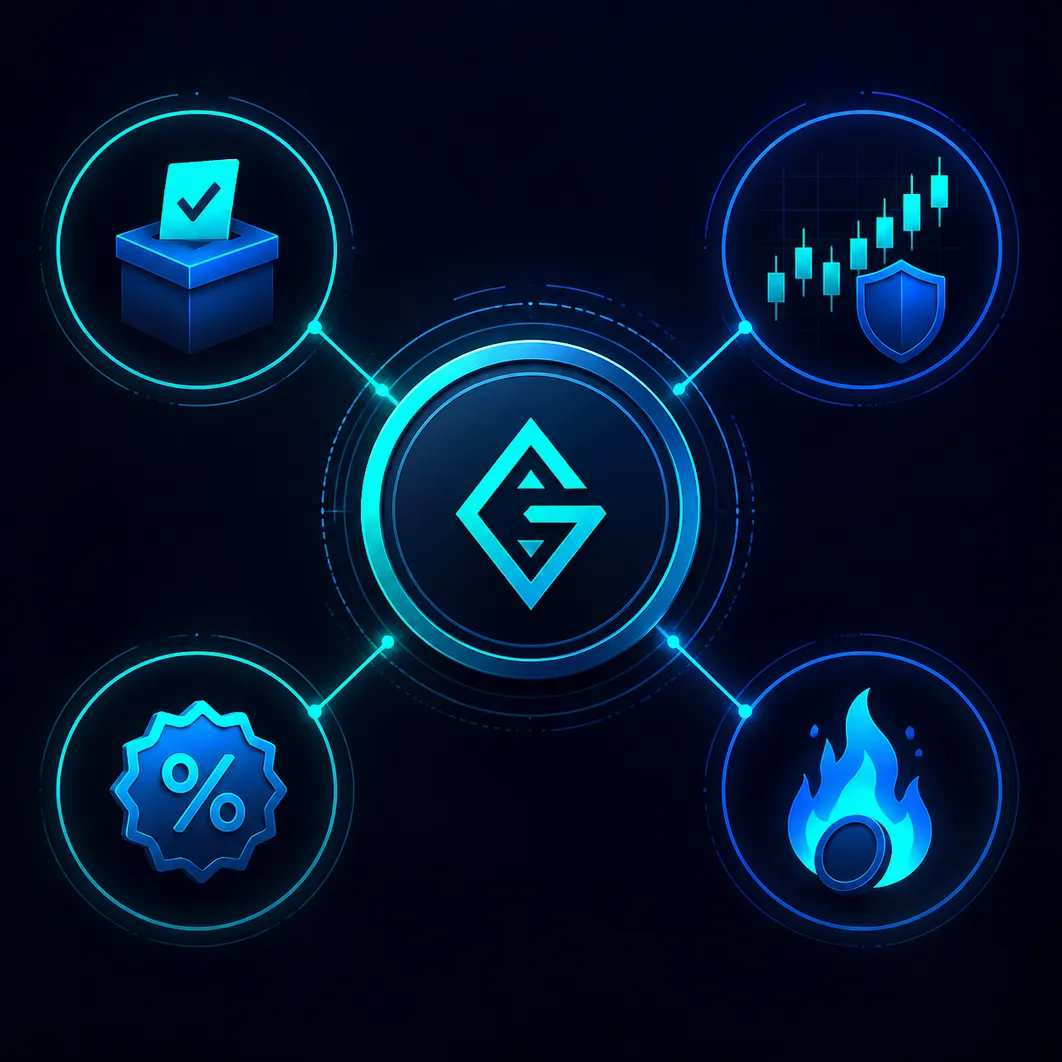
- Protocol counterparty and vault backstop: Gains states that GNS can be minted when vaults are undercollateralized and burned when they are overcollateralized. This mechanism is designed to connect token supply with the health of the system, but it also means token holders are exposed to protocol-specific risks.
- Buyback and burn mechanism: According to the official token page, 54% of trading fees are allocated to buying back and permanently burning GNS. A burn removes tokens from circulation, but it does not guarantee that the price will rise.
- Staking and fee discounts: Staking GNS can unlock up to 50% off trading fees, according to Gains Network. This creates practical utility for active gTrade users.
- Governance: GNS holders can participate in votes related to tokenomics and the project’s future direction.
The official page also says that all GNS tokens are circulating, with no locked team or investor allocations and no future unlock schedule. That is useful information for tokenomics research, although investors should still independently verify supply data and monitor any future governance changes.
GNS contract address: verify the network first
A common and costly mistake when buying smaller crypto assets is sending funds over the wrong network or importing a fake token into a wallet. Gains Network lists the Arbitrum GNS contract as:
0x18c11FD286C5EC11c3b683Caa813B77f5163A122
Always confirm the contract address from the official Gains Network page or an established block explorer before making a decentralized exchange swap or a withdrawal. The official site lists Arbitrum as the network for the address above.
How to buy GNS on Binance
For many people, the simplest answer to how to buy GNS is to use a centralized exchange. Binance has an active GNS trading page, and its current buying guide says access and payment choices depend on the user’s country, account status, and local product availability. (binance.com)
1. Open a Binance account
Create an account through Binance using referral code CRYPTONEWER. The provided promotion advertises a 20% fee discount and up to $10,000 in benefits; review the offer screen and applicable terms carefully, because eligibility, rewards, and regional availability can change.
2. Complete identity verification if required
Binance says identity verification is required before purchasing GNS through its platform. This process may also affect deposit methods, purchase limits, and which products are available in your jurisdiction. (binance.com)
3. Deposit funds or purchase a supported base asset
Depending on your location, Binance may offer card purchases, bank transfers, P2P, an existing account balance, or other regional payment methods. A practical spot-market route is to deposit or buy a supported quote asset, such as USDT, then use it to purchase GNS. Binance notes that available methods vary by jurisdiction.
4. Find the GNS market
Navigate to Trade → Spot, search for GNS, and select a trading pair shown as available for your account. Binance’s GNS trading page currently displays the GNS/USDT market.
5. Pick a market or limit order
A market order buys immediately at the best available market price, which is convenient but can result in slippage during volatile periods. A limit order lets you set the maximum price you are willing to pay and only executes if the market reaches that level. Binance’s buying guide presents both order types for Spot purchases.
6. Review the order before confirming
Check the amount of GNS, quoted price, trading fee, and total cost. Start small if this is your first crypto purchase. Avoid entering a trade simply because a token is moving quickly; volatile tokens can reverse just as rapidly.
Can you buy GNS through a decentralized exchange?
Yes. Gains Network’s official GNS page links to decentralized venues including Camelot and 1inch, alongside centralized exchanges such as Binance and Bitget. A DEX route normally requires a self-custody wallet, gas tokens for the relevant network, and careful contract-address verification.
For example, if using Arbitrum, you would generally need an Arbitrum-compatible wallet and enough ETH on Arbitrum to pay network fees. DEX swaps provide more direct self-custody, but they also place more responsibility on you: there is no exchange support team to reverse a transaction sent to the wrong address.
Important risks before buying Gains Network coin
GNS has genuine protocol utility, but that does not make it low risk. Its token model is closely linked to a leveraged-trading ecosystem, which can be affected by trading activity, vault performance, liquidity conditions, oracle behavior, smart-contract vulnerabilities, regulatory developments, and crypto-market sentiment. Buybacks and burns are mechanisms—not promises of investment returns.
Before you buy GNS, consider checking the official protocol documentation, the live trading pair’s liquidity, withdrawal-network availability, token distribution, protocol audits, and the amount you can realistically afford to lose. It is also wise to decide in advance whether you plan to keep GNS on an exchange for convenience or withdraw it to a self-custody wallet after verifying the exact supported network.
Quick checklist for buying GNS safely
- Use the exact ticker: GNS.
- Confirm you are buying Gains Network, not another asset with a similar name.
- Use Binance referral code CRYPTONEWER only after checking the displayed campaign terms.
- Verify fees and the final order total before submitting.
- If withdrawing, confirm the destination network and wallet address character by character.
- Never share your exchange password, two-factor authentication code, seed phrase, or private key.
- Treat GNS as a speculative crypto asset and size any position accordingly.
Related posts:
 Blockchain in Logistics and Shipping: Powerful Ways to Build Trust Across Global Trade
 What Is XO (Xociety Token) Coin? A Powerful, Reality-Checked Guide to How to Buy XO
 What Is DeFi (Decentralized Finance)? Essential Guide with Risks, Yields, and Real Use Cases
 What is the $PAAL(PAAL AI) Coin and how to buy — Actionable 2026 Guide