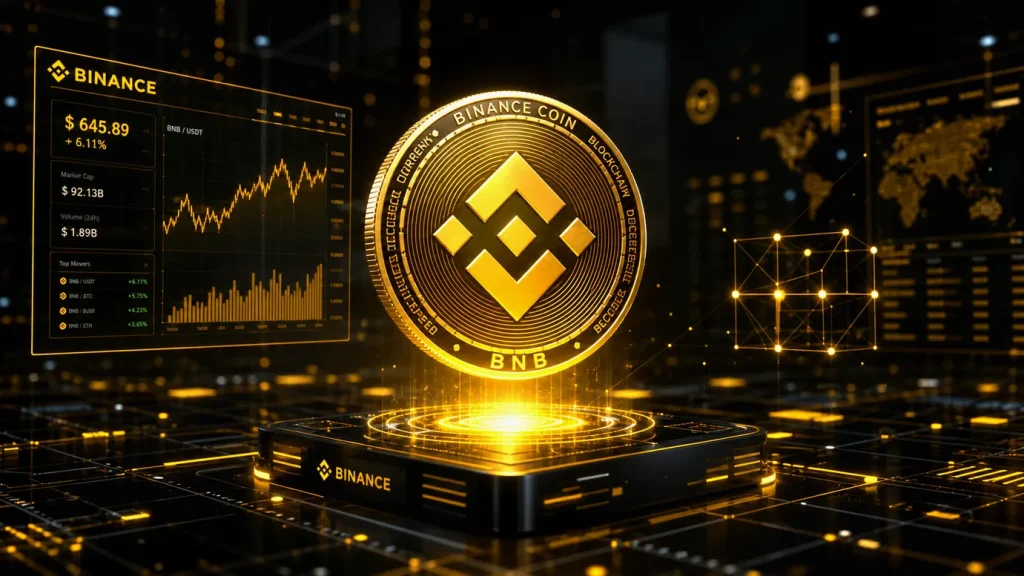
If you’ve ever asked yourself “What is BNB token on Binance?”, you’re far from alone. BNB has grown from a simple exchange token to a multifaceted asset powering one of the most active blockchain ecosystems in the world. In this guide, I’ll break down what BNB is, why it matters, how its tokenomics and burns work, where its utility shows up across the Binance and BNB Chain universe, and how you can potentially use it to reduce trading costs and access new opportunities.

- 50% trading fee discount
- 20% fee cashback
- $6,200 futures bonus

- 20% trading fee discount
- $100 signup bonus
- $10,000 futures bonus

- 20% trading fee discount
- $30,050 signup bonus

- 20% fee cashback
- $60,000 futures bonus

- 20% fee cashback
- $10,000 bonus

- 20% fee cashback
- $8,000 bonus
Quick tip: New to Binance? You can register with the referral code CRYPTONEWER to unlock a 20% fee discount and eligibility for up to $10,000 in benefits. Use this link: Sign up for Binance with code CRYPTONEWER
What exactly is BNB?
- BNB (originally “Binance Coin”) launched in 2017 and later rebranded simply as BNB.
- It started on Ethereum (as an ERC-20 token) and now lives natively on the BNB Chain, which comprises two core layers:
- BNB Beacon Chain (governance and staking layer)
- BNB Smart Chain, or BSC (EVM-compatible execution layer for smart contracts)
- On BNB Smart Chain, BNB acts as the gas token, paying for transaction fees across thousands of dApps, DeFi protocols, NFT markets, and on-chain services.
In short, BNB is both a utility token on Binance (the exchange) and the gas token for the BNB Chain. That dual role is a big reason people ask “What is BNB token on Binance?”—it does more than just reduce trading fees.
Core utilities of BNB
- Pay trading fees on Binance at a discount (when the BNB fee toggle is enabled; discount rates can change—check the current schedule on Binance).
- Access token launches and yield events through Binance Launchpad and Launchpool.
- Pay for gas on BNB Smart Chain (BSC) when interacting with dApps, DEXs, DeFi, and NFTs.
- Participate in staking/delegation within the BNB Chain validator ecosystem.
- Collateral or utility within many third-party applications: lending platforms, payment gateways, cross-chain bridges, and more.
Because BNB spans exchange and on-chain use cases, it helps tie together trading, investing, and Web3 activity.
Tokenomics at a glance: supply, burns, and design
- Initial supply: 200 million BNB at launch.
- Long-term target: 100 million BNB via systematic token burns.
- Two major burn mechanisms:
1) BNB Auto-Burn: A transparent, formula-driven quarterly burn that references BNB price and the number of blocks produced on BNB Smart Chain.
2) BEP-95 (real-time burn): A portion of gas fees on BSC are burned continuously, making on-chain activity directly contribute to supply reduction.
This dual-burn architecture means BNB’s effective supply can decline over time, aligning usage (on-chain transactions) with tokenomics. The exact supply at any moment varies; always check the latest figures from official BNB Chain resources.
How BNB reduces trading costs on Binance
Many traders hold BNB to reduce their spot and margin fees when they opt to pay fees in BNB. Historically, this has meant a meaningful percentage discount compared to paying in the base asset or quote asset. Additionally, holding certain amounts of BNB may contribute to tiered VIP levels, which can further reduce fees if your trading volume qualifies. Because fee schedules evolve, always verify your current discount in your Binance account settings.
- Typical flow:
1) Enable “Pay fees with BNB” in your Binance account.
2) Maintain a small BNB balance to cover fees.
3) Monitor VIP tiers and BNB holdings for potential extra savings.
For new users, you can stack savings from day one using the referral below.
- Get started: Register on Binance with CRYPTONEWER for a 20% fee discount and eligibility for up to $10,000 in benefits (terms and eligibility may apply).
Staking and earning with BNB
BNB’s staking landscape sits at the intersection of centralized convenience and decentralized control:
- Delegation on BNB Beacon Chain: You can delegate BNB to validators who secure the network. This can be done through interfaces that connect to the BNB ecosystem. APYs vary and carry validator and slashing risks.
- Binance Earn products (centralized): Options such as BNB Locked Staking, Simple Earn (Flexible or Locked), Launchpool, or BNB Vault may be available in your region. They let you participate in yield opportunities with varying lock-ups and risk profiles.
- DeFi on BSC: Provide liquidity to DEXs, farm rewards, or lend BNB in decentralized money markets. This route is more hands-on and involves smart contract risks, impermanent loss, and evolving yields.
Always research risks, compare lock periods, and track your net return after fees and potential token volatility.
Where BNB shows up in daily crypto use
- On-chain gas: Every swap on a BSC DEX or NFT mint is a reminder that BNB is the gas that keeps the network running.
- Launchpad/Launchpool access: Historically popular with users seeking early exposure to new tokens. Availability and rules vary by event.
- Payments and integrations: Merchants, wallets, and cross-chain tools frequently include BNB due to BSC’s low fees and fast finality.
- Portfolio collateral: In some CeFi/DeFi systems, BNB can be used as collateral to borrow other assets, adding flexibility to portfolio management.
How to buy BNB on Binance in a few steps
1) Create your account: Use this referral to secure a 20% fee discount and get eligibility for up to $10,000 in benefits: Open a Binance account with CRYPTONEWER.
2) Verify your identity (KYC) if required in your region.
3) Deposit funds: Bank transfer, card, or crypto deposit, depending on availability.
4) Buy BNB: Search “BNB” on the Spot market. You can place a market order for speed or a limit order for price control.
5) Enable “Pay fees with BNB” to activate fee discounts on trades.
6) Transfer some BNB to your Web3 wallet if you plan to interact with BSC dApps.
BNB Chain basics for builders and users
- BNB Smart Chain (BSC) is EVM-compatible, so Ethereum developers can port Solidity smart contracts with minimal changes.
- Transaction fees are typically low and block times are fast, which helps foster bustling activity in DeFi, gaming, and NFTs.
- BNB Beacon Chain handles governance and validator operations; BSC handles smart contracts. They work together as the BNB Chain.
For users, the practical takeaways are simple: fund your wallet with a bit of BNB to cover gas, choose a trusted RPC endpoint or wallet, and verify contracts before interacting with new protocols.
Security and risk considerations
- Custodial risk: If you keep BNB on a centralized exchange, use strong 2FA, withdrawal allowlists, and device security best practices.
- Smart contract risk: In DeFi, code exploits can and do happen. Stick to well-audited protocols and size positions prudently.
- Market volatility: BNB’s price can move quickly. Consider your time horizon and risk tolerance.
- Regulatory changes: Availability of products or features (like Launchpool or staking) may vary by jurisdiction and can change over time.
None of the above is financial advice. Always do your own research and consider professional guidance where appropriate.
FAQs: “What is BNB token on Binance?” and related questions
-
Is BNB just an exchange token?
- No. While it started as one, BNB now powers on-chain gas on BSC and integrates with a wide range of dApps. It remains a utility token for the exchange but has grown far beyond that role.
-
How do the burns affect price?
- Burns decrease circulating supply over time, but price depends on many variables: demand, market conditions, ecosystem growth, and macro trends. Burns alone don’t guarantee any outcome.
-
What networks does BNB use?
- Natively on BNB Chain, with BNB Beacon Chain for governance/staking and BNB Smart Chain for EVM-based smart contracts. Wrapped versions may exist on other networks, but use trusted bridges and verify token contracts.
-
Can I get fee discounts automatically?
- You need to enable the BNB fee payment option in your Binance account and hold a small BNB balance. Discounts can vary, so check your dashboard.
-
Where do I track BNB activity?
- On-chain explorers for BNB Chain (for transactions and contracts) and your Binance account (for exchange-based activity).
Practical tips to get more from BNB
- Keep a small buffer of BNB for gas if you’re active on BSC; running out mid-transaction is inconvenient.
- When trying new dApps, start with tiny amounts. Test first; scale later.
- Revisit your fee settings on Binance periodically. If you grow into higher volume, VIP tiers plus BNB fee payment can materially impact your net costs.
- Watch for Launchpool/Launchpad announcements if you like early-stage token participation. Confirm regional eligibility and terms.
- If you’re yield-seeking, compare centralized options (Simple Earn, Locked products) with decentralized ones (lending, LPing) and account for risk-adjusted returns.
A quick recap in plain English
- BNB is the backbone token of the BNB Chain and a practical utility asset on Binance.
- It reduces trading costs (when enabled), fuels dApps with gas, and participates in a structured burn system.
- You can stake or delegate BNB, earn yield through various products, or use it as collateral in DeFi.
- Like any crypto asset, it carries risks—manage them thoughtfully and stay informed.
Ready to explore BNB? Start here with your benefits: Create your Binance account with CRYPTONEWER and get a 20% fee discount plus eligibility for up to $10,000 in rewards (regional availability and terms apply).