Perpetual futures open a world of opportunity for active crypto traders—24/7 markets, the ability to go long or short, and flexible leverage. This guide shows you exactly How to Trade Perpetual Contracts on Bitget with practical, risk-first tactics you can apply today. Whether you’re moving from spot trading or leveling up your futures game, you’ll find workflows, examples, and pro tips that clarify the path from first login to confident execution.

- 20% trading fee discount
- $100 signup bonus
- $10,000 futures bonus

- 20% fee cashback
- $60,000 futures bonus

- 20% fee cashback
- $10,000 bonus

- Bonus pack worth $100–$1,500 USDT
- Fee discount

- 50% trading fee discount
- 20% fee cashback
- $6,200 futures bonus

- 20% fee cashback
- $8,000 bonus

- 20% trading fee discount
- $30,050 signup bonus
Fast-track your setup: Claim a 50% trading fee discount, 20% fee cashback, and up to $6,200 futures bonus when you sign up for Bitget with code cryptonew0. Use this link: Claim Bitget Perps Bonus
What Are Perpetual Contracts?
Perpetual contracts (often called “perps”) are crypto futures with no expiry date. You can hold a position indefinitely as long as you maintain margin and your position isn’t liquidated. Key traits:
- No expiry or settlement date
- Long and short exposure without holding the underlying coin
- Leverage to amplify exposure (and risk)
- A funding rate mechanism that keeps contract price aligned with spot
On Bitget, you’ll find USDT-M (USDT-margined) and Coin-M (coin-margined) perpetual contracts across major assets like BTC, ETH, and many altcoins.
Why Trade Perpetuals on Bitget?
Bitget is known for deep liquidity, fast matching, and a trader-centric feature set:
- Robust order types (limit, market, stop, trigger orders)
- Intuitive margin controls (Cross/Isolated)
- Clear PnL, liquidation, and funding visualizations
- Copy trading, grid bots, and “demo”/mock trading for practice
- Strong fee incentives and promos for active traders
Unlock maximum savings and bonuses with our exclusive offer: Sign up to Bitget with code cryptonew0 to secure a 50% trading fee discount, 20% fee cashback, and up to $6,200 in futures bonus credits.
Core Concepts You Must Master First
- Leverage: Increases your position size relative to margin. 10x leverage magnifies both gains and losses by 10. Lower is safer.
- Margin Mode:
- Cross Margin: Your entire futures wallet balance can support all positions—more flexible, but losses can cascade.
- Isolated Margin: Margin is isolated per position—tighter risk control and clearer liquidation lines.
- Funding Rate: Periodic payments exchanged between longs and shorts. When funding is positive, longs pay shorts; when negative, shorts pay longs. It nudges perp prices toward spot.
- Mark Price vs Last Price: Mark Price helps avoid unfair liquidations during short-term spikes. Triggers and liquidation often use Mark Price.
- Liquidation: If your margin can’t cover losses, the exchange closes your position automatically. Avoid by using reasonable leverage and tight risk controls.
Fees, Funding, and Savings on Bitget
- Trading Fees: Maker (for adding liquidity) is typically lower than Taker (for removing liquidity). Using limit orders can reduce costs over time.
- Funding Payments: Paid between longs and shorts on a schedule (e.g., every 8 hours), independent of trading fees.
- Promotions: With Bitget code cryptonew0, you get a 50% trading fee discount, 20% fee cashback, and up to $6,200 in futures bonuses—powerful tailwinds for active traders.
How to Trade Perpetual Contracts on Bitget: A Practical Walkthrough
1) Open an Account and Activate Rewards
– Go to Bitget signup with code cryptonew0
– Complete KYC for higher limits and full features
– Ensure the code cryptonew0 is applied to secure fee discounts and the futures bonus pack
2) Deposit or Transfer Funds
– Deposit USDT for USDT-M perps, or coin collateral for Coin-M perps
– Use the “Transfer” function to move funds into your futures wallet
3) Choose Your Market
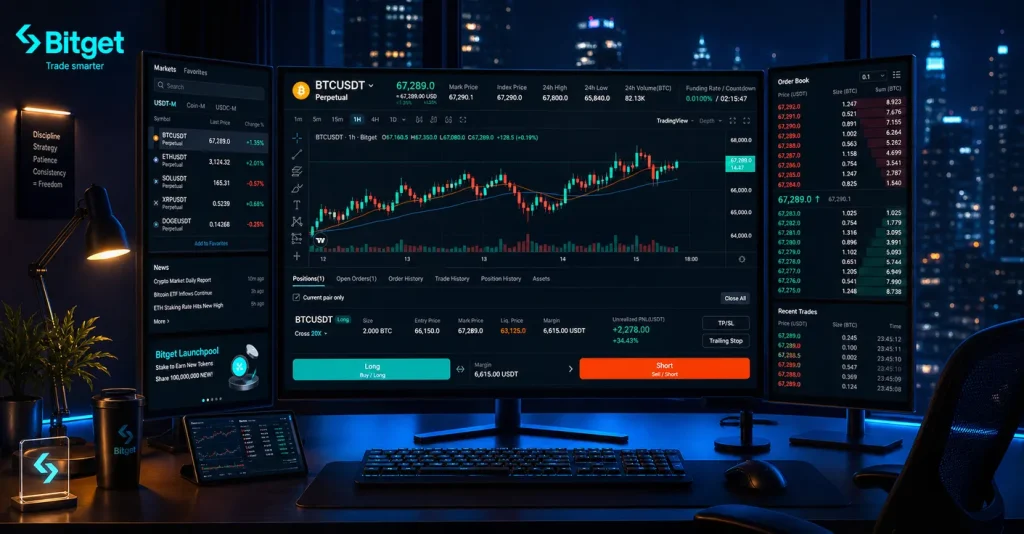
– Navigate to “Futures” and pick a pair (e.g., BTCUSDT Perpetual)
– Confirm the contract type (USDT-M is most common for beginners)
4) Set Margin Mode and Leverage
– Pick Isolated margin when you want strict risk control per position
– Start with low leverage (1–5x). You can scale later with experience
5) Define Your Risk First
– Decide your dollar risk per trade (for example, 1% of your futures balance)
– Place a stop-loss where your trade idea is invalidated
– Work backward to size your position within that risk limit
6) Pick Your Order Type
– Market: Instant execution at current price (fast, but may slip)
– Limit: Specify your desired price (cheaper fees; may not fill instantly)
– Trigger/Stop: Automate entries/exits at defined conditions (crucial for risk control)
7) Go Long or Short
– Long if you expect price to rise; short if you expect it to fall
– Confirm the take-profit and stop-loss are set before confirming the order
8) Monitor and Adjust
– Track the Mark Price, Funding countdown, and PnL
– Move stop-loss to break-even if momentum follows through
– Scale out in partial take-profit steps when available
9) Close the Position
– Use “Close by Market” for speed or a limit order for better price control
– Review the trade journal for mistakes and improvements
Order Types and Triggers on Bitget
- Limit Order: You set the price; good for maker rebates and precision entries
- Market Order: Immediate fill; use sparingly for volatility or urgent exits
- Stop-Loss Order: Automatically closes your position to cap losses
- Take-Profit Order: Secures gains at predefined targets
- Trigger Orders: Fire when a condition is met (using Last or Mark price)—vital for clean breakouts and disciplined exits
Pro tip: When markets are choppy, use limit orders near key levels and bracket them with stop-loss/TP to automate decisions.
Example: From Idea to Execution
Scenario: You’re bullish on ETH and plan to buy the dip into support.
- Balance: $2,000 USDT; risk per trade: 1% ($20)
- Entry: $3,100; Stop-loss: $3,060 (risk $40 per ETH if price hits stop)
- Size: To risk $20 max, position size ≈ $20 / $40 = 0.5 ETH equivalent
- With 3x leverage, required margin is roughly one-third of notional
This framing keeps you anchored to dollar risk instead of pure leverage. Even as you scale leverage, keep the dollar risk constant.
Funding Rate, Timing, and Holding Strategy
- If funding is positive and you’re long, you’ll pay funding periodically. Consider scaling out or holding through only the most favorable windows
- If funding flips negative, longs receive payment—can offset some costs during swing holds
- Intraday traders may plan entries to avoid paying funding repeatedly
Risk Management: Small Edges, Big Longevity
- Keep Leverage Modest: 1–5x is plenty for most setups
- Use Isolated Margin for Learning: Prevents one bad trade from wiping out multiple positions
- Always Bracket Trades: Pair entries with stop-loss and take-profit
- Cap Daily Losses: Have a max drawdown per day and stop trading if hit
- Respect Volatility Spikes: During news, widen stops or reduce size—or stand aside
Remember: Futures amplify mistakes as easily as they amplify wins. The best traders are expert risk managers first.
Strategies That Fit Perpetual Contracts
- Trend-Following Pullbacks: Enter with the trend on retracements to moving averages or prior support/resistance
- Breakout + Retest: Wait for a level to break, then buy/sell the retest with a tight invalidation
- Range Trading: Fade extremes in established ranges; switch to breakout mode when range resolves
- Funding Bias: When funding is heavily one-sided, watch for mean-reversion setups—but avoid fighting strong trends blindly
- Maker-Focused Scalps: Use limit orders at liquidity pockets for lower fees; exit quickly if invalidated
Each strategy lives or dies by risk control and position sizing. Backtest with mock trading to see how your rules hold up.
Bitget Features That Make a Difference
- Copy Trading: Mirror experienced traders while you learn—but diversify, track stats, and set your own drawdown limits
- Grid and Bots: Automate accumulation or mean-reversion logic; still use stop-outs for black swans
- Mock Trading: Practice with virtual funds to refine entries, exits, and sizing
- Unified Interface: Clean layout for charting, order flow, and risk panels in one place
Kick off with the promo that supercharges your runway: Join Bitget with code cryptonew0 for a 50% trading fee discount, 20% fee cashback, and up to $6,200 in futures bonuses.
Common Mistakes to Avoid
- Oversizing because leverage “allows it”—anchor to dollar risk, not maximum leverage
- Ignoring Mark Price—your stop may not trigger as expected if you set it to Last Price only
- Going Cross Margin too soon—Isolated is generally safer while you learn
- Failing to account for funding—long swing holds during positive funding can erode PnL
- Chasing Breakouts Late—use triggers or plan entries; don’t FOMO into vertical candles
Troubleshooting: When Things Don’t Go to Plan
- Slippage on Entries: Use limit or post-only, and consider entering in tranches
- Stops Not Triggering: Verify trigger source (Mark vs Last), stop type, and placement
- Frequent Liquidations: Lower leverage, switch to Isolated, and widen stops while reducing size
- Fee Drift Impacting PnL: Prefer maker orders and secure fee discounts via code cryptonew0
Quick FAQ: How to Trade Perpetual Contracts on Bitget
- Do I need KYC? For full features and limits, yes.
- USDT-M vs Coin-M? USDT-M uses USDT as collateral and PnL units—simpler for most traders. Coin-M lets you stay in the coin you trade.
- What’s a safe leverage to start? 1–3x for beginners; size by risk per trade first.
- How do I avoid liquidation? Use Isolated margin, conservative leverage, and stop-losses.
- How do I claim the promo? Register via this link and use the code: Get Bitget perks with cryptonew0
Bonus Workflow: A Repeatable Trade Checklist
- Thesis: Trend, Range, or Breakout? Identify the market context
- Level: Mark entry, invalidation, and take-profit zones
- Risk: Fix your dollar risk (e.g., 1% of balance); compute size from stop distance
- Order: Choose limit or market; set trigger conditions if breakout trading
- Protect: Attach stop-loss and at least one take-profit target
- Review: Log entries/exits and reflect on execution quality, not just PnL
Fast access to all the perks: Sign up to Bitget with code cryptonew0 for a 50% fee discount, 20% fee cashback, and up to $6,200 in futures bonuses.
Final Notes on Safety and Process
Trading crypto futures is high risk. Nothing here is financial advice. Test your approach in mock trading, favor Isolated margin, keep leverage modest, and let position sizing do the heavy lifting. Your edge compounds through consistency: clear rules, small controlled losses, and disciplined exits.
If you’re ready to put these steps into action, lock in the rewards first so you keep more of what you earn: Bitget signup — code cryptonew0.