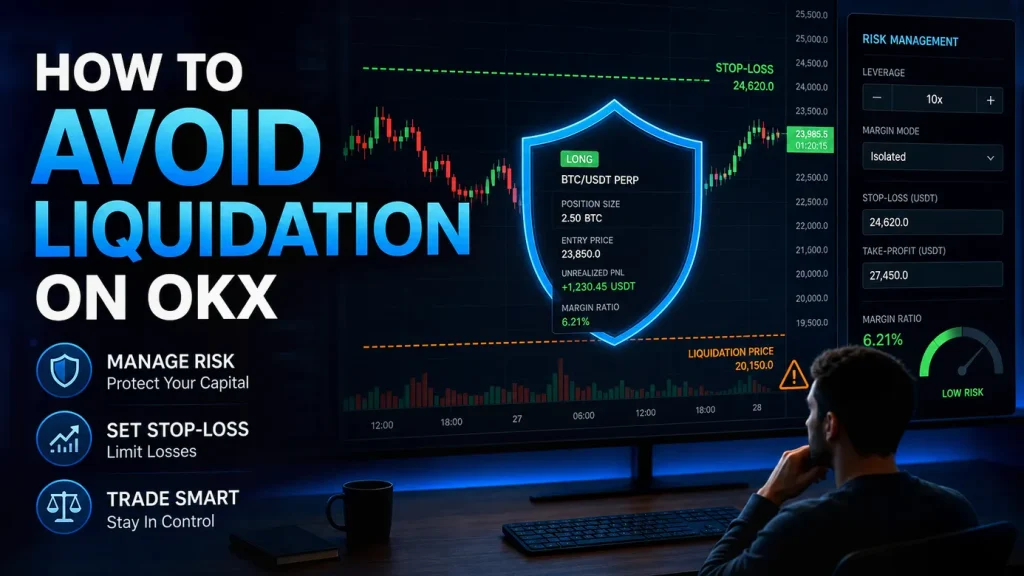
Learning how to avoid liquidation on OKX is less about finding a perfect entry and more about controlling leverage, position size, margin, and exits before a trade turns against you. Futures can be useful for hedging or expressing a market view, but they also amplify losses. If account equity can no longer support a leveraged position, OKX may liquidate it to limit further losses.

- 20% trading fee discount
- $100 signup bonus
- $10,000 futures bonus

- 20% fee cashback
- $60,000 futures bonus

- 20% fee cashback
- $8,000 bonus

- 20% trading fee discount
- $30,050 signup bonus

- 50% trading fee discount
- 20% fee cashback
- $6,200 futures bonus

- 20% fee cashback
- $10,000 bonus
This guide explains practical OKX liquidation prevention habits for traders using perpetual swaps or delivery futures. It is educational material, not financial advice—always verify current product rules, fees, and risk disclosures directly on the OKX website.
Understand what triggers liquidation
Liquidation is not simply “price reached my entry level.” It is tied to the health of your margin. When market losses, funding payments, trading fees, and other applicable costs reduce your available equity enough that the maintenance-margin requirement is no longer met, the platform can begin the liquidation process.
Your liquidation price is therefore a moving risk reference, not a price target. It may change when you add or remove margin, alter position size, receive or pay funding, or open additional positions that affect account-level risk. Before placing any futures order, review the estimated liquidation price and margin ratio shown in the OKX trading interface.
Key principle: A trade is only as safe as the distance between the market price and the point where your remaining collateral can no longer sustain it.
Use lower leverage than you think you need
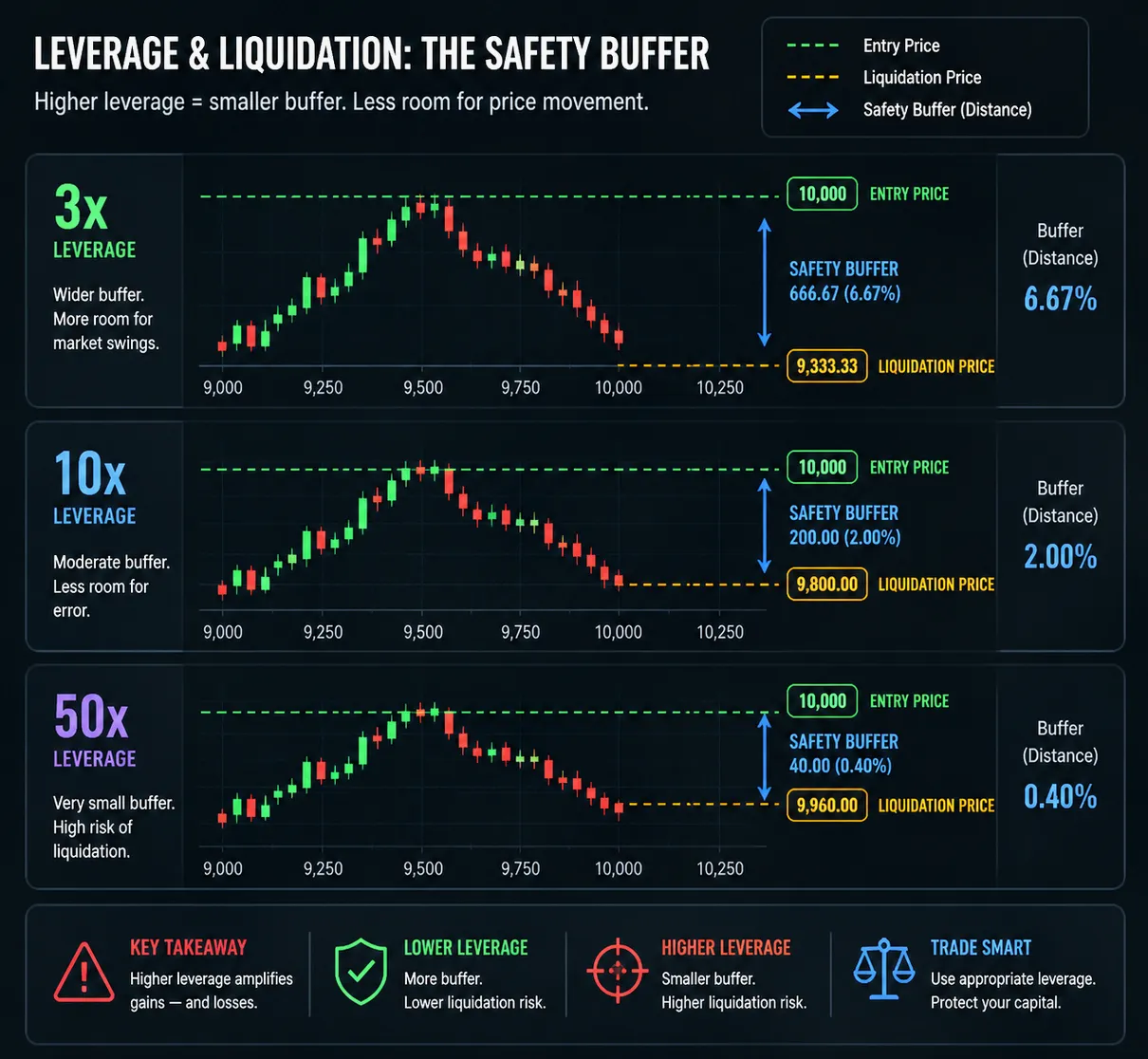
The fastest way to reduce liquidation risk is to use less leverage. High leverage makes even a routine intraday move dangerous. For example, a position at 50x leverage has far less room for an adverse move than a similarly sized trade at 3x or 5x leverage.
A lower leverage setting does not automatically make a trade profitable, but it gives a position more tolerance for volatility. Bitcoin and altcoins can move sharply during economic announcements, liquidations, exchange outages, or low-liquidity periods. Build your trade around a realistic volatility range rather than the largest position your account technically permits.
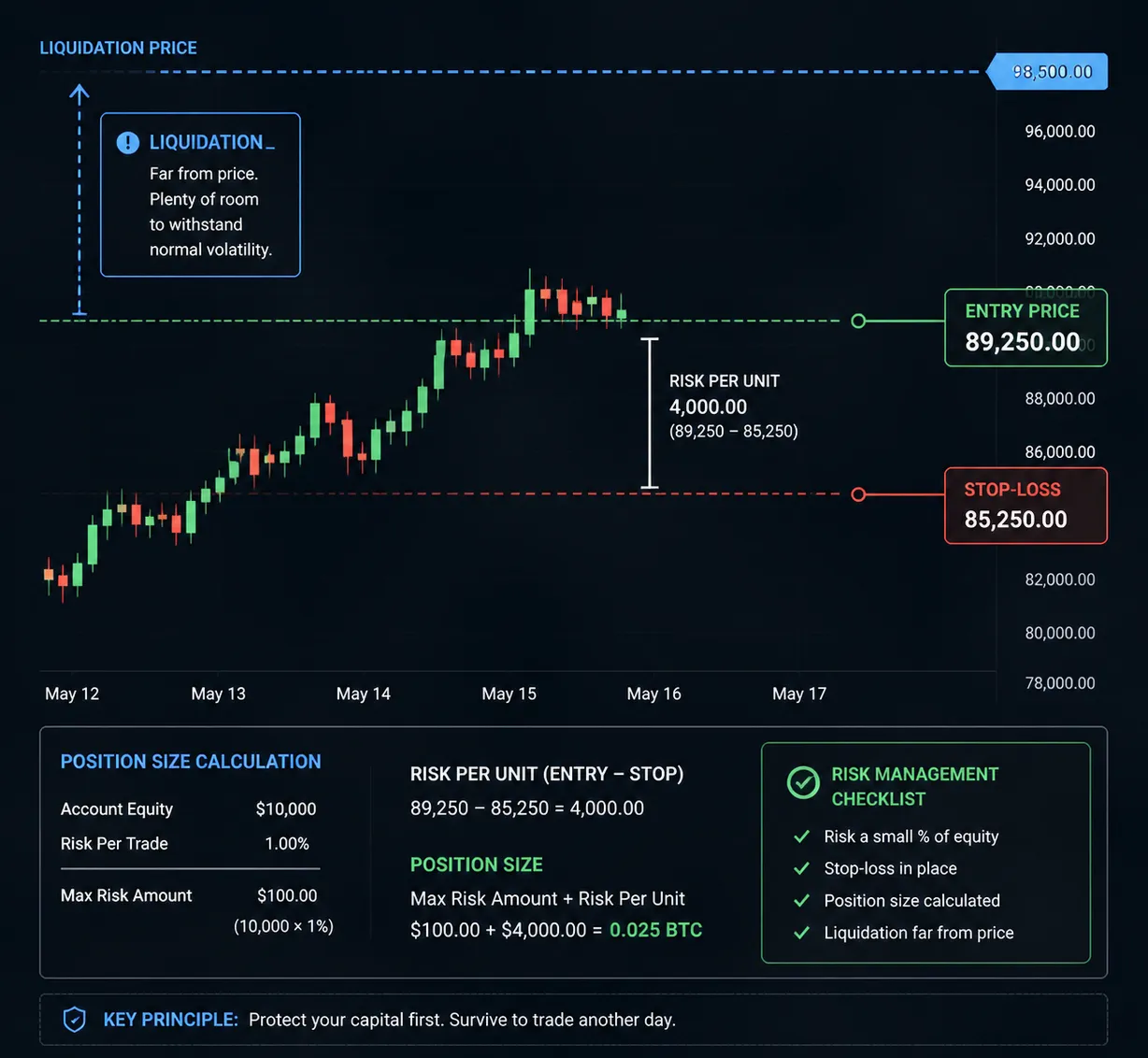
For many traders, the better question is not “How much leverage can I use?” but “How much of my account am I willing to lose if my stop is hit?” Decide that amount first, then calculate a position size that fits it.
Calculate position size from your stop-loss
A stop-loss is most effective when it is placed at the point where your trade idea is invalidated—not at an arbitrary percentage. Once you know that level, work backward:
- Choose a fixed risk amount per trade, such as a small percentage of your trading capital.
- Set an invalidation level based on market structure, volatility, or your strategy.
- Measure the difference between entry and stop price.
- Select a position size where that move equals your pre-set risk amount.
- Confirm that the liquidation price sits well beyond the stop-loss, with room for normal price noise.
This approach helps you avoid liquidation on OKX futures because your planned exit should happen before the position approaches a critical margin level. Do not treat a liquidation price as a substitute for a stop-loss. Liquidation is a forced risk event; a stop-loss is a deliberate trading decision.
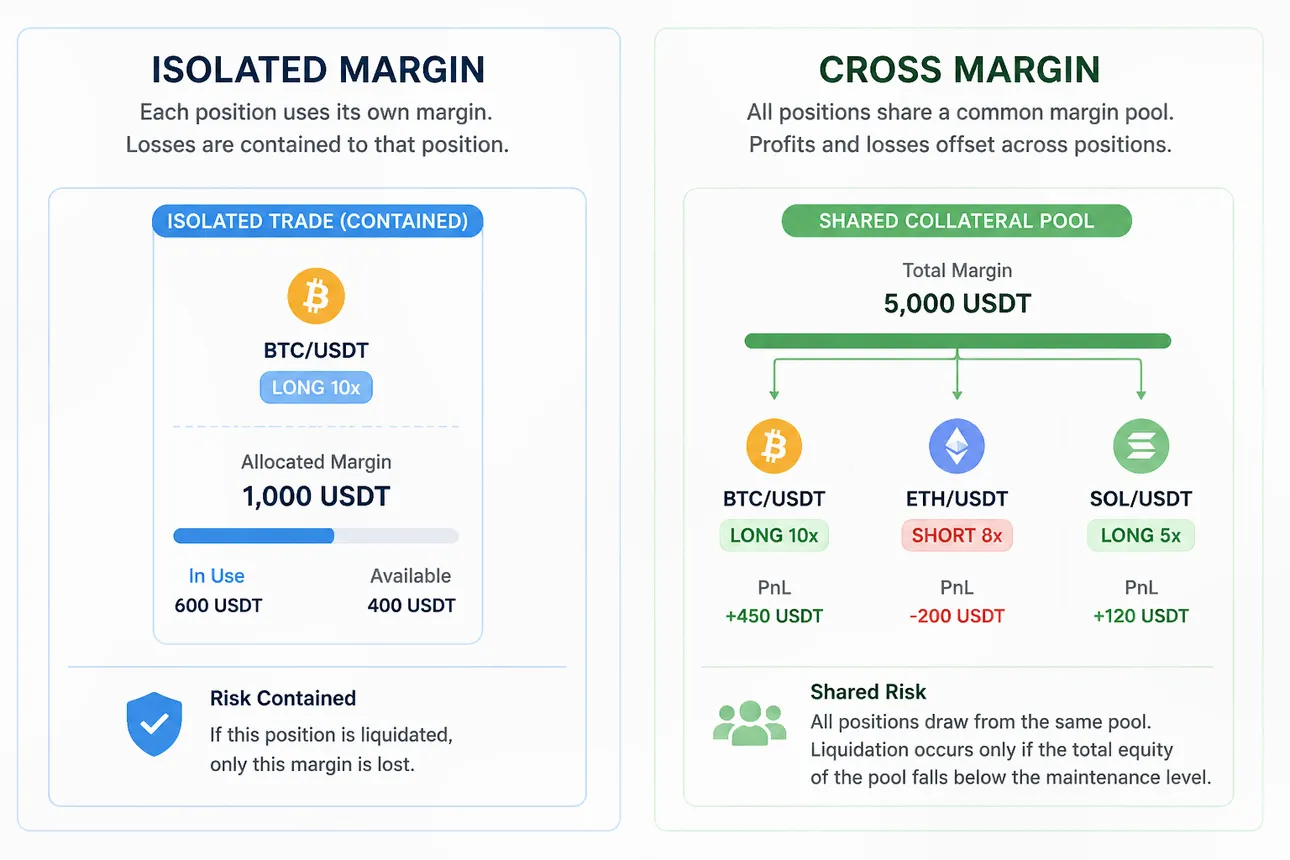
Choose isolated margin when you want defined trade risk
OKX offers margin modes that can materially change how losses affect your account. In isolated margin, collateral assigned to one position is separated from other positions in the relevant setup. This can make it easier to define the amount of margin exposed to a specific trade.
In cross margin, available collateral may support multiple positions. Cross margin can be useful in carefully managed portfolios, but it can also allow losses from one trade to draw on a broader portion of your available balance. Traders using cross margin should monitor total exposure especially closely, because multiple correlated positions can deteriorate at the same time.
Neither mode eliminates risk. The suitable choice depends on your plan, hedge structure, and familiarity with futures mechanics. If you are new to derivatives, take time to understand the effect of each mode before placing a live order.
Keep a meaningful buffer from the liquidation price
A position can look comfortable at entry and become fragile quickly. Volatility spikes, spreads widen, and fast wicks can reach levels that seem unlikely on a calm chart. A disciplined trader leaves a substantial gap between the stop-loss and the estimated liquidation price.
Avoid adding to a losing position merely because its liquidation price feels close. Adding collateral or averaging down can increase breathing room, but it can also commit more capital to an invalid trade idea. Only add margin if it is part of a written plan and you can explain why the original thesis remains valid.
Useful safeguards include:
- Set price alerts before your stop and well before the liquidation zone.
- Use stop-market orders where appropriate to prioritize execution during rapid moves.
- Check whether your order size could move the market in thin liquidity.
- Reduce exposure before major news events if your strategy does not account for event volatility.
- Avoid stacking highly correlated long or short positions across several crypto assets.
Monitor funding rates, fees, and account equity
Perpetual swaps often involve funding payments between long and short traders. Depending on your position and the prevailing rate, funding can gradually reduce your available equity. A position held for days may have a different risk profile than it had at entry, even if price barely moved.
Also account for trading fees, partial fills, and the possibility that a stop executes at a worse price than expected in a fast market. This is why a buffer matters. A strategy that only works if every order fills exactly at the displayed price is too fragile for real conditions.
Make it a routine to inspect the position panel: entry price, mark price, estimated liquidation price, margin ratio, unrealized P&L, funding information, and open conditional orders. The mark price is particularly important because derivatives risk controls may reference it rather than the last traded price.
Avoid revenge trading and oversized recovery bets
After a loss, it is tempting to raise leverage and try to recover immediately. That behavior often converts a manageable loss into a liquidation. Build a daily loss limit and a maximum number of attempts for one setup. When either limit is reached, step away and review the trade instead of increasing risk.
A simple trading journal can expose recurring problems: entering during volatile news, moving stops farther away, using excessive leverage after wins, or holding positions through funding intervals without a plan. Risk management improves faster when you can identify the specific habit causing damage.
Use the OKX referral offer while keeping risk first
If you are opening an account or planning to trade on the platform, you can join OKX with referral code CRYPTONEWER. The offer advertises 20% fee cashback and a $60,000 futures bonus. Eligibility, bonus amounts, trading requirements, regional availability, and campaign terms can change, so read the applicable terms on OKX before relying on any promotion.
Lower fees can help reduce trading costs, but they should never be a reason to take larger or riskier positions. The core answer to how to avoid liquidation on OKX remains consistent: limit leverage, size trades from a defined stop, maintain margin room, and monitor every open futures position.
A pre-trade checklist for OKX futures
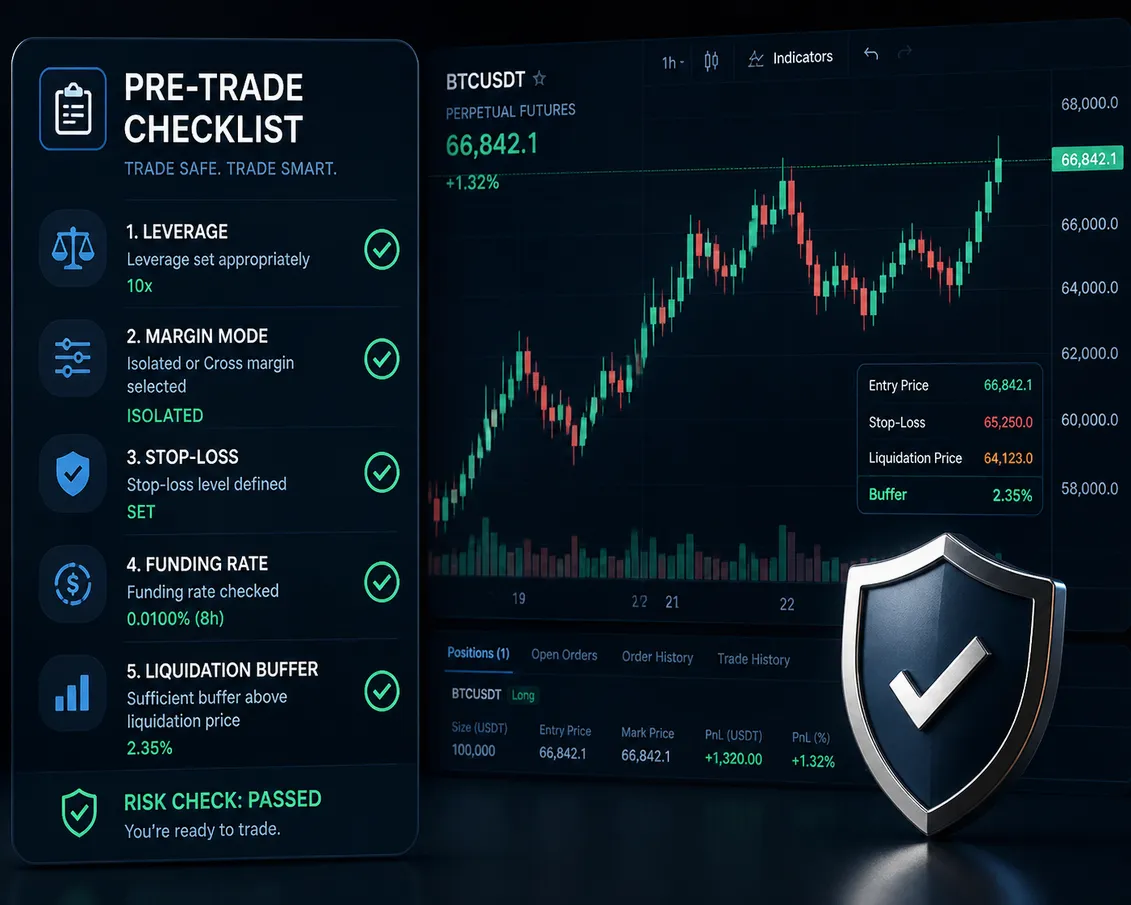
Before clicking Buy or Sell, run through this checklist:
- Margin mode: Do I understand whether this is isolated or cross margin?
- Leverage: Is it low enough to survive normal volatility?
- Position size: Does the loss at my stop stay within my planned risk amount?
- Liquidation buffer: Is the liquidation price far beyond my planned exit?
- Stop order: Is it already placed, and is its trigger type appropriate?
- Funding and fees: Can holding costs materially affect the position?
- Market conditions: Is high-impact news, thin liquidity, or a sharp volatility event expected?
- Correlation: Do other positions create hidden exposure in the same market direction?
A checklist cannot predict price, but it can prevent avoidable mistakes. Consistency is far more valuable than chasing maximum leverage: protect capital first, then let sound trade setups do their work.