
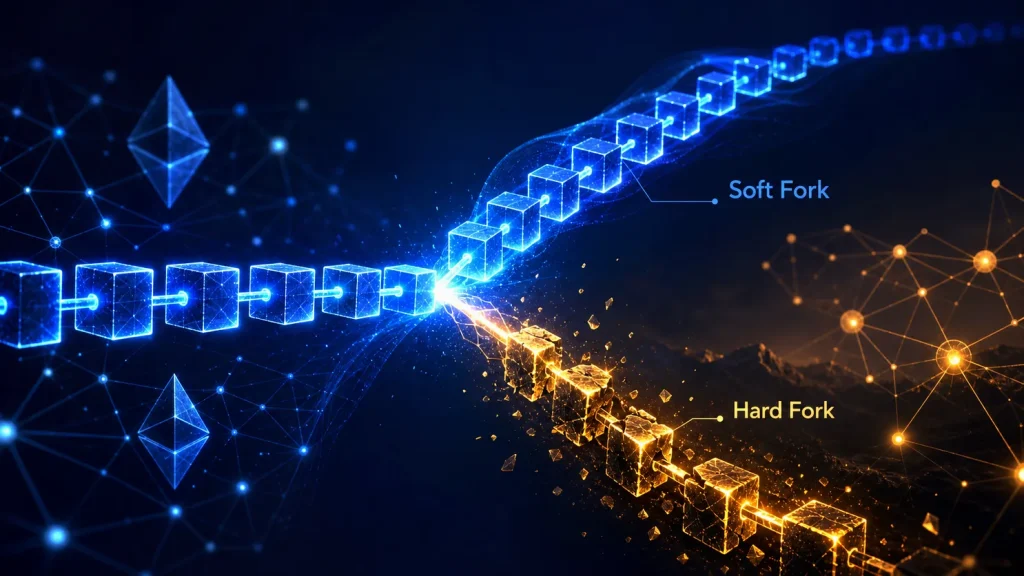
Hard Forks vs Soft Forks Explained is more than a technical debate: it is the key to understanding how blockchains change without a central administrator. Bitcoin, Ethereum, and many smaller networks must occasionally repair bugs, strengthen security, expand capacity, or add new functionality. The difficult part is that thousands of independent nodes need to agree on the rules at the same time.

- 20% fee cashback
- $8,000 bonus

- 20% trading fee discount
- $100 signup bonus
- $10,000 futures bonus

- 20% fee cashback
- $60,000 futures bonus

- 20% fee cashback
- $10,000 bonus

- 50% trading fee discount
- 20% fee cashback
- $6,200 futures bonus

- 20% trading fee discount
- $30,050 signup bonus
A fork is the point where a blockchain’s rule set changes. The word can sound dramatic, but not every fork creates a new coin or splits a community. The central question is compatibility: can software running the old rules still recognize blocks produced under the new rules as valid? That answer separates a soft fork from a hard fork.
What is a soft fork?
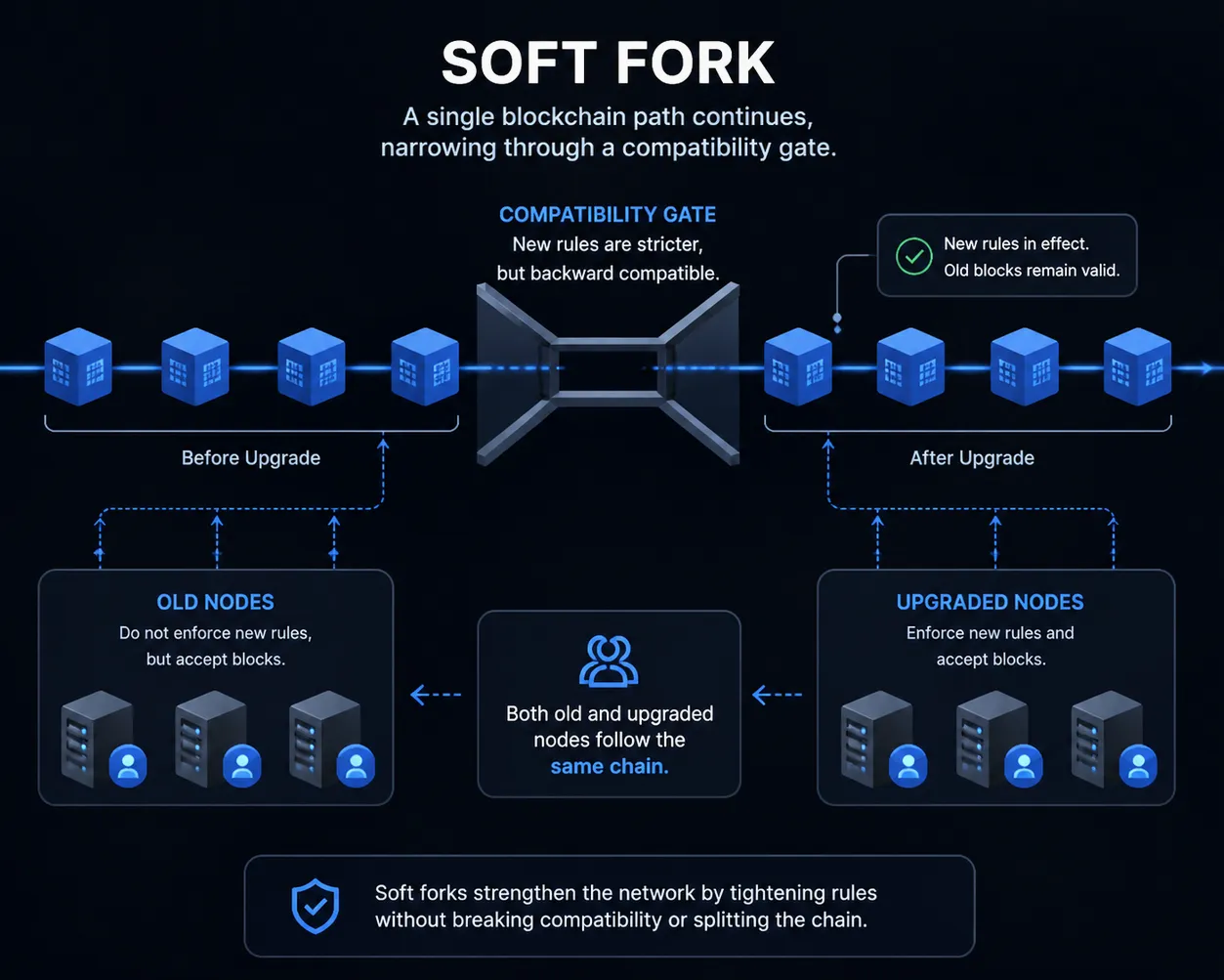
A soft fork is a backward-compatible blockchain protocol upgrade. It tightens or restricts the set of blocks and transactions considered valid. Nodes that upgrade enforce the new rules, while nodes using older software can generally still accept blocks created under the updated rules.
Think of a soft fork as narrowing a rule. If an old rule says a transaction may use several valid formats and the new rule permits only a safer subset of those formats, upgraded nodes reject the deprecated formats. Older nodes may not fully understand the new restrictions, but they can still treat compliant new blocks as valid because those blocks fit within the old rule boundaries.
The clearest practical example is Bitcoin’s Segregated Witness (SegWit) activation in 2017. SegWit changed how signature data was handled, improving transaction capacity and addressing transaction malleability. It was designed as a soft fork, so older Bitcoin nodes could continue operating without being forced immediately onto new software.
Why soft forks matter
Soft forks can make upgrades less disruptive because universal, immediate adoption is not always required. Yet “less disruptive” does not mean effortless. A soft fork still needs meaningful support from miners, validators, full-node operators, wallet teams, exchanges, and businesses. If critical infrastructure fails to update when necessary, users can face service interruptions or misunderstand transaction behavior.
What is a hard fork?
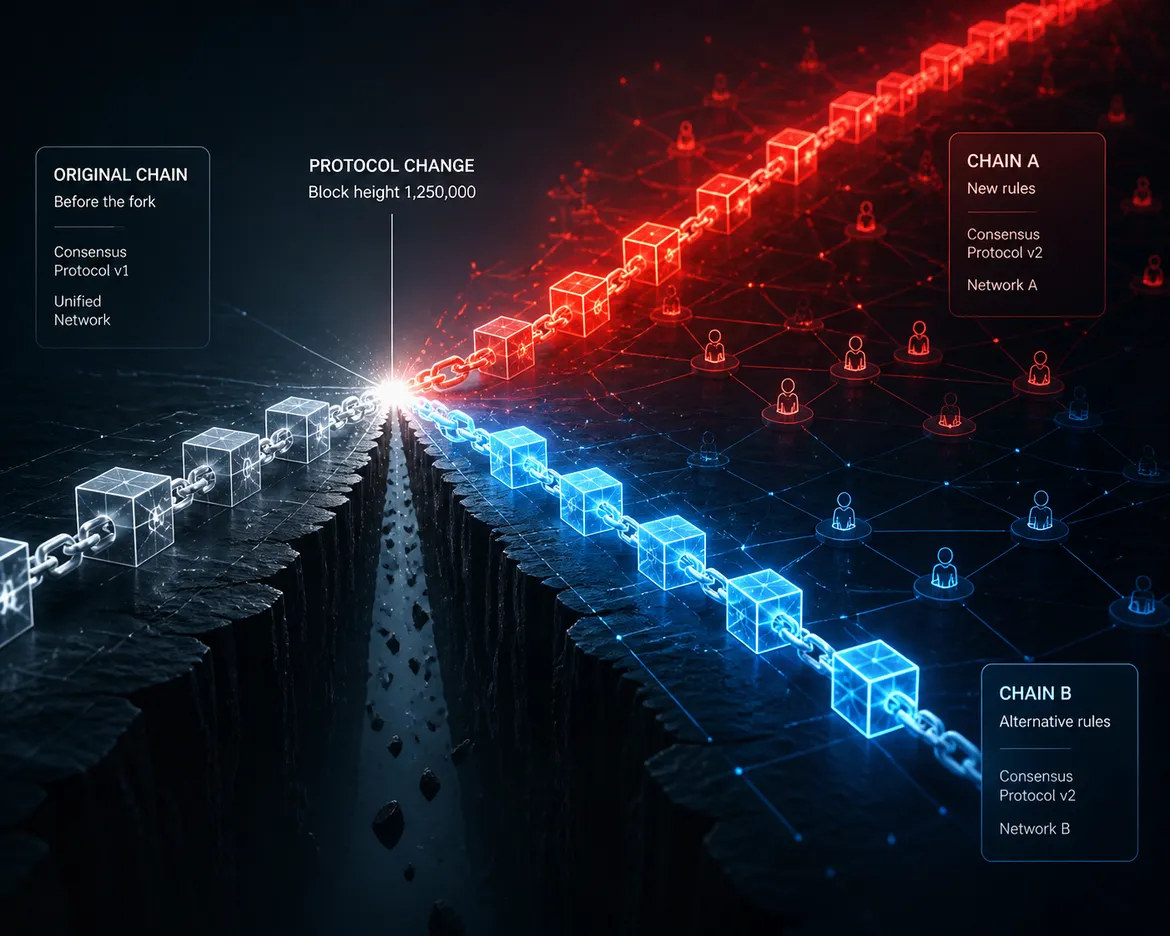
A hard fork is a non-backward-compatible protocol upgrade. It expands or changes the valid rule set in a way that old nodes reject. Once the new rules are active, a node that has not upgraded sees blocks from the upgraded chain as invalid.
For example, raising a block-size limit beyond what old software permits would typically require a hard fork. New nodes would accept the larger blocks; old nodes would reject them. To stay on the intended network, participants must install compatible software.
A hard fork can be planned and widely supported, in which case the network simply migrates to a new version. Ethereum’s Shanghai upgrade, which enabled validator withdrawals, is an example of a coordinated hard fork. In these events, “hard fork” does not automatically mean conflict or a new asset.
However, a hard fork can also become contentious. If a meaningful group refuses the new rules and continues validating the old ones, two independent chains can survive. The 2017 Bitcoin Cash split is the classic case: disagreement over Bitcoin’s scaling approach led to separate networks, separate transaction histories after the split point, and separate assets.
Hard fork vs soft fork: the essential differences
| Feature | Soft fork | Hard fork |
|---|---|---|
| Compatibility | Backward-compatible | Not backward-compatible |
| Rule change | Usually restricts valid behavior | Can add, expand, or fundamentally alter rules |
| Old nodes after activation | Can usually follow new blocks | Reject new-rule blocks |
| Upgrade pressure | Important but older nodes may remain functional | Required for nodes that want to remain on the new chain |
| Chance of a chain split | Lower, though not impossible | Higher if the community disagrees |
The popular shortcut is that a soft fork is a “small” change and a hard fork is a “big” one. That is not reliably true. The correct distinction is whether old software accepts the new chain’s blocks. A technically modest incompatibility can require a hard fork, while a significant rule restriction can be deployed as a soft fork.
What happens to holders during a blockchain fork?
For a routine, coordinated upgrade, holders normally do nothing. Their balances remain on the network as it adopts the new rules. The wallet, exchange, or validator software they use may update in the background or request an upgrade, but there is no automatic windfall merely because a hard fork occurred.
When a contentious hard fork produces two live chains, the situation becomes more complex. A holder with coins at the split block may potentially have corresponding balances on both networks. Access depends on where the assets were held, whether the wallet supports both chains, and whether replay protection exists. Never enter a seed phrase into unfamiliar fork-claim tools. Scammers often exploit the confusion around splits with fake wallets, phishing pages, and misleading airdrop claims.
Traders should also expect volatility around major upgrades. Markets react not only to the code change but to validator readiness, exchange support, the possibility of delayed deposits and withdrawals, and community sentiment. Before taking a position, read the project’s official upgrade documentation and check how your chosen venue will handle the event.
How traders can prepare for fork events
First, identify whether the event is a scheduled protocol upgrade or a disputed chain split. Official developer announcements, repository releases, and reputable exchange notices are more useful than social-media rumors. Second, confirm which ticker, network, and contract specifications apply to your trade; names can become confusing when multiple chains claim a similar identity.
For users trading spot or derivatives, platform notices matter because venues may pause deposits, withdrawals, or trading while they verify network stability. If you want access to a broad set of market tools during fast-moving crypto events, consider joining OKX with referral code CRYPTONEWER. New eligible users can receive 20% fee cashback and a $60,000 futures bonus, subject to the platform’s applicable terms and campaign rules.
Risk management is especially important around forks. Avoid assuming that an announced upgrade guarantees a price move. Use position sizing that can tolerate sharp swings, know where liquidation occurs if using leverage, and do not leave funds on a platform solely because you expect a fork-related credit. Exchange policies differ, and support for any resulting asset is never guaranteed.
Governance is the real story behind a fork

Forks reveal how decentralized governance works in practice. Developers can write code, but they cannot unilaterally force the network to run it. Validators or miners choose what to validate, node operators choose what software to execute, exchanges choose what assets to list, and users decide which chain has economic value.
That distributed decision-making is why blockchain protocol upgrades take so much coordination. A soft fork and a hard fork are technical categories, but their outcomes are social and economic as well. Understanding backward compatibility, activation rules, and ecosystem support gives investors a far clearer view of what an upgrade may actually mean than a headline announcing that a “fork” is coming.
Reminder: This article is educational and not financial advice. Verify upgrade details through official project and exchange communications before transferring, trading, or claiming assets.