DeFi keeps reinventing itself. Yield design, tokenomics, and real-world integrations are maturing fast, and the next leg of adoption will likely ride on three narratives: sustainable fees, on-chain credit (RWAs), and Ethereum staking/restaking. If you’re building a high-conviction watchlist for the next cycle, these are the Binance DeFi tokens to watch—plus a framework to analyze them, and practical steps to trade and track them efficiently.

- 20% fee cashback
- $60,000 futures bonus

- 20% trading fee discount
- $30,050 signup bonus

- 50% trading fee discount
- 20% fee cashback
- $6,200 futures bonus

- 20% trading fee discount
- $100 signup bonus
- $10,000 futures bonus

- 20% fee cashback
- $10,000 bonus

- 20% fee cashback
- $8,000 bonus
Fast track your setup: New to Binance? Get a 20% fee discount and access up to $10,000 in benefits when you join with code CRYPTONEWER. Register on Binance with code CRYPTONEWER.
Why this short list matters
Most DeFi tokens look similar on the surface—TVL charts, emissions, governance talk. But a practical watchlist should focus on tokens with:
- Clear fee generation and a path to value capture (buybacks, staking, burn, or fee switch)
- Durable, non-ponzinomic demand (perps volume, stablecoin usage, ETH staking, RWA cash flows)
- Catalysts visible on a 3–12 month horizon (product upgrades, token economics changes, integrations)
- Reasonable float and unlock profile (no constant sell pressure from emissions or vesting)
Below is a curated watchlist organized by theme. These names are already listed on Binance, making tracking and execution simple.
Binance DeFi tokens to watch: The curated list by narrative
1) DEX liquidity and on-chain derivatives
-
Uniswap (UNI)
- Why watch: UniswapX rollout, cross-chain intents, and ongoing discussions around a fee switch give UNI credible value capture paths that didn’t exist in prior cycles. L2 expansion grows TAM for routing and swapping.
- On-chain signals: Growth in L2 swap share, MEV-capture initiatives, governance progress on fee policy.
- Risks: Regulatory pressure, fee switch timing, competitor aggregators compressing margins.
-
dYdX (DYDX)
- Why watch: A perps-native chain with fee sharing to validators/stakers and strong product-market fit among derivatives traders. The move to its own chain improved control over fees and incentives.
- On-chain signals: Perp volume, funding rates, revenue share to stakers, validator set decentralization.
- Risks: Centralized competitors, liquidity fragmentation across L2s/chains.
-
GMX (GMX)
- Why watch: Proven perps and spot-synthetic model with v2 iterations, emphasizing sustainable liquidity and fee sharing to stakers/liquidity providers.
- On-chain signals: Fee revenue trends, GLP risk exposure, perps open interest.
- Risks: Oracle dependencies, tail-risk events during volatility.
-
PancakeSwap (CAKE)
- Why watch: BNB Chain’s flagship DEX with aggressive multi-chain expansion and recurring revenue mechanisms. Strong retail distribution and frequent product shipping.
- On-chain signals: CAKE burn/mint dynamics, share of BNB Chain volume, new chain deployments.
- Risks: Emissions management, multi-chain overhead.
2) Lending, stablecoins, and credit rails
-
Aave (AAVE)
- Why watch: The GHO stablecoin initiative plus risk-managed lending across major L2s. Aave continues to dominate blue-chip collateral markets.
- On-chain signals: GHO peg stability and adoption, safety module performance, L2/layer expansion.
- Risks: Smart contract risk and broader stablecoin competition.
-
Maker (MKR)
- Why watch: Maker’s “Endgame” strategy and RWA yield are transforming DAI’s revenue profile. Institutional-grade assets backing DAI can improve resilience across cycles.
- On-chain signals: RWA share of revenue, DAI supply growth, surplus buffer, governance throughput.
- Risks: Regulatory risk around RWAs and centralized custody concentration.
-
Liquity (LQTY)
- Why watch: Over-collateralized, interest-free borrowing backed by ETH with algorithmic stability mechanisms (Stability Pool). Minimal governance reduces attack surfaces.
- On-chain signals: Trove activity, Stability Pool TVL, peg resilience during stress.
- Risks: ETH price drawdowns, liquidity depth, competition from newer ETH-backed stablecoins.
3) Liquid staking and restaking (ETH yield stack)
-
Lido (LDO)
- Why watch: Market-leading ETH liquid staking with broad DeFi integrations. The narrative remains strong as staking penetration grows.
- On-chain signals: stETH supply growth, validator performance, fee/treasury health, DVT/open-source roadmap.
- Risks: Concentration concerns, governance capture risk.
-
Rocket Pool (RPL)
- Why watch: Decentralized node-operator set and consumer staking align with Ethereum’s ethos. Catalysts include DVT and smoother onboarding for mini-pools.
- On-chain signals: rETH discount/premium, node count, commission changes.
- Risks: Growth pacing vs. Lido, operator economics.
-
ether.fi (ETHFI)
- Why watch: LRT (liquid restaking) and integrations with restaking ecosystems aim to stack ETH security budget and yield sources.
- On-chain signals: eETH supply, restaking program integrations, reward sustainability.
- Risks: Smart contract and validator set complexity, restaking risk layering.
-
Pendle (PENDLE)
- Why watch: Yield tokenization lets you trade future yield vs. principal, a core primitive for institutional DeFi. Pendle benefits from LST/LRT growth.
- On-chain signals: PT/YT volumes, pool APR dispersion, integrations with LSD/LRT providers.
- Risks: Liquidity fragmentation, complex UX in volatile markets.
4) Real-world assets (RWA) and on-chain cash flows
-
Ondo (ONDO)
- Why watch: Tokenized treasuries and on-chain cash management strike at the heart of institutional DeFi adoption. Expanding venues and wrapped on-chain access.
- On-chain signals: RWA AUM growth, partner exchanges, compliance frameworks.
- Risks: Regulatory scope changes, custody and counterparty exposure.
-
Frax Finance (FXS)
- Why watch: A modular DeFi suite—frxETH staking, lending, and stablecoin mechanics—that increasingly monetizes protocol synergies.
- On-chain signals: frxETH/staked frxETH growth, AMO profitability, revenue to veFXS.
- Risks: Multi-product complexity, governance execution risk.
-
Curve (CRV)
- Why watch: The backbone of stable/liquid staking swaps. Governance wars cooled, but Curve remains critical liquidity infrastructure when paired with veTokenomics and ecosystem gauges.
- On-chain signals: Stablecoin pool volumes, LLAMMA updates, cross-chain deployments, crvUSD traction.
- Risks: Contract vulnerabilities, incentive sustainability.
How to evaluate DeFi tokens like a pro
Use a repeatable framework to separate signal from noise:
- Revenue and cash flows: Track fees, real yield, or value accrual (buybacks/burns/staking) vs. emissions.
- Token supply dynamics: Circulating vs. total supply, unlock schedule, treasury runway.
- Product-market fit: Usage metrics (active wallets, TVL quality, volume, spread capture, retention).
- Governance and security: Audit pedigree, bug bounties, upgrade keys, decentralization level.
- Catalysts and timelines: Concrete releases (v2/v3, L2 expansion), fee switch votes, RWA partnerships.
- Comparative multiples: EV/fees or P/S vs. peers; sanity-check valuations during hype phases.
Pro tip: Build a research template and score each token monthly. This keeps your watchlist fresh while controlling bias.
Building your Binance DeFi watchlist the smart way
- Set automated alerts: Price levels, 24h/7d volume spikes, and funding flips for perps names.
- Track narratives: Create folders by theme (LRT/LSD, RWAs, perps, credit).
- Ladder entries: Don’t chase. Use DCA or conditional orders. Consider grid or TWAP for liquidity-sensitive names.
- Manage liquidity risk: Prefer pairs with deep books and perpetual futures when hedging is needed.
Start with the fee discount: Join Binance with code CRYPTONEWER for 20% off trading fees and up to $10,000 in new-user benefits.
Tactics for trading DeFi narratives on Binance
-
Event-driven setups
- Governance proposals: Monitor UNI fee switch votes, AAVE GHO updates, Maker Endgame rollouts.
- Network launches/upgrades: GMX v2 changes, L2 deployments of DEXs, restaking integrations for ETHFI.
- Listings/expansions: New pairs or margin support can unlock liquidity and attract flows.
-
Risk management checklists
- Size per thesis: 1–5% per idea for diversified baskets; smaller for experimental tokens.
- Use stop/invalidations: Define thesis-breakers (e.g., a governance rejection, exploit, or lost peg).
- Hedge with perps when directional conviction is low; rotate to spot for longer holds.
-
Yield overlays (know the trade-offs)
- Simple Earn or staking when available for blue chips.
- Avoid over-leveraging yield with volatile collateral; stress-test downside scenarios.
Data signals to watch each week
- Fees and revenue: Are protocol fees outpacing emissions? Any buybacks/redistributions planned?
- TVL composition: Stable TVL vs. mercenary TVL; concentration by pool or chain.
- Stability metrics: For stablecoins (DAI, GHO, crvUSD), peg resilience and liquidity coverage.
- Liquidity depth: Spot order book thickness on Binance; slippage for larger clips.
- Cross-chain growth: L2 adoption for UNI/AAVE; new EVM and non-EVM deployments.
- Token unlocks: Track vesting cliffs and liquidity mining halvenings.
Practical setup: from research to execution in 15 minutes
1) Curate the basket
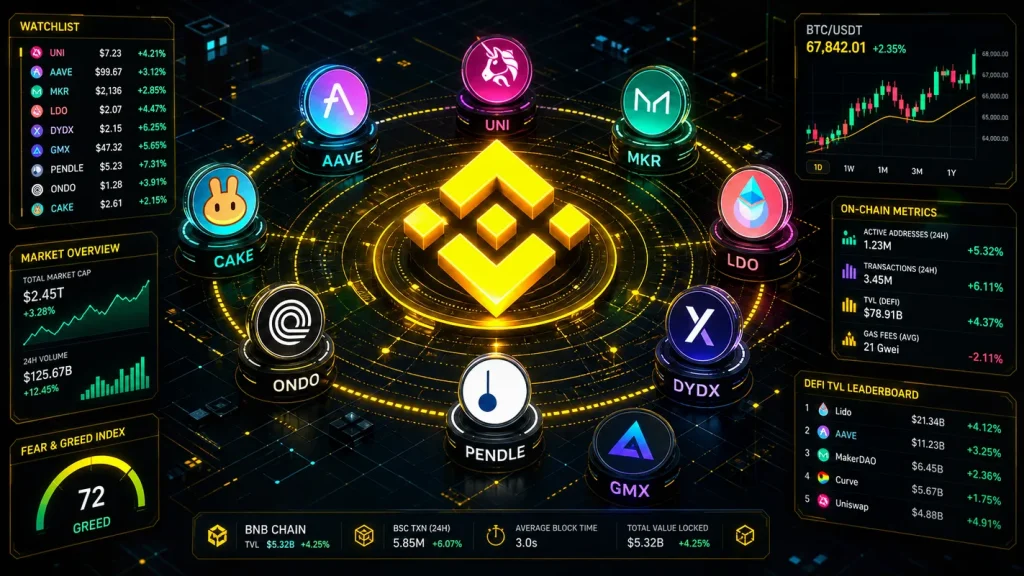
– Pick 5–8 names across narratives: e.g., UNI, DYDX, GMX, AAVE, MKR, LDO, PENDLE, ONDO.
– Add two wildcards for optionality: FXS, ETHFI, or CAKE depending on BNB Chain exposure desired.
2) Create rules
– Entries: DCA on red weeks; add on on-chain growth (fees/TVL) or key governance wins.
– Exits: If unlocks > revenue for multiple months, or a security incident degrades trust, de-risk.
3) Execute on Binance
– Split orders: Use limit + conditional orders; avoid single large market buys.
– Set alerts for 7d volume spikes and funding rate extremes.
– Consider a public watchlist to keep yourself accountable.
4) Keep fees low and benefits high
– New users: Register on Binance with code CRYPTONEWER to secure a 20% fee discount and up to $10,000 in benefits. If you already have an account, review VIP tiers and fee schedules quarterly.
FAQs: Binance DeFi watchlist, answered
-
What makes a “top” DeFi token on Binance?
- Sustainable fees, proven usage, upcoming catalysts, and reasonable supply dynamics. Hype without cash flow rarely sustains.
-
How often should I rebalance?
- Monthly for majors; faster for event-driven positions. Trigger-based rebalances beat calendar-only methods.
-
Are RWAs really DeFi?
- Yes, when on-chain interfaces, transparency, and programmability enhance traditional assets. The counterparty layer still matters—assess custody and compliance risk.
-
Is restaking too risky?
- It adds complexity. Focus on providers with transparent validator operations, audited contracts, and clear risk disclosures.
-
Should I favor perps tokens or DEX spot tokens?
- Blend them. Perps DEXs monetize trader demand; spot DEXs monetize routing and LP depth. They respond differently to volatility regimes.
Quick reference: keywords and narratives to track
- Short tail: DeFi tokens, Binance DeFi, DEX tokens, staking tokens, RWA crypto
- Long tail: best DeFi tokens on Binance, Binance DeFi tokens to watch, top DeFi coins 2026, liquid restaking tokens, on-chain derivatives tokens, yield tokenization crypto
Final notes before you build positions
- Guardrails over hindsight: Codify your framework now—fees, supply, catalysts—so decisions aren’t emotional later.
- Expect rotation: Narratives lead and lag. RWAs and restaking may decouple from DEXs at times.
- Security never goes out of style: Hardware wallets, 2FA, allowlisting, and least-privilege approvals.
Get your infrastructure ready and keep fees down with the referral perks: Join Binance with code CRYPTONEWER for a 20% fee discount and up to $10,000 in bonuses.