
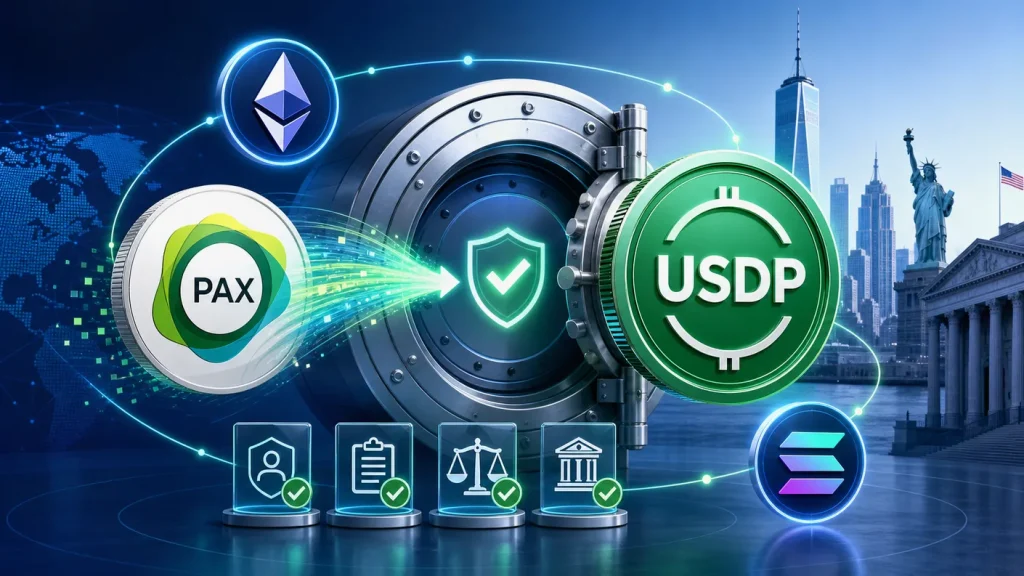
If you’ve heard of “PAX,” you’re really hearing about Paxos’ original USD stablecoin that was renamed “Pax Dollar (USDP)” back on August 24, 2021. In other words, PAX ≡ USDP today. That matters because most exchanges, wallets, and block explorers now show the ticker USDP, not PAX. (paxos.com)

- 20% trading fee discount
- $100 signup bonus
- $10,000 futures bonus

- 20% fee cashback
- $60,000 futures bonus

- 20% fee cashback
- $10,000 bonus

- 20% trading fee discount
- $30,050 signup bonus

- 50% trading fee discount
- 20% fee cashback
- $6,200 futures bonus

- 20% fee cashback
- $8,000 bonus
To help you buy confidently, this guide explains what PAX/USDP is, how it keeps its peg, where it runs on-chain, and step-by-step ways to purchase it—as of May 5, 2026. I’ll also show you how to reduce trading fees with a verified referral on Binance.
TL;DR
- PAX (Paxos Standard) was rebranded to Pax Dollar (USDP) in 2021; treat PAX and USDP as the same coin today.
- USDP is a dollar-backed stablecoin issued by Paxos Trust Company, a New York–regulated trust. Paxos publishes reserve attestations and disclosures. (paxos.com)
- USDP exists natively on Ethereum as an ERC‑20 token and also on Solana as an SPL token. (help.paxos.com)
- Binance historically supported PAX and has, at different times, adjusted how competing stablecoins appear or trade (e.g., 2022 auto-conversion) and has made region-specific changes under EEA MiCA rules. Availability of USDP trading pairs can vary by jurisdiction and time—always check inside your account. (prnewswire.com)
- New to Binance? Register with the 20% fee discount and up to $10,000 in benefits using this link: Join Binance with code CRYPTONEWER.
What is PAX (now USDP)?
PAX launched in 2018 as a regulated “digital dollar.” In 2021, Paxos renamed it to Pax Dollar (USDP) to make the USD peg obvious in the ticker and branding. Functionally, it’s the same regulated, fiat-backed stablecoin. (paxos.com)
USDP is issued by Paxos Trust Company, which operates under oversight from the New York State Department of Financial Services (NYDFS). Paxos states that USDP reserves are held in cash and U.S. Treasuries, and it publishes monthly attestations and periodic reports by independent auditors (Withum). These disclosures let anyone verify the token supply against reserves.
How USDP maintains its $1 peg
- Regulated issuance and redemption: Authorized partners can mint USDP by sending USD to Paxos and redeem USDP back to USD at par, enforcing the 1:1 peg through arbitrage. (docs.paxos.com)
- Transparent reserves: Paxos provides ongoing attestation reports of reserves backing USDP.
- Conservative assets: Disclosures show reserves in cash and short-duration U.S. government instruments, aligning with common best practices for fiat-backed stablecoins. (paxos.com)
On which blockchains does USDP run?
- Ethereum: USDP is an ERC‑20 token. Official contract address (Ethereum mainnet): 0x8E870D67F660D95d5be530380D0eC0bd388289E1. (docs.sandbox.paxos.com)
- Solana: As of January 17, 2024, Paxos added a Solana (SPL) version of USDP.
This multi-chain availability gives you lower fees (Solana) when moving funds, while Ethereum remains the default settlement layer for many institutions.
PAX vs. USDP vs. other Paxos stablecoins
- PAX → USDP: Same product, new name since 2021.
- PYUSD: PayPal’s USD stablecoin is also issued by Paxos under the same regulatory umbrella but distributed via PayPal’s ecosystem. (eco.com)
- Additional Paxos initiatives (for non‑U.S. distribution) include products like USDL/USDG under separate entities and jurisdictions; these are distinct from USDP. Always confirm the ticker and issuer before you buy. (docs.paxos.com)
Can you buy USDP (ex‑PAX) on Binance?
Short answer: Often yes—but it depends on your region and current compliance rules. Binance listed PAX in 2018 and later reflected Paxos’ 2021 rebrand to USDP. In September 2022, Binance temporarily auto‑converted competing stablecoins (including USDP) to its then‑house stablecoin (BUSD), and in 2025 it adjusted EEA spot markets to remove non‑MiCA‑compliant stablecoin pairs (which included USDP) for users in those jurisdictions. Because policies evolve, you should check current spot pairs in your logged‑in account.
Separate from regional restrictions, third‑party market trackers have shown a USDP/USDT spot pair on Binance at times in 2026, but always verify inside Binance before placing orders. (bitinfocharts.com)
Step‑by‑step: how to buy PAX/USDP on Binance (as of May 5, 2026)
1) Create your account
– Use this referral to get 20% spot fee discount and access up to $10,000 in benefits: Register on Binance with code CRYPTONEWER.
2) Verify and secure
– Complete KYC where required and enable 2FA. (Regulatory rules and required checks vary by country.) (dextools.io)
3) Add funds
– Deposit fiat (bank card/transfer) or transfer crypto from another wallet/exchange.
4) Find the market
– In Spot, search “USDP.” If you see a live pair (e.g., USDP/USDT), proceed. If you don’t see USDP in your region, skip to the “Fallback routes” below. Regional availability can differ (e.g., EEA rules under MiCA). (fxnewsgroup.com)
5) Place your order
– Choose Market for immediate execution or Limit to set your price. Enter the amount and click Buy.
6) Withdraw to your wallet (optional)
– For self‑custody, withdraw USDP to an address on the correct chain (ERC‑20 for Ethereum or SPL for Solana). Always match networks to avoid loss.
Fallback routes if USDP isn’t listed for you on Binance today
- Route A: Buy USDT or USDC on Binance, then transfer to an exchange that currently offers USDP spot pairs and swap there. Aggregators often show where USDP is trading; still, verify liquidity and fees first. (coincodex.com)
- Route B: Use a DEX on Ethereum with the official USDP contract—be mindful of liquidity and gas fees. Confirm the contract address from Paxos documentation before swapping.
Fees, slippage, and on‑chain costs
- Exchange trading fees: With the referral above, your spot trading fees on Binance are reduced by 20%. Join with code CRYPTONEWER.
- Network fees: ERC‑20 transfers incur Ethereum gas; Solana transfers are typically cheaper but confirm your recipient supports USDP on that chain.
- Slippage: Stablecoin pairs often have tight spreads, but check order book depth—especially if you’re trading outside peak hours or in regions with restricted pairs.
How to verify you’re buying the right token
- Contract check: On Ethereum, USDP’s mainnet contract is 0x8E870D67F660D95d5be530380D0eC0bd388289E1 (verify via Paxos docs or reputable contract registries).
- Issuer check: The issuer should be Paxos Trust Company (NYDFS‑regulated). Avoid look‑alike tickers on unsupported networks.
Security and transparency notes
- Attestations and disclosures: Paxos posts monthly and periodic reserve reports so you can verify supply vs. backing assets.
- Smart‑contract controls: As with other regulated stablecoins, USDP contracts include mint/burn and freeze/blacklist functionality held by the issuer to comply with law. Review the white paper and contract docs if these controls matter for your use case. (insights.paxos.com)
Common questions
-
Is USDP the same as BUSD?
- No. BUSD was a separate Binance‑branded stablecoin issued by Paxos; its status changed over 2023–2024, and Binance has since restructured how it handles stablecoin markets. Don’t confuse BUSD with USDP. (en.wikipedia.org)
-
Why can’t I find USDP pairs in the EEA?
- Under the EU’s MiCA framework, Binance removed or converted certain non‑compliant stablecoin pairs (including USDP) in EEA spot markets in 2025. This does not necessarily apply outside the EEA.
-
Is there a Solana version of USDP?
- Yes, Paxos added an SPL version; confirm that your wallet/exchange supports USDP on Solana before withdrawing.
Ready to buy?
If USDP is listed for your region, you can complete the whole purchase on Binance in minutes. If it isn’t, use the fallback routes and still enjoy discounted fees on the rest of your trades. Start here: Binance sign‑up (20% off fees) — code CRYPTONEWER.
SEO quick hits (for buyers who skim)
- Focus keyword: What is the PAX (Paxos Standard) Coin, and how to buy
- Long‑tail ideas: “how to buy Paxos Standard on Binance,” “USDP stablecoin explained,” “PAX vs USDP difference,” “NYDFS regulated stablecoin,” “USDP Solana ERC‑20 contract.”
- Buyer intent terms: buy USDP, purchase PAX, where to buy Paxos Standard, Binance USDP pair.
Related posts:
 How Blockchain Is Changing Online Gaming — A Game-Changing Deep-Dive for Players and Studios
 What is the PIGGY(Piggycell) Coin, and how to buy — a hands‑on, step‑by‑step guide for 2026
 How Does Bitcoin Work? An Overview In-Depth Breakdown for Curious Builders and Investors
 Actionable Bitget Mobile App Full Trading Guide for Pro-Level Trading on the Go