
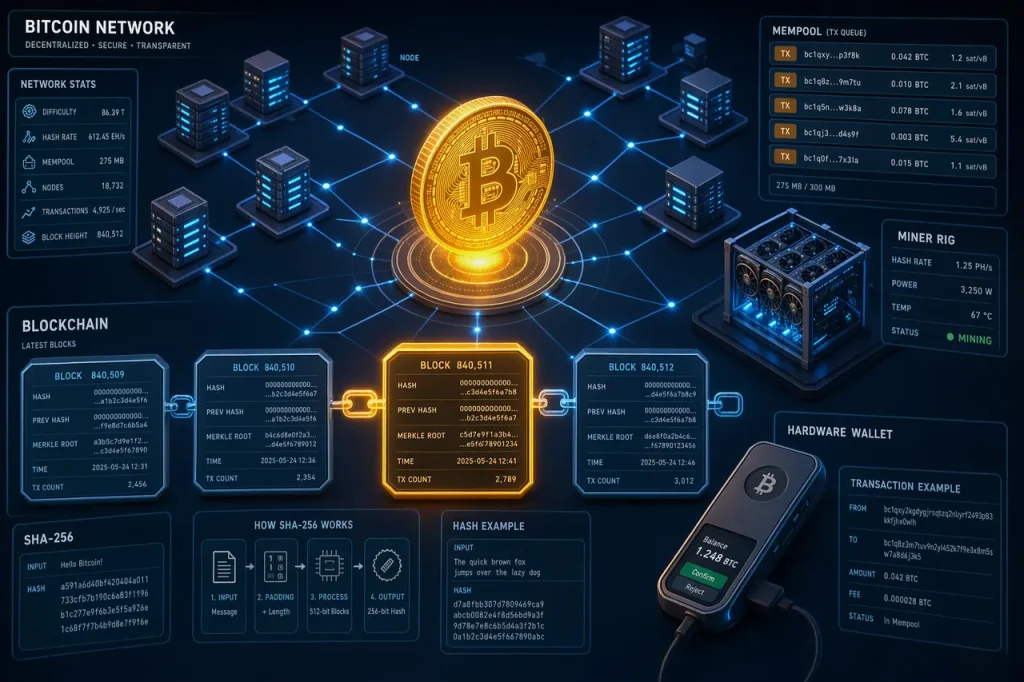
If you’ve ever wondered how bitcoin actually moves from one person to another, what makes blocks secure, or why miners matter, this no-nonsense guide is for you. I’ll walk you through the mechanics behind the scenes—keys and addresses, transactions and the UTXO model, proof of work, nodes, fees, confirmations, and scaling—so by the end you’ll have a working mental model of how Bitcoin really operates.

- 20% fee cashback
- $10,000 bonus

- 20% trading fee discount
- $100 signup bonus
- $10,000 futures bonus

- 20% fee cashback
- $60,000 futures bonus

- 20% fee cashback
- $8,000 bonus

- 50% trading fee discount
- 20% fee cashback
- $6,200 futures bonus

- 20% trading fee discount
- $30,050 signup bonus
Along the way, if you’re looking for a reputable exchange to start small or to practice responsible trading, you can sign up at Bitget and use code cryptonew0 for a 50% trading fee discount, 20% fee cashback, and up to $6,200 in futures bonuses.
TL;DR
- Bitcoin is a decentralized ledger maintained by thousands of nodes.
- Transactions spend “Unspent Transaction Outputs” (UTXOs) using digital signatures made from private keys.
- Miners batch transactions into blocks and secure them with proof of work (double SHA-256) under a dynamic difficulty target.
- Longest valid chain wins; confirmations accumulate security.
- Fees incentivize miners alongside the block subsidy, which halves about every four years.
- Scaling advances include SegWit, Taproot, and the Lightning Network for fast, low-cost payments.
How Does Bitcoin Work? An Overview
The phrase “How Does Bitcoin Work? An Overview” can sound abstract until you picture Bitcoin as a publicly shared spreadsheet—replicated across thousands of computers (nodes)—that anyone can verify but no single party controls. Each row on this spreadsheet represents a spendable output (a UTXO). When you make a payment, you reference one or more of your UTXOs and cryptographically prove you have the right to spend them.
What makes the network tick is a combination of cryptography (private/public keys, digital signatures), consensus (nodes agreeing on valid blocks), and economics (fees and mining rewards enticing honest behavior). Put simply: math and incentives replace banks and arbiters.
Keys, Addresses, and Signatures
- Private key: a secret 256-bit number that lets you authorize spending. Keep it offline if possible.
- Public key: derived from the private key; used by others to verify your signature.
- Bitcoin address: a human-friendly encoding (e.g., bech32 starting with bc1) that people can send funds to.
When you “send BTC,” your wallet uses your private key to produce a digital signature over a transaction. Nodes verify that signature using your public key. Thanks to elliptic curve cryptography, signatures are easy to verify but practically impossible to forge without the private key.
Tip: Modern wallets are “HD” (hierarchical deterministic) and derive many addresses from a single seed phrase (BIP39). Back up that seed phrase offline; it’s the master key to your funds.
The UTXO Model Explained Simply
A transaction consumes inputs (existing UTXOs) and creates new outputs (new UTXOs). You can think of it like breaking and reassembling bills:
– If you have a 0.5 BTC UTXO and want to send 0.1 BTC, your transaction might create two outputs: 0.1 BTC to the recipient and 0.4 BTC back to you (change output).
– Any small difference between inputs and outputs is the fee paid to miners.
Because UTXOs are indivisible units at the protocol level, wallets handle the math of construction for you—selecting inputs, crafting outputs, and minimizing fees (coin selection).
Mempool, Fees, and Confirmations
Once you sign a transaction, your wallet broadcasts it to the network. Nodes place it in a waiting area called the mempool. Miners pick from the mempool to build a block, prioritizing higher-fee transactions.
- Fee rate: measured in sats/vB (satoshis per virtual byte). Higher fee rates get confirmed faster during congestion.
- Confirmations: each block mined after your transaction’s block counts as one confirmation. For everyday payments, 1–3 confirmations may suffice; for large settlements, 6+ is common.
Proof of Work and Mining
Miners compete to find a valid block hash by:
1. Assembling a block of transactions plus a special coinbase transaction that mints the block subsidy.
2. Hashing the block header with SHA-256 twice.
3. Tweaking the nonce and other fields until the resulting hash is below the network’s difficulty target.
- Difficulty adjusts roughly every 2,016 blocks (~2 weeks) so blocks average ~10 minutes.
- Block subsidy halves about every four years (210,000 blocks). This predictable issuance schedule drives the 21 million BTC hard cap.
- Economic security: To rewrite history, an attacker would need massive hash power and energy, making attacks prohibitively expensive.
Nodes vs. Miners
- Full nodes: validate every block and transaction independently against the consensus rules. They don’t mine; they protect your view of the rules.
- Miners: propose blocks under proof of work. They must create valid blocks that full nodes accept, or their blocks are rejected.
Running your own node is the gold standard for sovereignty: you verify the rules rather than trusting others.
Script, SegWit, and Taproot in Plain English
- Bitcoin Script: a simple, stack-based language that locks coins to conditions (e.g., a signature or timelock). It enables multi-sig, time-locked vaults, and more.
- SegWit (2017): fixes transaction malleability and improves block capacity by separating signatures from the main data structure.
- Taproot (2021): enhances privacy and flexibility by making complex spending conditions look like ordinary transactions and enabling more efficient multi-sig (MuSig) constructs.
These upgrades lay the groundwork for better scaling, privacy, and smart contracting within Bitcoin’s conservative design.
The Lightning Network: Fast, Low-Fee Payments
On-chain Bitcoin is global settlement; Lightning is for instant, small payments:
– Open a channel on-chain with another party.
– Route payments across a network of channels using hashed time-locked contracts (HTLCs).
– Close channels later, settling net changes on-chain.
Lightning reduces congestion and fees for everyday payments while preserving Bitcoin’s base-layer security model for final settlement.
Security Best Practices for Wallets
- Non-custodial first: control your keys (hardware wallet recommended).
- Backups: write your seed on paper or steel, never store unencrypted in the cloud.
- Multi-sig: distribute signing power across devices/locations to reduce single points of failure.
- Test sends: move a small amount first, then the rest.
- Address hygiene: use a new address each time for privacy.
The Economics: Issuance, Halving, and the Fee Market
- Supply: capped at 21,000,000 BTC by protocol rules.
- Halvings: reduce the block subsidy over time, historically every ~4 years.
- Fees: as block subsidies shrink, fees play a larger role in miner revenue, supporting long-term security.
This combination of predictable issuance and a growing fee market aligns incentives for users and miners over decades.
Environmental and Resilience Considerations
- Energy use: Bitcoin converts energy into security; miners seek cheap, stranded, or renewable power to compete.
- Geographic dispersion: mining and nodes worldwide increase censorship resistance and uptime.
- Market incentives: if energy costs outweigh rewards, inefficient miners drop out, keeping the system adaptive.
Step-by-Step: A Transaction’s Journey
- You create a transaction spending your UTXOs to a recipient address and (usually) a change address.
- Your wallet signs it with your private key and broadcasts it to nodes.
- Nodes verify signatures, inputs, and scripts; valid transactions enter mempools.
- A miner selects transactions, constructs a block, then solves proof of work.
- The block propagates; nodes validate it and extend the chain.
- Your payment is now confirmed and accumulates deeper security with each subsequent block.
Where to Buy, Trade, and Learn by Doing
Whether you’re dollar-cost averaging or exploring futures with strict risk controls, picking a reliable, liquid venue matters. If you’re comparing platforms, I’ve had a strong experience with Bitget:
- 50% trading fee discount with code cryptonew0
- 20% fee cashback credited to your account
- Up to $6,200 in futures bonus for new users
Pro tip for beginners: Start small, practice moving funds from the exchange to your own wallet, and learn fee selection. When you’re ready, use Bitget and code cryptonew0 to reduce costs while you learn.
Note: Futures involve leverage and can be risky. Keep position sizes modest and always use stops.
Common Questions Answered
- Is Bitcoin anonymous? It’s pseudonymous. Addresses don’t map to legal names, but transactions are public. Use best practices and privacy tools where legal.
- Can Bitcoin be hacked? Attacking the network’s consensus is massively expensive; most losses stem from user error or insecure custody.
- Why do confirmations matter? The deeper your transaction is in the chain, the more proof-of-work secures it against reorgs.
- What if miners collude? Full nodes enforce rules; invalid blocks are rejected. An attacker still faces steep, continuous costs.
Glossary for Quick Recall
- Address: Where others send you BTC; derived from your public key.
- Block: A batch of verified transactions mined about every 10 minutes.
- Difficulty: Adjusts every ~2 weeks so blocks stay near the 10-minute target.
- Halving: Scheduled reduction of block subsidy roughly every 4 years.
- Node: Software that validates the entire blockchain independently.
- UTXO: Unspent Transaction Output; the atomic unit of spendable BTC.
- SegWit/Taproot: Upgrades that improved capacity, flexibility, and privacy.
- Lightning Network: Layer-2 for instant, low-fee payments.
Next Steps and Deep Dives
- Get a hardware wallet, write down your seed, and practice receiving/sending.
- Spin up a node (e.g., Bitcoin Core) to verify the chain yourself.
- Read the Bitcoin Whitepaper and check developer docs for Script, SegWit, and Taproot.
- Try small on-chain and Lightning payments to experience both layers.
- If you want to trade while keeping costs low, explore Bitget with code cryptonew0 for substantial discounts and bonuses.
Related posts:
 What is the 客服小何(客服小何) Coin, and how to buy — No‑Hype Deep Dive for 2026
 Proven 2026 Crypto Futures Trading Tips That Sharpen Your Edge
 Proven insights About Pepe coin history, tokenomics, risks, and how to buy PEPE in 2026
 Essential Playbook for Blockchain and the Internet of Things (IoT) in Real Systems