
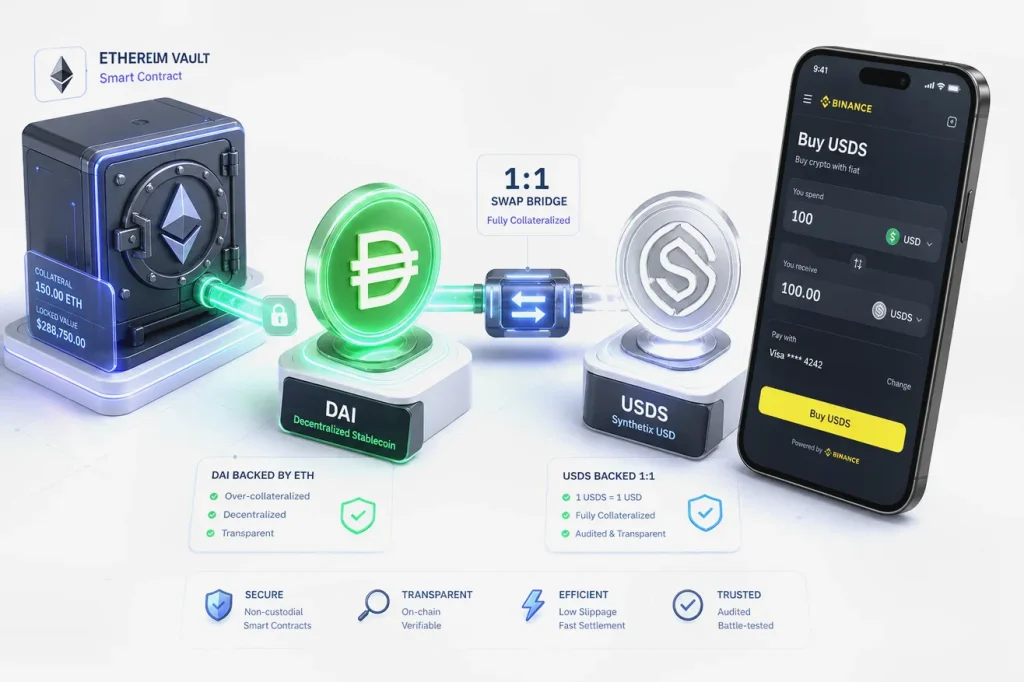
If you’re searching for what DAI is and how to buy it right now, you’ve probably noticed two names in the same breath: DAI and USDS. This guide explains DAI in plain English, what changed with the Sky (formerly MakerDAO) rebrand, why many exchanges now default to USDS, and the exact, step‑by‑step ways you can still acquire DAI today. (academy.binance.com)

- 20% trading fee discount
- $100 signup bonus
- $10,000 futures bonus

- 20% fee cashback
- $60,000 futures bonus

- 20% fee cashback
- $8,000 bonus

- 20% trading fee discount
- $30,050 signup bonus

- 50% trading fee discount
- 20% fee cashback
- $6,200 futures bonus

- 20% fee cashback
- $10,000 bonus
Timestamp note: Today is May 10, 2026. Several centralized exchanges migrated DAI markets in early April 2026. I’ll flag these changes below with dates, so you know what’s current. (news.cnyes.com)
TL;DR
- DAI is a decentralized, over‑collateralized stablecoin that aims to track $1 via on‑chain mechanisms governed by the Maker/Sky protocol. (coinmarketcap.com)
- Since 2024–2026, the protocol rebranded to Sky and introduced a newer stablecoin, USDS. DAI still exists, and you can convert between DAI and USDS 1:1 using the protocol’s converter.
- As of April 2026, major centralized exchanges (including Binance) delisted DAI spot pairs and auto‑swapped balances to USDS. To hold DAI, buy USDS, withdraw to your wallet, and convert USDS→DAI on‑chain.
- You can also buy DAI directly on decentralized exchanges or earn yield as sDAI (a token representing DAI deposited into the Dai Savings Rate). (help.defisaver.com)
What is DAI?
DAI is a crypto‑collateralized stablecoin originally launched by MakerDAO. It targets a soft peg to the US dollar and lives primarily as an ERC‑20 token on Ethereum. Instead of a bank holding dollars, smart contracts enforce over‑collateralization and liquidations to keep DAI near $1.
The stablecoin is issued and governed by the Maker/Sky protocol through decentralized voting and risk parameters (collateral types, fees, and limits). Holders use it across DeFi for payments, trading, lending and savings via the Dai Savings Rate (DSR). (community-portal-staging.makerfoundation.com)
How the peg works (in short)
- Users lock collateral (e.g., ETH and other approved assets) into vaults and mint DAI against it. If collateral falls too much, positions are liquidated to keep the system solvent. (securities.io)
- The Peg Stability Module (PSM) lets traders swap certain stablecoins for DAI at near‑fixed rates to tighten the peg mechanically during stress. This tool was introduced in late 2020 and remains a key stabilizer. (acfr.aut.ac.nz)
DAI, DSR and sDAI
- DSR: Protocol‑set savings rate for DAI holders who opt in.
- sDAI: A yield‑bearing token that represents DAI deposited in the DSR module; it accrues yield automatically in your wallet. Think of sDAI as “DAI earning the DSR, tokenized.”
- For a market view of sDAI’s standing and mechanics, see independent listings and overviews. (coinmarketcap.com)
The 2024–2026 shift: MakerDAO → Sky, and the rise of USDS
In 2024, MakerDAO rebranded to Sky. Alongside governance updates and new architecture, Sky introduced USDS, a newer stablecoin within the same ecosystem. Educational and research resources from major venues describe USDS and SKY as the protocol’s forward‑looking pair of tokens.
Importantly for buyers today: DAI did not vanish. The protocol offers a native DAI↔USDS converter that lets users move between the two stablecoins 1:1 whenever they want. This removes friction if your exchange now lists USDS by default. (developers.sky.money)
Sky’s ecosystem also introduced SSR (Sky Savings Rate) for USDS (the USDS analogue to DAI’s DSR), which governance has kept roughly in line with treasury yields through Q1 2026. (eco.com)
Why did so many platforms gravitate to USDS? In parallel with the rebrand, exchanges adapted listings and liquidity to the new default. As an example of the timing, Binance and others announced DAI→USDS migrations and removed DAI spot pairs in the first half of April 2026.
For context on the protocol’s collateral book and focus on real‑world assets (a big part of how DSR/SSR is funded), analyst research from 21Shares explains the drivers clearly. (cdn.21shares.com)
How to buy DAI in 2026 (three reliable paths)
Path 1 — Buy via Binance (USDS route) and convert to DAI on‑chain
Since April 2026, Binance auto‑swapped exchange DAI balances to USDS and delisted DAI spot pairs. The workaround is simple: buy USDS on Binance, withdraw to your wallet, and convert USDS→DAI 1:1 with the Sky converter.
- Create a free Binance account with my referral to reduce fees and unlock extra benefits: Join Binance with code CRYPTONEWER — 20% fee discount plus up to $10,000 in benefits for new users.
- Complete KYC and fund your account.
- Buy USDS (you’ll typically find USDS/USDT, BTC/USDS, ETH/USDS pairs live as of April 9, 2026). (t.signalplus.com)
- Withdraw USDS to a self‑custody EVM wallet (e.g., MetaMask) on Ethereum.
- Use the protocol’s converter to swap USDS→DAI 1:1 in one transaction. Keep a little ETH for gas.
Pro tip: If your goal is yield, you can also move DAI into sDAI to earn the DSR without giving up self‑custody.
Path 2 — Buy DAI directly on a decentralized exchange (DEX)
- Connect your wallet to a DEX like Uniswap and swap from a common stable (USDC/USDT/USDS) into DAI. Slippage is typically minimal around $1, but always check your route and fees.
- If your exchange options are limited regionally, this DEX route is often the most direct way to acquire on‑chain DAI.
Path 3 — Generate stablecoins by opening a Vault (advanced)
Historically, users minted DAI by opening over‑collateralized vaults. With the Sky rebrand, new‑mint flows and incentive design focus on USDS, but the underlying vault mechanics and risk governance remain the same family of tools. This is powerful, but it’s for advanced users who understand liquidation risk and stability fees.
Step‑by‑step: Converting USDS to DAI 1:1
- Verify you’re on the official Sky converter interface.
- Connect your wallet holding USDS on Ethereum mainnet.
- Approve USDS, then execute the 1:1 conversion into DAI. There are no extra protocol restrictions on this route.
- Optional: Deposit your DAI into the DSR module via an sDAI wrapper to earn on‑chain yield.
DAI vs. USDS vs. sDAI at a glance
- DAI: The original decentralized, over‑collateralized dollar‑tracker with deep, legacy DeFi integrations.
- USDS: The newer Sky ecosystem stablecoin; many CEXs list USDS by default as of April 2026. You can freely convert between USDS and DAI.
- sDAI: A token that represents DAI deposited into the DSR for yield; it automatically accrues in your wallet.
Fees, networks, and safety
- Network: DAI’s deepest liquidity remains on Ethereum mainnet, though bridged and canonical versions exist on L2s and other chains. Gas fees vary; hold some ETH for transactions.
- Exchange vs. on‑chain costs: Buying USDS on Binance involves trading fees; the converter transaction to DAI costs only gas. Check fee schedules and always test with a small transaction first. (Binance re‑opened USDS spot pairs on April 9, 2026.)
- Risk reminders: Over‑collateralized stablecoins can see brief premiums/discounts during market stress. Read protocol docs and understand liquidation and peg tools (like the PSM).
Maker/Sky by the numbers and why it matters
- The protocol’s long‑running design — collateralized vaults, governance, the DSR/SSR, plus PSM — is why DAI became DeFi’s archetypal decentralized stablecoin.
- The rebrand to Sky, and the introduction of USDS and SKY governance, is documented across major education and research channels, reflecting the ecosystem’s evolution rather than an abrupt end to DAI.
- Real‑world asset income (e.g., treasuries via allocators) has been a growing share of protocol revenue, helping fund DSR/SSR and savings products.
How to maximize value when buying
- Use a fee discount when you can. If you’re using a CEX for the USDS leg, sign up with Binance — code CRYPTONEWER to get 20% off trading fees plus up to $10,000 in new‑user benefits.
- When converting to DAI, keep transactions on the canonical network and verify contract addresses in official docs.
- For passive yield on DAI, consider sDAI; for USDS, look into SSR‑based options (like sUSDS) if they fit your risk profile.
Frequently asked questions
-
Is DAI still decentralized after the rebrand?
Yes. The mechanics — over‑collateralized vaults, liquidations, risk parameters set by governance — remain decentralized and transparent on‑chain. -
Why can’t I just buy DAI on Binance like before?
Because in early April 2026 Binance and several other exchanges removed DAI spot pairs and supported a DAI→USDS migration. You can buy USDS there, then convert 1:1 to DAI on‑chain. -
What’s the practical difference between holding DAI and sDAI?
DAI is the base stablecoin. sDAI is a wrapper representing DAI deposited into the DSR, so your position auto‑accrues yield in‑wallet. You can always unwrap back to DAI. -
Is there a savings token for USDS like sDAI?
Yes — sUSDS lets USDS holders access the Sky Savings Rate (SSR). Yield ranges with market conditions and governance. -
Can I move between DAI and USDS any time?
Yes. The protocol exposes a DAI↔USDS converter that permits 1:1 conversions with no extra restrictions.