
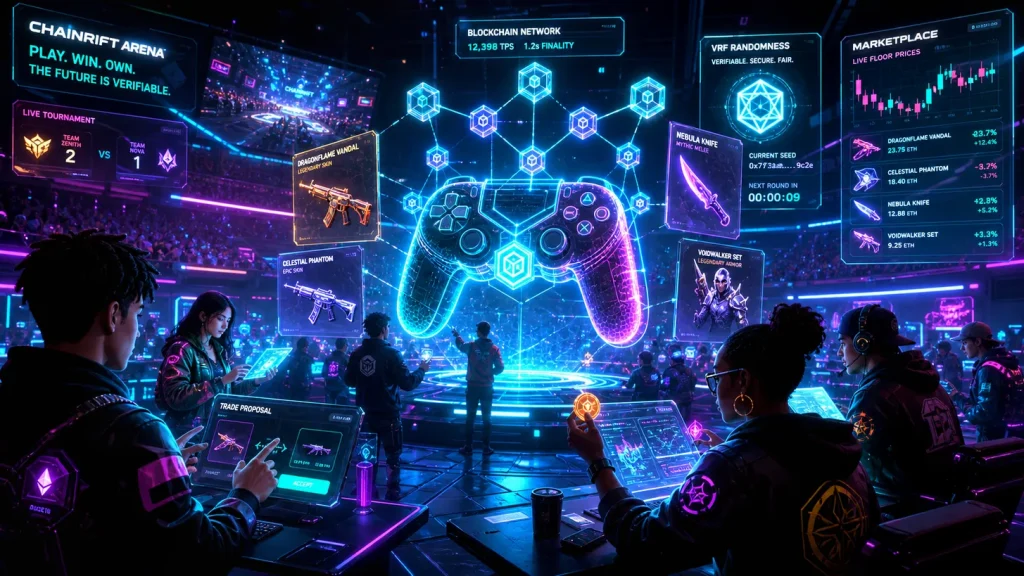
Online games are evolving faster than ever, and the question most players and studios are asking is simple: how blockchain is changing online gaming in real terms—not just hype. In this deep-dive, we explore what Web3 actually unlocks for developers, pro players, and everyday gamers. From true digital ownership to provably fair mechanics, from interoperable skins to player-run economies, this is where gameplay meets verifiable code and open markets.

- 20% fee cashback
- $60,000 futures bonus

- 20% trading fee discount
- $100 signup bonus
- $10,000 futures bonus

- 20% fee cashback
- $10,000 bonus

- 20% fee cashback
- $8,000 bonus

- 20% trading fee discount
- $30,050 signup bonus

- 50% trading fee discount
- 20% fee cashback
- $6,200 futures bonus
Quick note for deal hunters: if you’re setting up your crypto rails for Web3 games, you can grab a 20% fee discount and up to $10,000 in benefits with this sign-up: Binance registration with code CRYPTONEWER.
TL;DR for the curious
- Focus keyword: how blockchain is changing online gaming
- Real value drivers: digital ownership, provable fairness, open marketplaces, interoperable assets
- Tech enablers: Layer 2 rollups, account abstraction, oracles, low-cost minting
- Design patterns: “own-to-play” over grind-to-earn, sustainable tokenomics, asset sinks
- Onboarding: centralized exchange on-ramps, gas-abstracted wallets, fiat ramps
From free-to-play to own-to-play
Free-to-play turned games into billion-dollar businesses, but players never truly owned the core assets that shaped their identity or skills. Blockchain flips the script with verifiable ownership:
– NFTs as game objects: characters, skins, land, items, badges
– On-chain provenance: tradable history and rarity tracked on public ledgers
– Secondary markets: players can sell or loan items without gray-market risk
This new model—own-to-play—doesn’t mean “pay-to-win.” Done right, it means fairer, more transparent digital property rights where skill, time, and creativity can translate into liquid value.
Why ownership matters for gameplay
- Skill expression: items and reputational NFTs can reflect accomplishments that live beyond a single title or server wipe.
- True interoperability: a skin, pet, or emote designed for Game A might unlock cosmetics or buffs in Game B via shared metadata and open standards.
- Player-created economies: guilds, creators, modders, and esports teams can build businesses around open assets and licensable IP.
Provably fair mechanics and transparent odds
“Provably fair” isn’t marketing language—it’s mathematics on a public ledger. Blockchain games can use on-chain oracles (for example, verifiable random functions) to generate randomness that anyone can independently verify. That means:
– Publicly auditable drop rates
– No shadow-balancing of loot boxes after the fact
– Inspectable smart contracts governing rewards, staking, and payouts
When the rules are code, fairness becomes checkable, not just promised.
Interoperability without the handcuffs
The dream is a metaverse of interoperable assets. The reality requires standards, metadata, and incentives aligned across studios. We’re getting closer with:
– Open metadata schemas that standardize attributes (rarity, power levels, cosmetics)
– Cross-game collaborations and brand activations that read the same token and grant game-specific perks
– Chain-agnostic bridges and Layer 2 ecosystems enabling low-cost transfers
Practical takeaway: aim for “contextual interoperability.” A sword in a fantasy RPG should not become an assault rifle in a sci‑fi shooter—but it can map to a cosmetic, a badge, or a social status that respects the new game’s balance.
Play-to-earn was a lesson, not a blueprint
The first wave of play-to-earn (P2E) models proved that open markets can move serious value—but they also showed how extractive loops break. Sustainable Web3 game economies focus on:
– Utility-first tokens (access, crafting, governance), not just emissions
– Asset sinks: fusing, crafting, upgrading, durability, and seasonal rotations
– Demand anchored in fun, mastery, and social status—not pure yield
– Longer-tail rewards: e.g., tournament tickets, exclusive cosmetics, or narrative unlocks
Think “play-and-own” or “play-and-create” over “play-to-earn.” Fun and community drive demand. Scarcity alone does not.
The tech stack powering blockchain gaming
To understand how blockchain is changing online gaming under the hood, here’s the core stack gamers and studios are adopting:
-
Wallets and identity
- Smart contract wallets with account abstraction remove seed phrases and reduce friction
- Social and email logins with gas fee sponsorship (meta-transactions)
- Session keys for safer play sessions and marketplace actions
-
Chains and scaling
- Layer 2 rollups (Optimistic and ZK) for low gas fees and fast confirmations
- App-specific chains and sidechains for throughput and customizability
- Interoperability protocols for cross-chain asset movement
-
Oracles and randomness
- Verifiable randomness (VRF) for loot, matchmaking, and tournaments
- Price feeds and metadata oracles for dynamic item stats and seasonal balancing
-
Storage and media
- On-chain pointers with off-chain media (IPFS/Arweave) to keep assets portable and resilient
- Composability so games can remix open assets while respecting licenses
Marketplaces, royalties, and creator income
Open marketplaces change how value flows:
– Primary drops can seed a player economy without locking everything behind paywalls
– Secondary royalties may be enforced via in-game logic and allowlists, even as marketplaces evolve
– Creator tooling lets artists and modders issue licensed skins and share revenue
Studios can focus on design and live ops while players and creators build the long tail of content.
Esports, streaming, and fan tokens
Web3 slots neatly into competitive scenes and creator ecosystems:
– On-chain tournament prize pools with transparent payouts
– Tradable team passes and fan tokens that unlock meet-and-greets, exclusive drops, or voting power on event maps
– Proof-of-attendance NFTs for events and streams, building loyalty without bots
Safety, compliance, and age-appropriate design
With open markets comes accountability:
– Regional regulations and tax rules vary—games should build compliance checks and disclosures into UX
– Age gates, spending limits, and parental controls protect minors
– Custodial and non-custodial options let users choose their risk profile
– Audit smart contracts and use bug bounties; never ship unreviewed code controlling assets
Costs and performance: the gas reality check
Blockchain fees (gas) can break immersion if not handled gracefully. Modern patterns include:
– Gasless minting and transactions, sponsored by studios during onboarding
– Batching and session approvals to minimize signature spam
– Storing heavy logic off-chain and only settling core ownership or trades on-chain
The goal is simple: Web3 magic with Web2 smoothness.
Designing fair economies players actually love
A few battle-tested principles for sustainable tokenomics in gaming:
– Dual-token or no-token setups where “value” and “governance” are distinct
– Seasonal resets that preserve identity while refreshing the meta
– Crafting loops and limited-time events that encourage play, not just speculation
– Transparent emission schedules and dashboards players can audit
What this means for indie vs. AAA studios
- Indie studios gain distribution and monetization primitives without negotiating with a single platform gatekeeper
- AAA teams can build transmedia IP where game assets, collectibles, and real-world events talk to each other on a shared substrate
- Both can leverage community funding and modular content pipelines
Getting started as a player
Here’s a quick, safe path to jump into blockchain gaming:
1. Choose a wallet with simple onboarding (look for email/social logins and account abstraction).
2. Pick a chain with low fees and active gaming ecosystems (Layer 2 rollups are popular choices).
3. Use a reputable exchange to on-ramp small amounts first. You can secure a 20% trading fee discount and up to $10,000 in bonus benefits via this promo: Binance sign-up with code CRYPTONEWER.
4. Start with free mints and testnet experiences to learn flows without risking funds.
5. Stick to games with public documentation, audits, and clear asset policies.
Getting started as a developer
- Prototype economy off-chain first, then migrate ownership logic on-chain
- Implement verifiable randomness for loot and matchmaking
- Add gas abstraction and session keys early so testers don’t churn
- Instrument telemetry and on-chain analytics to monitor sinks, sources, and churn
- Consider open asset standards and cross-game compatibility from day one
Common myths about blockchain gaming
- “It’s all speculation.” Many successful titles hide blockchain under the hood and focus on fun; markets are optional layers.
- “Interoperability ruins balance.” Contextual mapping preserves balance while granting cross-title identity and perks.
- “Gas fees make it unplayable.” With Layer 2 and gas sponsorship, most actions can feel instant and cost pennies—or nothing.
- “Regulation will kill it.” Clearer rules tend to reward studios with transparent, auditable systems.
Metrics that matter more than floor price
- Retention: day-7/day-30 cohorts relative to comparable Web2 genres
- On-chain activity health: unique players, trade distribution, asset turnover
- Sink/source ratios: is the economy net-issuance or stabilizing?
- Social graph growth: guild participation, creator drops, tournament sign-ups
Real-world use cases to watch
- Skins that travel across a publisher’s portfolio as cosmetics with cross-game lore
- Tournament tickets and seating lotteries powered by verifiable randomness
- Seasonal battle passes issuing on-chain badges redeemable for offline perks
- Community-crafted dungeons or maps licensed via NFTs with transparent rev-share
Risks and how to manage them
- Smart contract bugs: prioritize audits, time-locked upgrades, and circuit breakers
- Market volatility: design for fun-first; ensure assets have non-speculative utility
- Phishing and scams: verify URLs, use hardware or passkey-based wallets, limit approvals
- Over-financialization: keep progression, narrative, and mastery at the core
Where the next wave is heading
- Account abstraction as the norm for logins and recoveries
- ZK proofs enabling private leaderboards and anti-cheat without leaking data
- Chain-specific performance boosts that let heavy simulations sync to on-chain ownership snapshots
- Better royalty mechanisms and creator splits built at the protocol level
Your on-ramp to Web3 games
If you’re building your first toolkit for Web3 gaming—whether you’re a player, collector, or indie dev—set up a trusted on-ramp and start small. Claim discounts where available and keep fees predictable while you experiment. A straightforward option with strong liquidity and broad asset support is here: Binance registration with code CRYPTONEWER for a 20% fee discount and up to $10,000 in benefits.
This is how blockchain is changing online gaming right now: from isolated items to portable identity, from opaque odds to provably fair randomness, and from closed economies to player-powered markets. The winners will be the teams who ship fun first—and quietly let the chain handle trust, ownership, and open value.
Related posts:
 How to Reduce Trading Fees on Binance: Proven, Actionable Strategies You Can Use Today
 The History of Blockchain: Before and After Bitcoin — An Essential Guide to How We Got Here
 Proven insights About Pepe coin history, tokenomics, risks, and how to buy PEPE in 2026
 What is the CHILLGUY (CHILLGUY) Coin, and how to buy — an Actionable, No‑Hype Guide