
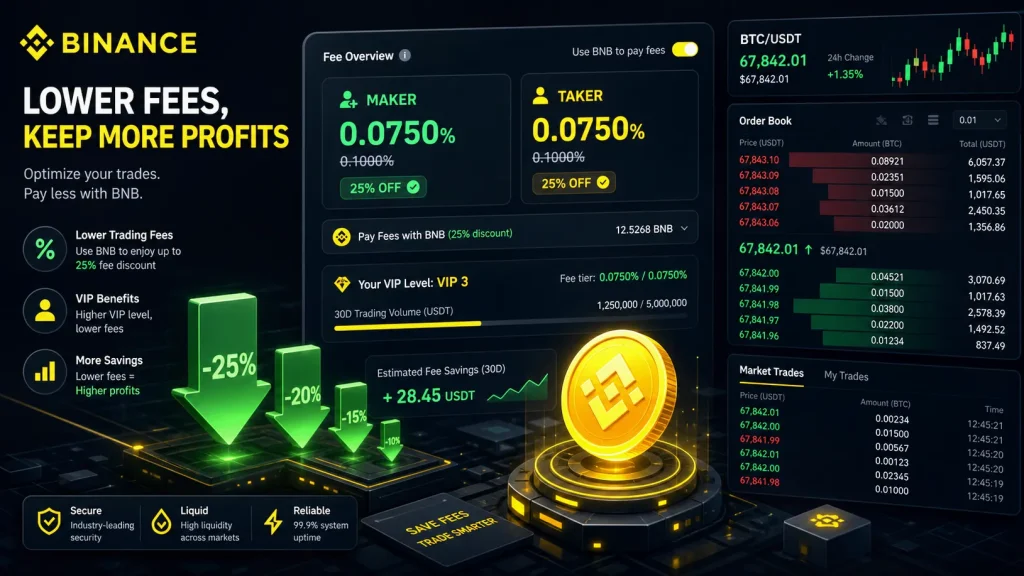
If you’re serious about improving your returns, learning how to reduce trading fees on Binance is one of the highest-ROI steps you can take. Fees compound quietly in the background—draining performance day after day—yet with a few smart tweaks, you can often cut your effective costs by 30–60% (and sometimes more) without trading less or taking extra risk.

- 20% trading fee discount
- $100 signup bonus
- $10,000 futures bonus

- 20% fee cashback
- $8,000 bonus

- 50% trading fee discount
- 20% fee cashback
- $6,200 futures bonus

- 20% fee cashback
- $60,000 futures bonus

- 20% fee cashback
- $10,000 bonus

- 20% trading fee discount
- $30,050 signup bonus
In this guide, you’ll get a complete, step-by-step playbook to lower spot, margin, and futures fees on Binance, understand maker/taker dynamics, climb VIP tiers efficiently, and avoid hidden costs like spread and slippage that can dwarf advertised rates. You’ll also find a ready-to-use checklist you can implement in minutes.
Tip: New to Binance or setting up a new account? Secure an immediate fee advantage before your first trade. Register with the referral code CRYPTONEWER to get a 20% fee discount plus up to $10,000 in benefits: Join Binance with code CRYPTONEWER.
Why fee optimization matters more than you think
- Small percentages add up: A 0.10% taker fee on $500,000 monthly volume is $500 in costs. Over a year, that’s $6,000—before considering compounding.
- Volume compounds: As your trading size grows, every basis point (0.01%) you shave off becomes increasingly valuable.
- Freeing up edge: Lower fees raise your net PnL and allow more room for error when testing strategies.
Your goal is to systematically stack structural discounts (referrals, BNB deduction, VIP tiers) with smart execution (maker orders, timing, liquidity checks) so your net effective fee is as low as possible on every trade.
Binance fee basics you need to know
- Maker vs. taker fees: Maker orders add liquidity (e.g., limit orders that rest on the book). Taker orders remove liquidity (market or marketable limit orders). Taker fees are typically higher than maker fees.
- Spot vs. futures vs. margin:
- Spot trading fees are usually quoted in the quote asset you trade against (e.g., USDT), and can be discounted by paying with BNB.
- USDⓈ-M and COIN-M futures have separate maker/taker schedules; BNB fee deduction and VIP status impact these too.
- Margin adds borrowing interest—focus on total cost (fees + interest + funding) rather than fees in isolation.
- Promotions and zero-fee pairs are dynamic: Binance often runs limited-time zero/discounted-fee promotions on specific pairs. Always check the pair details before placing larger orders.
Useful references:
– Official fee schedule: Binance Fee Rates
– BNB fee deduction info: Using BNB to Pay Fees
(Exact percentages can change; always confirm the current schedule.)
Strategy 1 — Lock in a permanent base discount with a referral
If you’re opening a new account, start here. Using a high-rebate referral code can give you an immediate, permanent kickback on every trade you make.
- Use referral code CRYPTONEWER at sign-up to receive:
- 20% trading fee discount (cashback on the fee you pay)
- Up to $10,000 in additional benefits and rewards
- Link for quick access: Join Binance with code CRYPTONEWER
How it stacks: The referral kickback applies to your fee after any other discount is applied (e.g., BNB fee deduction), reducing your effective net cost. This compounding effect is how you push effective spot fees toward 0.06% or better at entry-level tiers when combined with maker execution.
Strategy 2 — Turn on “Pay fees with BNB” for automatic discounts
BNB fee deduction is one of the simplest and biggest levers you can pull. When toggled on, Binance deducts fees in BNB and applies a discount to your trading commission (the exact rate may vary by product and over time; spot has historically offered a 25% reduction, futures a smaller but meaningful discount—check the latest in your account settings).
How to enable it (web):
1. Log in to Binance
2. Go to Profile (top right) > Dashboard
3. Find “Using BNB to pay fees” and toggle ON
4. Keep a small BNB balance to avoid reversion to standard rates
In the app: Profile > Settings > Pay Fees in BNB > ON.
Pro tip: Top up BNB slightly above your expected weekly or monthly fee spend so you don’t accidentally pay full price mid-session.
Strategy 3 — Favor maker orders and use Post-Only to avoid taker fees
Because taker fees are typically higher, prioritizing maker orders can save a lot—especially for active traders.
- Use limit orders with “Post Only” or “Reduce-Only + Post-Only” (for futures) to ensure your orders rest on the book and don’t execute immediately as takers.
- On API, use timeInForce=GTX to force post-only behavior.
- Caveat: Maker orders may not fill fully or at all if price runs away—balance fee savings against execution risk.
Execution tip: If you must cross the spread, consider partial maker entries (scale in with resting limits) to blend your effective fee lower rather than paying taker on the entire size.
Strategy 4 — Climb VIP tiers strategically
Binance VIP tiers reduce fees as your 30-day volume and/or BNB balance increase. Even moving from VIP 0 to VIP 1 can shave meaningful basis points off. The compounding effect is powerful at scale.
A simple planner:
– Estimate 30-day volume (spot + futures)
– Check current VIP thresholds and fee tables (they change; see the official schedule)
– Calculate savings per tier and what it would take to reach/maintain it (consider the opportunity cost of holding BNB if that’s part of the requirement)
– If you’re close to the next tier near month-end, batching volume or consolidating venues for a few days may push you over the line
Strategy 5 — Target fee-promoted or zero-fee pairs when practical
Binance routinely offers zero- or discounted-fee trading on select pairs. If a promoted pair already aligns with your strategy, route more volume through it to harvest near-zero fees. Always confirm liquidity and spread—zero commission doesn’t offset wide spreads or thin books.
How to check:
– On the trading page, look for fee tags or announcements on the pair
– Monitor Binance Announcements for new campaigns
Strategy 6 — Use Convert vs. Spot selectively for small tickets
Binance Convert can be cheaper than paying a taker fee on very small trades because you pay via spread rather than an explicit commission. This isn’t always the case—convert spreads can sometimes be wider. Compare:
– Spot taker fee cost = Notional × taker rate
– Convert cost ≈ Half-spread × Notional
If you only need to swap tiny amounts (e.g., dust consolidation or quick rebalancing), Convert may be the lower-cost route. For larger trades, spot (with maker orders) usually wins.
Strategy 7 — Batch orders to avoid rounding and micro-fee inefficiencies
Fees are proportional to notional but can be affected by minimum fee increments and quote-asset rounding. Replacing many tiny trades with fewer, larger clips can reduce rounding overhead and operational complexity—especially on illiquid pairs. Keep risk management first; don’t batch so much that you increase slippage risk.
Strategy 8 — Choose the right network when moving assets (total cost view)
While not a “trading fee,” withdrawal network fees can erase the savings you worked hard to secure on exchange. When funding or withdrawing, compare networks (e.g., native chain vs. L2) for the target asset to minimize on-chain costs and delays. Cheaper and faster rails mean you keep more of your capital compounding.
Strategy 9 — Earn rebates and vouchers through Binance programs
- Rewards Hub and Task Center often feature fee rebate vouchers, trial funds, and other perks that offset trading costs
- Liquidity programs: If you provide meaningful liquidity and qualify for market maker programs, your maker rates can drop sharply
- Campaigns: Time-limited futures campaigns sometimes include extra fee kickbacks
Check regularly; stacking these with BNB deduction and referral adds up.
Strategy 10 — Mind the hidden costs: spread, slippage, funding, interest
Fee minimization isn’t everything. Prioritize best-execution:
– Spread: A tight spread with maker execution often beats a zero-commission but wide-spread alternative
– Slippage: Aggressively crossing the book incurs implicit costs that can exceed explicit fees
– Perpetual funding: Positive/negative funding can dwarf your commission line item
– Margin interest: For leveraged spot, borrowing rates can outweigh small fee savings
Always evaluate total cost of trade (TCT): commission + spread + slippage + borrowing/funding.
Putting it together: an example stack
Assume you’re at VIP 0, trading spot with occasional futures:
– Baseline spot fee: 0.10%
– Turn on BNB deduction (historically -25% on spot): effective 0.075%
– Use referral code CRYPTONEWER for 20% cashback on paid fees: 0.075% × (1 – 0.20) = 0.060%
– Prefer maker execution where possible: if maker and taker are equal at VIP 0 on spot, your net remains 0.060%; as you reach higher VIP levels, maker can drop below taker, improving this further
On futures, the math is similar but with different base rates and discounts. The key is that BNB deduction + referral cashback + maker preference can push your effective fees meaningfully below headline numbers.
Step-by-step setup (5 minutes)
- New account: Register on Binance with code CRYPTONEWER to lock in 20% fee discount and up to $10,000 in benefits
- Enable BNB fee deduction: Profile > Dashboard > “Using BNB to pay fees” ON
- Maintain a BNB buffer: Deposit or Convert a small BNB amount for fee coverage
- Execution defaults: Use Post-Only for spot/futures limit orders where feasible
- Monitor fees: Check the Fee Schedule page and your VIP progress monthly
- Seek promos: Review Announcements and Rewards Hub for vouchers and zero-fee pairs
Maker/taker tactics that actually work
- Place resting limits just inside the spread to increase fill probability without flipping to taker
- Scale orders: ladder entries/exits to balance fill rate and maker eligibility
- For futures scalpers: combine Reduce-Only with Post-Only for controlled exits that don’t cross the spread unless necessary
- In APIs and bots: set default order parameters to maker-friendly and only allow taker in defined edge cases
Avoid these common mistakes
- Forgetting to toggle BNB fee deduction or running out of BNB mid-session
- Believing zero-fee pairs are always cheapest—check spread and depth
- Over-optimizing for fees at the expense of slippage or funding
- Splitting orders into dozens of tiny tickets that increase rounding costs and complexity
- Ignoring VIP thresholds right before month-end
Quick FAQ
-
Can I apply a referral code after I’ve already registered?
- No. Referral benefits are set at registration. If you’re new, use CRYPTONEWER at sign-up: Start here
-
What happens if my BNB balance hits zero?
- Fees revert to the standard rate until you top up. Keep a small buffer.
-
Do discounts apply to all products?
- Discounts vary by product (spot, margin, futures) and change over time. Check your account’s fee page for the latest specifics.
-
Are zero-fee promotions permanent?
- No, they’re time-bound and pair-specific. Confirm before routing size.
The set-and-forget checklist
- Referral locked: CRYPTONEWER
- BNB deduction ON and funded
- Maker-first execution (Post-Only default)
- VIP progress monitored monthly
- Announcements and Rewards Hub checked weekly
- Convert vs. Spot compared for micro-swaps
- Network fees minimized when moving funds
With these switches flipped and habits in place, you’ll have a durable, low-friction setup that keeps your effective costs near the floor while you focus on finding and executing good trades.
Resource links:
– Fee schedule and VIP tiers:
– Official announcements (promos/zero-fee pairs):
– New account with fee discount code: Join Binance with CRYPTONEWER
Related posts:
 Proven Steps — How to Set Stop-Loss and Take-Profit on Binance
 Binance Staking vs Savings Actionable Breakdown for Smarter Passive Income
 Proven Bitget Account Creation Guide with Security Tips and Bonus Maximization
 Binance listed coins 2026: Insider breakdown of new listings, exact dates, and smarter ways to trade them