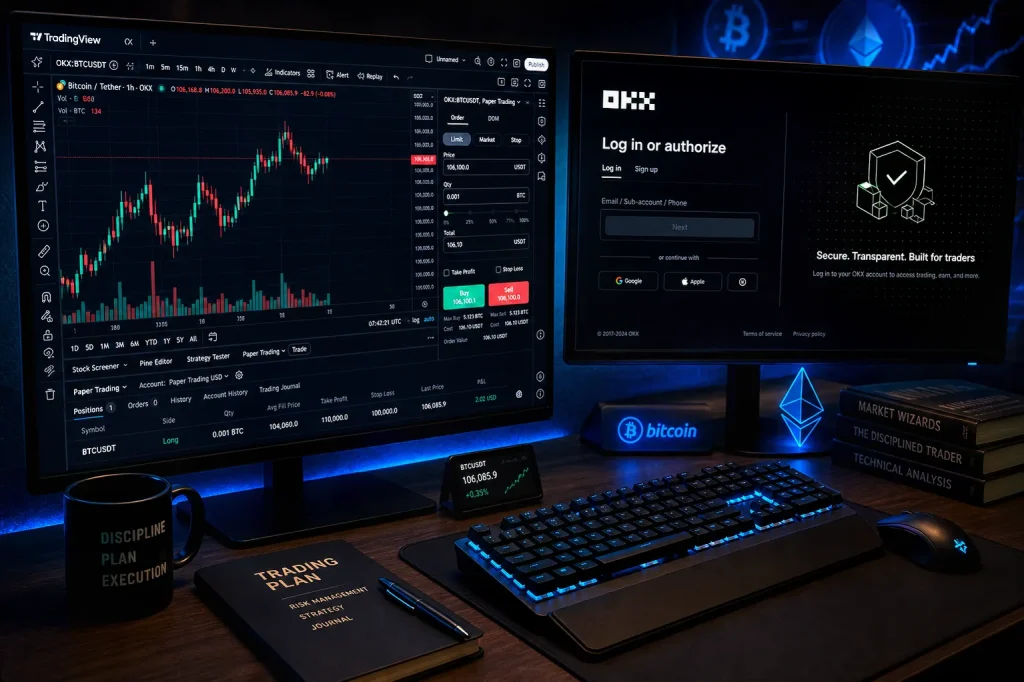
If you’ve ever wished you could analyze crypto charts and place orders from the same screen, you’re in the right place. This guide shows you exactly how to connect OKX to TradingView so you can trade spot and derivatives (where available) directly from your charts. We’ll cover setup, permissions, order types, fees, security, and troubleshooting—everything you need to go live with confidence.

- 20% fee cashback
- $8,000 bonus

- 20% trading fee discount
- $100 signup bonus
- $10,000 futures bonus

- 20% fee cashback
- $60,000 futures bonus

- 20% trading fee discount
- $30,050 signup bonus

- 20% fee cashback
- $10,000 bonus

- 50% trading fee discount
- 20% fee cashback
- $6,200 futures bonus
Pro tip: New to OKX or opening a fresh account for this workflow? Sign up with our partner link for extra savings and trading capital:
- Get 20% fee cashback and up to $60,000 futures bonus when you join OKX using code CRYPTONEWER: Join OKX with code CRYPTONEWER
This long-form tutorial uses the focus keyword “How to Connect OKX to TradingView” throughout and includes practical steps you can follow right away.
Why connect OKX to TradingView
Linking OKX to TradingView gives you a unified workspace to:
- Trade directly from the chart using limit, market, stop, and OCO orders
- See positions, balances, and order history in the TradingView “Trading Panel”
- Align technical analysis with execution without switching tabs
- Use alerts and scripts to streamline entries, then click-to-execute
- Access OKX symbols on TradingView with real-time data and depth (where provided)
It’s a smooth, pro-level workflow for discretionary and systematic crypto traders alike.
What you’ll need before you start
- An OKX account with security enabled (2FA) and any required verifications complete
- A TradingView account (free works; some features require paid tiers)
- Stable desktop browser (Chrome, Edge, Firefox, or Safari). Desktop is recommended for the Trading Panel
- Funds on OKX in the assets you plan to trade
- If you plan to trade derivatives, make sure derivatives are enabled in your OKX account and your region supports them
Speed up your setup and get fee savings:
– Use OKX signup — 20% fee cashback + $60k futures bonus with code CRYPTONEWER
Step-by-step: How to connect OKX to TradingView
This is the most common and user-friendly method via the TradingView Trading Panel.
1) Open TradingView and load a chart
– Go to tradingview.com and open any chart. If you’re planning to trade BTCUSDT on OKX, search the OKX symbol such as OKX:BTCUSDT.
2) Open the Trading Panel
– At the bottom of the screen, click “Trading Panel.” You’ll see a list of supported brokers and exchanges.
3) Select OKX
– Find “OKX” in the list and click “Connect.” A login window or authorization prompt will appear.
4) Log in and authorize
– Sign in to your OKX account within the pop-up. You’ll be asked to authorize TradingView to access trading and read-only data (balances/orders). Review permissions, then confirm.
5) Choose account and mode
– If you have sub-accounts, select the one you want to trade. For derivatives, ensure your margin mode (single/isolated/cross) and position mode (one-way/hedge) are set in OKX. Some of these settings can be adjusted within the TradingView order panel after connection, but it’s best to verify in OKX first.
6) Confirm in the Trading Panel
– Once connected, TradingView will display your balances, open orders, and positions from OKX. You can now place orders directly from the chart or via the order ticket.
7) Place a small test order
– Use a tiny position size to confirm everything works—routing, order types, and margin behavior—before scaling up.
That’s it. You’ve completed the core steps for connecting OKX to TradingView.
Alternative connection path with API keys (only if prompted)
In some regions or account configurations, TradingView may ask you to connect via API keys. If you see an API requirement in TradingView:
- Go to your OKX account > API section
- Create a new API key with “Read” and “Trade” permissions only
- Never enable withdrawal permissions for TradingView
- Store your secret key securely and add it only in the TradingView connector
Important: Use API keys only if TradingView specifically instructs you. The standard OAuth-style login via the OKX tile in TradingView is the preferred, easier method.
Configure TradingView for precise execution
- Symbols and venues: Ensure you’re trading the OKX symbol (e.g., OKX:ETHUSDT). Using another venue’s symbol may lead to confusion when placing orders.
- Order types: Market, Limit, Stop, and OCO are commonly available. Check the order ticket to confirm the exact selection OKX supports in your region.
- Time in Force (TIF): GTC, IOC, FOK may appear. Choose what matches your strategy.
- Quantity and precision: Many crypto pairs have minimum notional and step sizes. If your order isn’t accepted, adjust size to meet OKX’s filters.
- Margin and leverage: For futures/perpetuals, verify cross vs isolated and your leverage setting. TradingView may display or allow quick changes; always confirm before sending orders.
- Chart trading: Drag-and-drop limit orders on the chart, set stops/take-profits visually, and confirm in the preview.
Fees, cashback, and bonus funds
Trading costs directly affect your PnL. OKX offers competitive maker/taker fees and tiered discounts, plus you can stack savings and bonuses:
- Use code CRYPTONEWER to get 20% fee cashback and up to $60,000 futures bonus: Join OKX with code CRYPTONEWER
- Maker vs taker: Limit orders that rest can earn maker rates; market orders typically incur taker rates
- Rebate math example: If your taker fee is 0.05% and you trade $50,000 notional, the gross fee is $25. With 20% cashback, your effective cost drops by $5—meaningful over many trades
Combine fee savings with good execution on TradingView to improve net outcomes.
Common errors and quick fixes
-
“Insufficient permissions” or read-only mode
- Ensure you authorized trading permissions during the OKX connection prompt
- If using API keys, confirm Trade permission is enabled
-
“Not enough balance” despite funds on OKX
- Check you’re in the right sub-account and right asset
- For derivatives, ensure collateral is in the correct margin wallet and mode
-
Order rejected due to filters
- Adjust price/size to meet OKX’s minimums and step sizes
- Verify leverage limits and risk tiers for that instrument
-
Position mode mismatch (hedge vs one-way)
- Align position mode in OKX and TradingView. Mode conflicts can cause rejections or unexpected netting
-
Region restrictions
- Some products (e.g., certain derivatives) may be unavailable depending on your jurisdiction. Check OKX’s Terms and supported regions
-
Two-factor issues on login
- Make sure 2FA apps and backup codes are accessible when TradingView pops up the OKX login window
Security best practices when trading via TradingView
- Enable 2FA (TOTP) on OKX and TradingView
- Use strong, unique passwords and a reputable password manager
- If you must use API keys, restrict to Read/Trade only and rotate keys periodically
- Never share keys or screenshots containing secrets
- Double-check the browser address bar when logging in via pop-up windows
Long-tail tips for smoother TradingView x OKX workflows
- Layouts and watchlists: Create a dedicated layout for OKX trading with custom watchlists (e.g., “OKX Perp Majors,” “OKX Alt Spot”).
- Alerts to action: Let alerts handle monitoring. When your level triggers, execute via the Trading Panel with a pre-filled ticket.
- Strategy to manual handoff: Backtest with TradingView strategies, then use their signals as a cue for manual orders through the OKX connector.
- DOM and depth: If you focus on microstructure, pair chart trading with order book depth (where available) to refine entries.
- Paper Trade first: Validate your flow with TradingView Paper Trading, then switch the broker to OKX using the same charts and routines.
Frequently asked questions about connecting OKX to TradingView
-
Can I place OKX trades from TradingView?
- Yes, once connected via the Trading Panel, you can submit, modify, and cancel orders from TradingView. Availability of instruments and order types depends on your region and account permissions.
-
Do I need TradingView Pro to connect OKX?
- Many broker connections work on free plans, but some advanced features (extra alerts, more indicators, multiple charts) are Pro/paid.
-
Can I connect on mobile?
- The cleanest experience is on desktop web. TradingView’s mobile app supports broker connections in many cases, but desktop is recommended for setup.
-
Where do I see my positions and PnL?
- In the Trading Panel under Orders and Positions. You can also manage OCO brackets from there or directly on the chart.
-
Do I need API keys?
- Not usually. TradingView commonly uses a direct login/authorization flow. Only create API keys if TradingView instructs you to during the connection.
Quick checklist to finish your setup today
- Create or log in to OKX and enable 2FA
- Fund the account or transfer assets to the target sub-account
- Open TradingView, pick your OKX symbol, and connect via the Trading Panel
- Authorize trading, confirm margin/position mode
- Place a tiny test trade and verify fills
- Optimize fees with the best current promo: Join OKX with code CRYPTONEWER
Helpful resources
- TradingView Support Center: Getting started with broker connections — https://www.tradingview.com/support/
- OKX Learn & Academy — https://www.okx.com/learn
- OKX Fees — https://www.okx.com/fees
- OKX API Docs (if needed) — https://www.okx.com/docs
Whether you’re scalping on lower timeframes or swing trading majors, mastering how to connect OKX to TradingView unlocks a smoother, faster, and more disciplined execution flow. Save on fees, centralize your analysis and orders, and give yourself every edge possible by connecting the two today. And don’t forget to claim your benefits with code CRYPTONEWER: OKX signup — 20% fee cashback + $60k futures bonus.
Related posts:
 Bybit Mobile App Trading Guide Proven Tactics for Faster Crypto Trades
 What is the TOMO(TomoChain) Coin, and how to buy Essential Guide for 2026
 Understanding MEXC Trading Fees: Essential Insights and Proven Ways to Pay Less
 How to Start Trading on OKX Spot Market with Proven Steps to Trade Confidently