
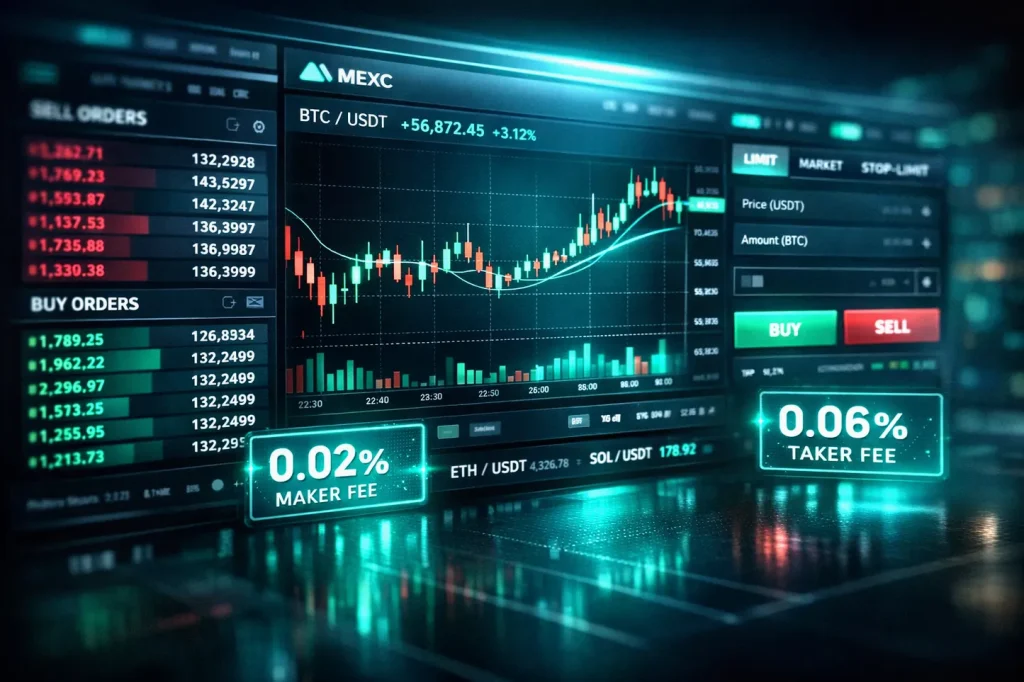
If you’re actively buying or selling crypto on MEXC, the difference between a taker trade and a maker trade, or a small VIP bump, can quietly add up to hundreds or thousands of dollars over a year. Understanding MEXC trading fees isn’t just “nice to know”—it’s one of the highest‑leverage moves for any trader who wants to keep more of their gains.

- 20% trading fee discount
- $100 signup bonus
- $10,000 futures bonus

- 20% fee cashback
- $8,000 bonus

- 20% fee cashback
- $10,000 bonus

- 20% fee cashback
- $60,000 futures bonus

- 50% trading fee discount
- 20% fee cashback
- $6,200 futures bonus

- 20% trading fee discount
- $30,050 signup bonus
Below, you’ll find a clear, field‑tested walkthrough of the full fee picture on MEXC—spot, futures (perpetuals), funding, leveraged ETFs, VIP tiers, MX token discounts, and hidden costs many traders miss. You’ll also get practical strategies and worked examples you can copy today to lower your effective rate per trade.
Fast win: Create or switch your account using this partner link to lock in an immediate discount on fees. New users who sign up with Claim 20% fee cashback on MEXC + up to $8,000 bonus and use referral code mexc-CRYPTONEWER can stack savings with existing discounts when available.
Why fees matter more than you think
- Fees are guaranteed; profits aren’t. Reducing friction is a direct, risk‑free boost to net returns.
- Compounding works against you when fees are high—especially for high‑frequency or grid strategies.
- Many traders fixate on entries but ignore fee tiering, order type, and funding timing—three levers with outsized payoff.
The MEXC fee stack at a glance
Understanding MEXC trading fees starts with the components that can affect your final cost per trade:
- Spot trading fees: Maker vs. taker on standard crypto pairs.
- Futures (perpetual) fees: Maker vs. taker on contracts, plus funding.
- Funding rate (futures): Periodic payments between longs and shorts.
- Leveraged ETF fees: Daily management/rebalancing costs.
- Deposits/withdrawals: Network fees and dynamic withdrawal charges.
- VIP levels and MX token discounts: Tiered rates and token‑based reductions.
- Promotions and referral rebates: Stacked savings through campaigns and partner links.
Exact percentages can change with market conditions and promotions. Always confirm your live rate in app: Profile > Fee Level or on the MEXC fee schedule page.
Maker vs. taker: the foundation
- Maker order: Adds liquidity by placing a limit order that doesn’t execute immediately; generally earns a lower fee rate than taker trades.
- Taker order: Removes liquidity by matching an existing order in the book; typically the higher fee rate.
On MEXC, maker/taker rules apply to both spot and futures. Your goal: engineer more maker fills when they make sense and use taker only when urgency is worth the extra basis points.
Spot trading fees on MEXC
- Base structure: Historically, MEXC has run aggressive promotions on spot fees (including 0% on selected pairs or periods). Outside promos, the industry‑standard baseline often centers around low double‑digit bps for takers and lower for makers.
- Pair‑specific promos: Some pairs have reduced or zero fees during campaigns; always check the pair’s detail page.
- MX token discounts: When enabled, “MX Deduction” can reduce the fee further (commonly around 10% off the base, subject to change). Toggle it on in your Fees/Settings panel if you hold MX.
Tip: If you scalp or rebalance often, even small maker discounts compound fast. Use post‑only when possible to avoid accidental taker fills.
Futures (perpetual) trading fees on MEXC
- Base fees: Many traders see figures in the neighborhood of 0.02% maker and 0.06% taker (illustrative; verify your live rate). VIP upgrades and MX deductions can shrink these further.
- Funding rate: A separate periodic payment between longs and shorts to keep perpetual prices aligned with spot. The rate and interval vary by contract and market conditions. Funding can be positive or negative—so time your entries and holding periods.
- Liquidation & insurance: Avoid unnecessary leverage; liquidation penalties are steep compared with standard fees.
Leveraged ETFs on MEXC
- Management fee: Leveraged tokens (e.g., 3x long/short) typically have a daily management and rebalancing cost (commonly around 0.1–0.3% daily; check the token’s info panel). These are separate from trading fees.
- Slippage risk: Because of embedded leverage and rebalancing, slippage around volatile periods can exceed the headline fee.
Deposits and withdrawals
- Crypto deposits: Usually free from the exchange side; network confirmations apply.
- Crypto withdrawals: Dynamic, network‑based fees; pick cost‑efficient chains (e.g., use Layer 2 or low‑fee L1s when supported).
- Fiat on/off‑ramp: Third‑party processors may charge their own fees.
VIP levels and MX token: how your tier changes the math
MEXC uses volume‑based VIP tiers and sometimes MX token holdings to set your fee bracket. In practice:
- 30‑day trading volume: Cross a threshold to unlock lower maker/taker rates.
- MX token: Holding a qualifying amount can support higher VIP tiers or unlock fee deductions.
- Combined effect: High volume + MX token + promotions can bring your effective rate close to zero on some pairs or materially reduce futures costs.
Action steps:
1) Check your current 30‑day volume and VIP tier in Profile > Fee Level.
2) Toggle on MX Deduction if you hold MX and it’s beneficial for your pairs.
3) Consider concentrating volume on MEXC to reach the next VIP bracket faster.
Proven strategies to lower your MEXC fees immediately
- Use a referral rebate: New users can join via Claim 20% fee cashback on MEXC + up to $8,000 bonus with code mexc-CRYPTONEWER to stack savings with other discounts.
- Favor maker orders: Use post‑only limit orders to target maker fills where execution risk is acceptable.
- Scale into positions: Place staggered limit orders to capture maker rebates across a range.
- Concentrate volume: Push your 30‑day volume over the next VIP threshold.
- Hold MX for deductions: Enable MX Deduction where it nets a lower effective rate than paying in quote.
- Pick cost‑efficient networks: For withdrawals, choose L2s or low‑fee chains when possible.
- Time funding: If you trade futures, consider the funding clock—entering after a funding debit can save you basis points.
- Prefer promo pairs: When fees are zeroed or reduced, route strategies (DCA, grid, rebalancing) through those pairs.
Worked examples: what you actually pay
The following are illustrative examples to show the mechanics. Check your live rates in app before trading.
Example A: Spot trade as a taker
– Notional: $10,000
– Taker fee (illustrative): 0.10% = $10
– With 20% referral cashback: saves $2; net fee ~$8
– With MX deduction (example 10% off base): base becomes $9, then 20% cashback reduces to ~$7.20
– Effective rate can fall from 10 bps to ~7.2 bps
Example B: Spot trade as a maker
– Notional: $10,000
– Maker fee (illustrative): 0.00–0.10% depending on pair/promo
– If pair is at 0%: fee $0. If not, say 0.05% = $5
– Apply MX deduction (10% off): $4.50, then 20% cashback: ~$3.60
Example C: Futures trade, taker entry and exit
– Entry notional: $50,000
– Taker fee (illustrative): 0.06% = $30
– Exit notional: $55,000, taker fee 0.06% = $33
– Total execution fees: $63
– Referral 20% cashback: saves $12.60; net fees ~$50.40
– If you can enter or exit as maker at 0.02%, the savings increase substantially
Example D: Funding rate impact (futures)
– Position: Long $100,000 notional
– Funding: -0.01% this interval (you pay) = $10
– If you delay opening until after funding, you can avoid the debit and still capture your trade thesis.
Example E: Leveraged ETF holding cost
– Position: $10,000 in a 3x ETF with daily management ~0.2% (illustrative)
– Holding 10 days: 10 x 0.2% = 2% notional drift from fees/rebalancing, independent of entry/exit spread
Hidden costs traders often miss
- Slippage: Market orders on thin pairs can add more than the posted taker fee. Use limit orders and check depth.
- Spread: A wide bid‑ask can quietly turn maker fills into an expensive hold. Consider more liquid pairs.
- Funding compounding: Multiple intervals in the wrong direction can overwhelm a small edge.
- Withdrawal timing: High network congestion spikes fees; time transfers during quieter periods.
- Cross‑pair routing: Moving through an intermediate pair with higher fees or worse spread can negate savings.
How to check your live MEXC fee rate in seconds
- In‑app: Profile (avatar) > Fee Level
- Web: Account menu > Fee Rate / Fee Schedule
- Pair detail page: Some promos are shown at the pair level
- Futures: Contract info panel for maker/taker and funding countdown
Long‑tail tactics for frequent traders
- Use post‑only + replace‑if‑touched (RIF) workflows to maintain maker status while chasing fills.
- Split large orders across time and price levels to reduce footprint and slippage.
- When running grid or TWAP bots, configure them to prefer maker logic and promo pairs.
- For basis trades, consider funding windows and borrow costs side‑by‑side with exchange fees.
Common questions about MEXC fees
- Are spot fees always zero on MEXC? Not always. MEXC frequently runs aggressive spot promos (including zero‑fee windows on selected pairs), but availability changes. Check the pair page and your tier.
- Is MX required to get lower fees? No, but holding MX and enabling MX Deduction can further reduce your fee versus paying in quote currency.
- Can I stack a referral rebate with other discounts? In many cases, yes—referral rebates, VIP rates, MX deductions, and pair promos can layer into a lower effective rate. Always verify the campaign’s terms.
- How do funding fees compare with trading fees? Funding can be smaller or larger depending on market conditions and how long you hold. For short‑term scalps, trading fees may dominate; for swing positions across many funding intervals, funding can outweigh execution fees.
A practical checklist to keep next to your terminal
- Confirm your current VIP tier and the next threshold.
- Turn on MX Deduction if you hold MX and the math works.
- Default to maker with post‑only when speed isn’t critical.
- Prefer promo or zero‑fee pairs for routine rebalancing.
- Check funding calendars before opening large futures positions.
- Route withdrawals through low‑fee networks; batch when possible.
- Track your effective bps per strategy, not just nominal rates.
Special promotion for new and returning users
- 20% fee cashback: Available when you register through our partner link
- Up to $8,000 in bonus rewards: Subject to campaign terms
- Referral code: mexc-CRYPTONEWER
- One‑tap access: Claim 20% fee cashback on MEXC + up to $8,000 bonus
Remember to verify eligibility, regional availability, and the latest terms on the promotion page before you trade.
Quick examples of how to plan trades around fees
- Swing spot buy: Place a post‑only limit just inside the bid to earn maker status; if unfilled, step it gradually. If the thesis is urgent, accept a partial taker fill but keep the rest as maker.
- Futures breakout: Enter partial size as maker during consolidation; add a smaller taker slice only on confirmation. Aim to exit as maker into strength using resting targets.
- ETF hedging: Limit your holding period to curb daily management costs; consider switching to futures if you need precise carry with transparent funding.
Building your personal fee calculator
- Inputs: Order size (notional), maker/taker rates, MX deduction %, referral cashback %, expected slippage, funding interval count.
- Output: Effective bps for the full trade lifecycle.
- Pro tip: Track per‑strategy effective bps monthly. If a strategy’s alpha is thin, fee tuning can be the difference between green and red.
Where to verify everything
- Your account panel (Fee Level) for live VIP status and deductions
- Pair info page for spot promos
- Contract info for futures funding timing and rates
- Official fee schedule and announcements for updates
By steering your execution with the ideas above and capturing stacked discounts—especially through the partner promotion—your effective cost on MEXC can drop meaningfully, often without changing your trading thesis at all. Use the leverage you control: order type, timing, tiering, and rebates.
Related posts:
 Proven Bitget Account Creation Guide with Security Tips and Bonus Maximization
 Binance listed coins 2026: Insider breakdown of new listings, exact dates, and smarter ways to trade them
 What is Blockchain? A Beginner-Friendly Explanation with Smart, Practical Examples
 What is the MSTRon (MicroStrategy (Ondo)) Coin, and how to buy — a smart 2026 guide