
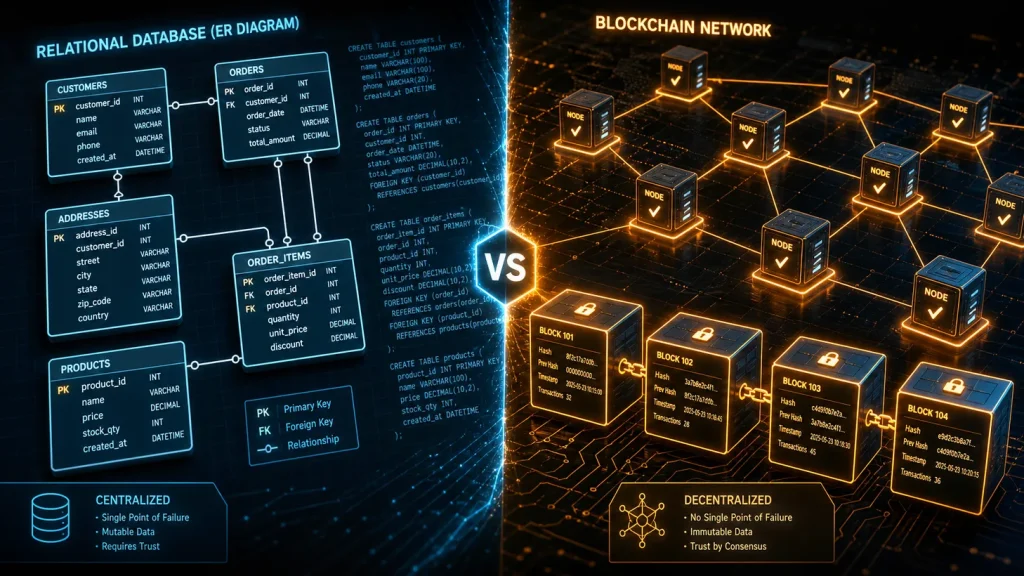
The question hits inboxes and boardrooms every quarter: Will Blockchain Replace Traditional Databases? Short answer—rarely, and only in specific scenarios. Long answer—read on, because the most valuable outcomes emerge when you combine both.

- 20% trading fee discount
- $30,050 signup bonus

- 20% trading fee discount
- $100 signup bonus
- $10,000 futures bonus

- 20% fee cashback
- $60,000 futures bonus

- 20% fee cashback
- $10,000 bonus

- Bonus pack worth $100–$1,500 USDT
- Fee discount

- 20% fee cashback
- $8,000 bonus

- 50% trading fee discount
- 20% fee cashback
- $6,200 futures bonus
In this in-depth guide, you’ll learn how to evaluate blockchain vs database choices, where each excels, and how emerging architectures blend decentralization with the performance and query power you already know from SQL and NoSQL.
- Focus keyword: Will Blockchain Replace Traditional Databases?
- Related short-tail keywords: blockchain vs database, decentralized ledger
- Related long-tail keywords: when to use blockchain instead of a database, hybrid blockchain database architecture, immutable audit trails for compliance
Contents
- What Traditional Databases Do Exceptionally Well
- What Blockchains Actually Are
- The Core Trade-offs: Immutability, Trust, and Throughput
- Where Blockchain Shines vs Where Databases Dominate
- Design Patterns That Blend Both Worlds
- Checklist: Should Your Next System Be On-Chain, Off-Chain, or Hybrid
- Performance, Cost, and Risk in Plain Terms
- Compliance and Privacy Considerations
- Trends to Watch in 2026 and Beyond
- Hands-on: Explore Web3, Tokens, and On-Chain Data
- Brief Case Notes: Wins, Misses, and Lessons
- FAQ
- Further Reading
What Traditional Databases Do Exceptionally Well
Traditional databases—relational (PostgreSQL, MySQL, SQL Server) and NoSQL (MongoDB, Cassandra)—excel at:
- ACID transactions for strict consistency within a trust boundary
- Complex queries, joins, and indexes
- High-throughput OLTP and OLAP workloads
- Low-latency reads and writes at predictable cost
- Mature tooling for backups, schema evolution, and access control
If your users expect millisecond responses, nuanced analytics, and complicated joins, a database remains the default. These systems are designed to be the centralized system of record for an organization’s data.
What Blockchains Actually Are
Blockchains are shared, append-only ledgers powered by consensus. They’re designed to coordinate state across untrusted or semi-trusted participants without a central administrator. Core properties include:
- Immutability: historical data is extremely hard to alter
- Verifiability: any participant can validate state transitions
- Decentralized control: no single party “owns” the ledger on public chains
- Programmability: smart contracts enforce rules and automate settlement
Public chains (like Bitcoin and Ethereum) maximize openness and censorship resistance. Permissioned chains (like Hyperledger Fabric) limit participants but retain auditability and shared control across multiple organizations.
The Core Trade-offs: Immutability, Trust, and Throughput
Ask why you want blockchain. If your answer is “because it’s faster,” pause. Most blockchains trade raw throughput for decentralization, security, and global verifiability.
- Throughput and latency: Public chains typically process far fewer transactions per second than enterprise databases and finalize transactions over seconds to minutes, not sub-milliseconds.
- Finality: Block confirmations and consensus epochs introduce probabilistic or delayed finality. Databases give you immediate commit semantics inside one trust domain.
- Query model: Blockchains store state as key-value or contract-specific data; rich, ad hoc querying is limited compared to SQL, unless you use indexing layers (The Graph, custom ETL to a warehouse).
- Cost model: On public chains every state change costs a fee; in databases, writes cost infra you control. On-chain costs can be economical for multiparty coordination but expensive for high-churn state.
Where Blockchain Shines vs Where Databases Dominate
Use blockchain when your primary risk is misaligned incentives across organizations—not when you just need a faster API.
Blockchain sweet spots:
- Multi-party business processes: settlement, clearing, trade finance
- Tokenization: real-world assets, in-game items, loyalty points
- Provenance and audit: tamper-evident logs across companies
- Payments and remittances: transparent, programmable money
- Identity and credentials: verifiable claims without a central gatekeeper
Database sweet spots:
- Internal line-of-business apps with one owner and clear trust boundaries
- High-volume OLTP and analytics with complex queries
- PII-heavy domains requiring right-to-erasure and tight schema control
- Low-latency user experiences where every millisecond matters
In other words, Will Blockchain Replace Traditional Databases? Only when the trust, audit, and coordination gains outweigh the performance and flexibility you’d give up.
Design Patterns That Blend Both Worlds
A hybrid approach lets you preserve speed and query power while gaining verifiability where it counts.
1) On-chain anchoring for integrity
– Keep detailed records in Postgres or a data lake.
– Periodically commit a Merkle root or hash of your change-log to a blockchain.
– Anyone can later verify the database state hasn’t been tampered with.
2) Event sourcing with selective settlement
– Emit critical inter-company events to a chain for shared truth.
– Keep heavy transactional detail off-chain, indexed in your warehouse.
3) Token-gated access and permissions
– Represent roles and entitlements as on-chain tokens or credentials (DID/VC).
– Your services read token state to grant access; core data still lives in your DB.
4) Decentralized storage pointers
– Store large files in IPFS/Filecoin/Arweave.
– Put only small content hashes and metadata on-chain.
5) Permissioned consortia for B2B workflows
– Use Fabric/Quorum for multi-company processes with privacy channels.
– Each org keeps its own operational DB while the ledger coordinates shared steps.
Checklist: Should Your Next System Be On-Chain, Off-Chain, or Hybrid
Ask these before you commit:
- Do multiple independent organizations need to share a canonical source of truth?
- Would tamper-evidence and public verifiability reduce disputes or fraud?
- Is automated settlement across parties a core requirement?
- Can your UX tolerate seconds-to-minutes finality on critical operations?
- Are per-transaction fees acceptable versus infra you already run?
- Does your app depend on complex ad hoc queries and joins?
- Do you need the right to erase personal data (e.g., GDPR)?
- Is the domain adversarial or high-stakes across trust boundaries?
- What happens if one participant misbehaves—does the chain’s neutrality help?
- Can you achieve the same auditability with append-only logs and attestations off-chain?
If you answer “yes” to the first three and “no” to the heavy SQL and low-latency needs, blockchain or a hybrid is promising. Otherwise, your database remains the star, with optional cryptographic proofs for integrity.
Performance, Cost, and Risk in Plain Terms
- Performance: Mature RDBMS can handle tens of thousands of TPS with sub-10ms latency on modest hardware. Public L1 blockchains typically handle far less throughput, though some L1s and L2s now reach thousands of TPS depending on workload. Treat marketing numbers with caution; real-world performance depends on network conditions and application design.
- Cost: Databases charge you in infra, ops time, and licenses. Public chains charge gas; the benefit is globally synchronized trust. A hybrid model often yields the best ROI: verifiable checkpoints on-chain, heavy processing off-chain.
- Risk: Smart contracts are unforgiving once deployed; audits and formal methods help, but bugs can be costly. Centralized databases have different risks—insider tampering, misconfigurations, and single points of failure—mitigated with controls and logging.
Compliance and Privacy Considerations
- Right to be forgotten: Public blockchains are append-only; avoid writing PII on-chain. Store only hashes or commitments.
- Jurisdiction: Nodes operate across borders; ensure your architecture respects data residency rules.
- Confidentiality: Use permissioned chains for sensitive B2B data, or pair public chains with encryption, off-chain storage, and zero-knowledge proofs where feasible.
Trends to Watch in 2026 and Beyond
- Layer-2s and data-availability layers: Rollups and DA networks reduce fees and increase throughput while preserving security from base layers.
- Verifiable databases: Systems that add Merkle trees to database pages or logs let you prove queries and history without surrendering performance.
- Zero-knowledge proofs: ZK tech can prove computations or facts about data without revealing the data itself, unlocking privacy-preserving apps.
- Indexing and subgraphs: Rich query layers over on-chain data continue to improve developer ergonomics.
Hands-on: Explore Web3, Tokens, and On-Chain Data
Even if your core system stays in Postgres, experimenting with wallets, tokens, and smart contracts will sharpen your intuition about where blockchain fits.
- Set up a wallet and try a testnet.
- Interact with dapps to feel latency, fees, and finality.
- Examine block explorers to understand data models and events.
To lower the barrier, you can onboard through a reputable exchange and then bridge to networks you’re exploring. New users can get strong fee savings and perks by joining through a referral.
- Get started: Join Binance with referral code CRYPTONEWER for 20% fee discount and up to $10,000 in benefits. After onboarding, you can transfer a small amount to a self-custody wallet and experiment on supported networks. Always start small and learn safely.
Binance offers a smooth KYC flow, a robust learning hub, and broad asset support—useful when you’re testing cross-chain tools or experimenting with tokenized assets.
Brief Case Notes: Wins, Misses, and Lessons
- Food traceability and provenance: Retailers and suppliers have used consortium chains to log product origin, batch IDs, and custody changes. The main value isn’t speed but auditability across multiple companies.
- Cross-border payouts: Stablecoins and programmable transfers reduce intermediaries. Enterprises still need controls for AML/KYC and treasury management, often integrating with existing ERP and databases.
- Asset tokenization: Real estate shares, invoices, carbon credits—put the ownership record on-chain, keep financial details and investor preferences in a database, and connect them via IDs and commitments.
- Overreach caution: Full migrations of internal CRM or HR systems onto a public chain usually backfire due to privacy, cost, and UX needs. A hybrid checkpoint or attestations model is almost always superior.
FAQ
-
Will Blockchain Replace Traditional Databases?
- In general, no. For multi-organization trust and auditable settlement, yes in part—or use a hybrid. For high-speed internal apps, databases remain unmatched.
-
Is a private blockchain just a slow database?
- Not if multiple parties operate it and rely on it as a shared source of truth. If one party controls all nodes, you may be better off with a database plus signed logs.
-
Can I make my database “immutable” without blockchain?
- You can approximate it with append-only logs, WORM storage, and cryptographic hashing anchored publicly. That often delivers the assurance you need.
-
How do I query blockchain data like SQL?
- Use ETL into a warehouse or indexers like subgraphs. Many teams pipe events to Kafka, then transform into star schemas for BI tools.
-
What about performance claims of thousands of TPS on some chains?
- They can be real under specific conditions. Validate on testnets, account for finality, and measure end-to-end latency with your business logic.
-
How do I start learning without risking large sums?
- Use small amounts, testnets, and reputable onboarding. A practical route is to begin with an exchange account, then move to self-custody for experiments. Join Binance with referral code CRYPTONEWER for 20% fee discount and up to $10,000 in benefits.
Further Reading
- Ethereum docs on smart contracts: https://ethereum.org/en/developers/docs/
- Hyperledger Fabric: https://www.hyperledger.org/use/fabric
- NISTIR 8202: Blockchain Technology Overview: https://csrc.nist.gov/publications/detail/nistir/8202/final
- PostgreSQL Docs: https://www.postgresql.org/docs/
- The Graph protocol: https://thegraph.com/
When you separate the marketing hype from system design reality, the choice becomes clear: use blockchains to solve multi-party trust and audit problems, and use traditional databases for performance, complex queries, and internal consistency. The best systems mix both with careful boundaries and cryptographic guarantees where they matter most.
Related posts:
 Utility Tokens vs Security Tokens Essential Guide for Investors and Builders
 Top NFT Marketplaces Compared Expert Breakdown of Fees Liquidity Royalties and Chains
 Practical Breakthrough in Blockchain and Crowdfunding Transforming Startup Finance
 MEXC Launchpad Guide for Beginners — Step-by-Step Playbook for Early Access