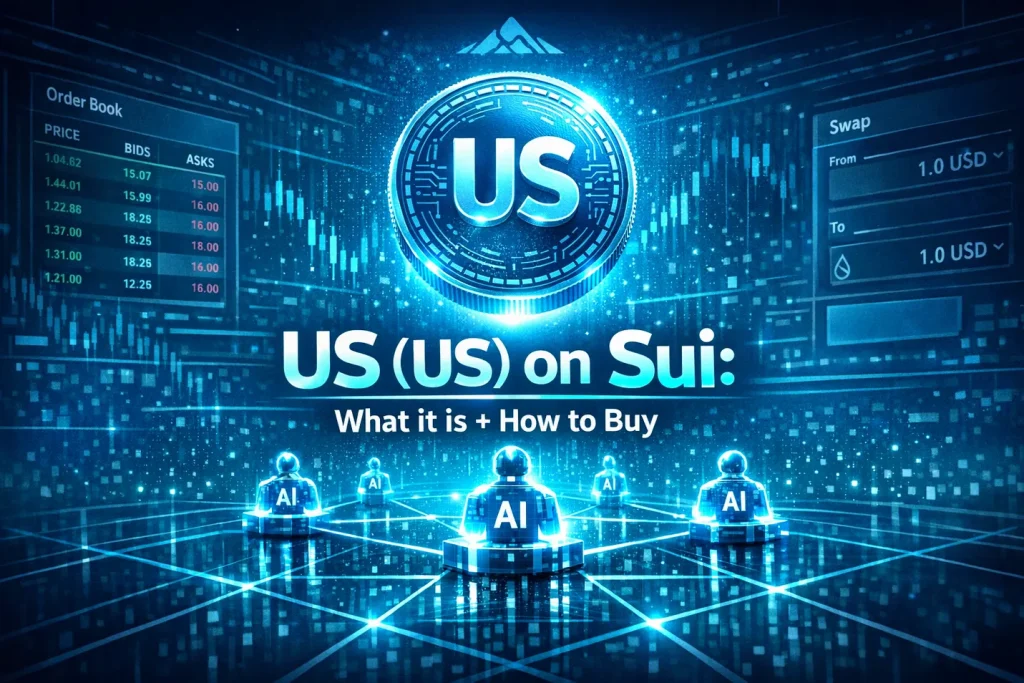
If you’ve been seeing the ticker “US” or headlines about Talus Network and wondered “What is the US(US) Coin, and how to buy it?”, this guide walks you through exactly what the token is, why it exists, where it trades as of April 12, 2026, and safe, step‑by‑step ways to purchase and store it.

- 20% fee cashback
- $60,000 futures bonus

- 20% trading fee discount
- $100 signup bonus
- $10,000 futures bonus

- 20% fee cashback
- $8,000 bonus

- 50% trading fee discount
- 20% fee cashback
- $6,200 futures bonus

- 20% fee cashback
- $10,000 bonus

- 20% trading fee discount
- $30,050 signup bonus
Pro tip for lower fees while funding your purchase:
– New users can register on Binance with code CRYPTONEWER for a 20% fee discount plus up to $10,000 in benefits. Use it as a fiat on‑ramp to acquire USDT/SUI before moving to an exchange or DEX that lists the US token.
What is US (ticker: US)?
US (often shown as “US(US)” on price trackers) is the native utility token of Talus Network, an AI‑centric blockchain infrastructure built on Sui. Within Talus, US is used to price and settle workflow activity for autonomous agents, reward tool and agent developers, and participate in staking and governance according to protocol rules. While Sui (SUI) remains the base gas asset of the underlying chain, Talus converts protocol‑collected fees into US for distribution under network rules. (docs.talus.foundation)
Key ways US is used in the Talus economy:
– Operation pricing and settlement for on‑chain agent workflows (with fees ultimately accounted for in US).
– Monetization for published tools/agents; developers are paid in US for usage.
– Staking to participate in the Leader Network (coordination/security layer) and for tool registration bonds.
– Eligibility for governance‑related participation as features roll out.
Tokenomics snapshot
- Total supply cap: 10,000,000,000 US.
- At Token Generation Event (TGE), approximately 22.2% of total supply entered circulation.
- High‑level allocations include Community & Ecosystem programs, Foundation, Investors, Core Contributors, and Bootstrapping/Airdrop incentives with structured cliffs and linear vesting. (docs.talus.foundation)
Note: Some community posts summarize a “deflationary” element via fee‑driven buybacks/burns in certain materials; always verify the latest mechanics in Talus’s official docs as the protocol evolves. (web.gate.it)
Where can you buy US today? (checked April 12, 2026)
As of today, US is live on multiple centralized exchanges and on Sui‑based DEXs.
Centralized exchanges with public listings/announcements:
– KuCoin: US/USDT since December 11, 2025 (deposits via Sui network; trading began 13:00 UTC on Dec 11). (kucoin.com)
– Bitget: US/USDT listing and Launchpool campaigns around December 11–12, 2025. Bitget also published the Sui contract/address. (bitget.com)
On‑chain DEX liquidity (Sui):
– Cetus lists US pairs (e.g., US/USDC), offering a non‑custodial option for Sui wallet users. Liquidity and pricing vary intraday—check the live markets before swapping. (coingecko.com)
Tip: Always confirm the token’s contract/address from an exchange announcement or the project’s official docs before swapping. Example (Sui address from a listing notice): 0xee962a61432231c2ede6946515beb02290cb516ad087bb06a731e922b2a5f57a.
How to buy US (US) step‑by‑step
Below are two straightforward paths—one via centralized exchanges (CEXs) and one fully on‑chain.
Path A: Buy US on a centralized exchange
1) Fund your account
– If you don’t already hold crypto, open a fiat on‑ramp. Register at Binance (code: CRYPTONEWER) and buy USDT or SUI with card/bank options. Then send funds to an exchange that lists US, such as KuCoin or Bitget.
2) Transfer to a listing exchange
– From Binance, withdraw USDT to your chosen exchange. Pick a broadly supported network (e.g., TRON for USDT) to minimize fees; confirm the deposit network the destination exchange supports for your chosen asset.
3) Trade US/USDT
– On KuCoin or Bitget, search “US” and choose the US/USDT market. Place a market order for instant execution or a limit order at your target price. Review fees and slippage before confirming the trade.
4) Secure storage (if you plan to hold)
– Either keep US on the exchange with security settings maxed out (2FA, anti‑phishing code, withdrawal allowlist), or withdraw on‑chain to a Sui wallet you control (see Path B for wallet options/notes).
Path B: Buy US on‑chain via the Sui ecosystem
1) Set up a Sui‑compatible wallet
– Install a reputable Sui wallet (e.g., Sui Wallet/Slush, Suiet). Follow the official Sui wallet guides and only download from links referenced in Sui’s documentation or the wallet’s verified site. Back up your recovery phrase securely—offline. (blog.sui.io)
2) Fund the wallet with SUI or USDC on Sui
– Acquire SUI or bridged USDC; many users buy on a CEX and withdraw to Sui if supported, or bridge from a supported chain. Always match networks exactly when withdrawing.
3) Swap on a Sui DEX
– Connect your wallet to Cetus or another reputable DEX, select a US pair (e.g., US/USDC), and review the quote, depth, and price impact. Confirm the token address matches what you’ve verified from official sources before swapping.
4) Advanced users: manage routes and slippage
– Aggregators or multi‑route swaps may reduce price impact for larger orders; start with small test transactions to validate the path and token address.
Using Binance as your on‑ramp, then pivot to US
Because not every token is available on every CEX, a popular workflow is to use a large, liquid exchange as your funding hub and then move to where the token trades.
- Step 1: Create your account at Binance with code CRYPTONEWER for a 20% fee discount and up to $10,000 in benefits.
- Step 2: Buy USDT or SUI on Binance.
- Step 3: Transfer to a US‑listing venue (KuCoin, Bitget) and trade US/USDT—OR withdraw SUI to your Sui wallet and swap US on Cetus.
Always verify deposit networks, minimums, and any temporary maintenance notices before moving funds. If you withdraw stablecoins, ensure the destination supports that stablecoin on that specific network.
Smart safety checks before you click “Buy”
- Contract verification: Match the token address from at least two trusted sources (official docs or exchange announcements). On Sui DEXs, a single wrong address can’t be reversed.
- Slippage and liquidity: Thin liquidity can cause poor fills. Use limit orders on CEXs or set conservative slippage on DEXs.
- Wallet hygiene: Use strong 2FA on CEXs; for self‑custody, keep seed phrases offline and beware of extension look‑alikes. Follow the Sui team’s wallet guidance.
Quick fundamentals refresher: US vs. USDC
They sound similar but are different assets:
– US (US): Utility token of Talus Network used for pricing/settlement of agent workflows, staking, governance, and developer monetization on Sui.
– USDC (USD Coin): A regulated, fiat‑backed stablecoin designed to track $1.00; issued by Circle, available across multiple chains. Don’t confuse the two in deposits or swaps. (en.wikipedia.org)
Exchanges and notable milestones (with dates)
- December 11, 2025: KuCoin lists US/USDT; deposits via Sui; trading starts 13:00 UTC.
- December 11–12, 2025: Bitget opens spot trading for US/USDT and runs Launchpool rewards; Bitget also publishes the Sui contract address for US.
- DEX availability: US pools on Cetus (Sui) provide non‑custodial trading paths.
Token economics and project background (for due diligence)
- Supply and circulation: 10B maximum supply; ~22.2% in circulation at TGE per Talus Foundation docs. Allocations and vesting are detailed transparently, with long‑term unlock schedules for investors and contributors and sizable ecosystem incentives.
- Governance and network direction: Long‑term holders are expected to gain governance participation rights under protocol rules as features are shipped.
- Origins and funding: Talus publicly disclosed a seed raise led by Polychain Capital (GlobeNewswire, February 26, 2024). Subsequent ecosystem notes and exchange literature have referenced additional rounds and strategic support; rely on primary sources for confirmed amounts and cap table details. (globenewswire.com)
Frequently asked questions
-
Is US listed on every major exchange?
- No. As of April 12, 2026, US trades on exchanges such as KuCoin and Bitget, and across Sui DEXs like Cetus. Availability can expand; always check the live token page at your preferred venue.
-
Do I need SUI to use Talus?
- SUI remains the base gas for Sui. Inside Talus, pricing/settlement integrates US under protocol rules, and protocol‑collected fees are converted to US. Practically, you’ll often hold a bit of SUI for gas and US for Talus activities.
-
What’s the easiest path if I’m new?
- Use a large on‑ramp such as Binance (code: CRYPTONEWER) to buy USDT quickly, send to a listing exchange (e.g., KuCoin/Bitget), and trade the US/USDT pair. If you prefer self‑custody, withdraw SUI to a Sui wallet, then swap for US on Cetus.
Step‑by‑step recap (bookmark this checklist)
- Create and verify your Binance account with code CRYPTONEWER for fee discounts and bonuses.
- Purchase USDT or SUI on Binance.
- Move funds to a US‑listing exchange (KuCoin/Bitget) and buy US, or withdraw SUI to a Sui wallet and swap on a DEX like Cetus.
- Double‑check token addresses and networks; start with a small test transaction.
- Enable 2FA on CEXs and store seed phrases offline for wallets.
Discipline around addresses, networks, and order types will save you from the most common pitfalls—especially when a token trades across several venues and chains.
Related posts:
 What is the ALLO (Allora) Coin, and how to buy — Essential Guide for 2026
 What is Ethereum(ETH) Essential Guide to Smart Contracts, Gas, Staking, and Layer 2
 What is the TOMO(TomoChain) Coin, and how to buy Essential Guide for 2026
 What is the $PAAL(PAAL AI) Coin and how to buy — Actionable 2026 Guide