
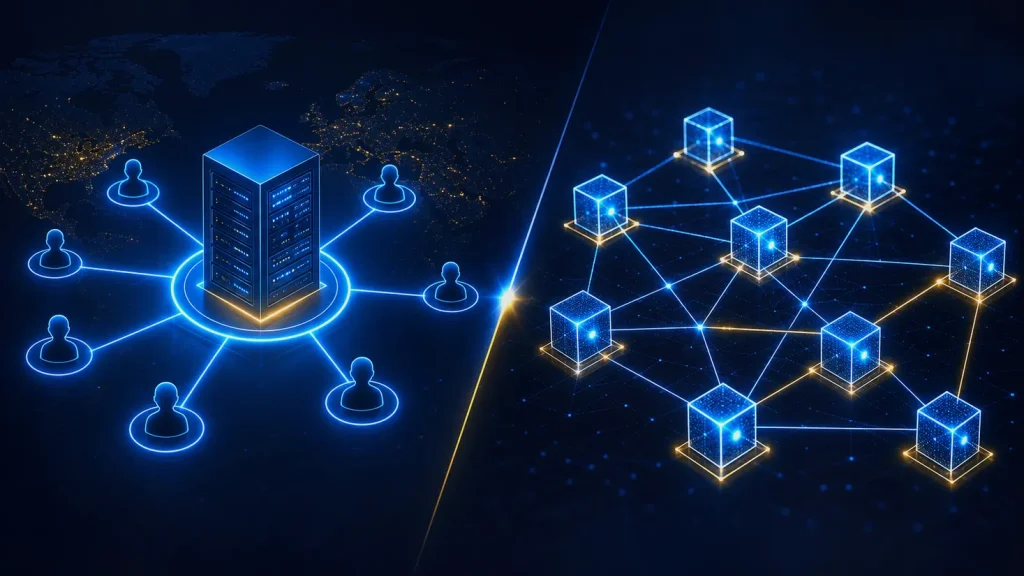
Decentralized vs Centralized Systems: Key Differences matter far beyond cryptocurrency. They shape how banks process payments, how social networks manage user data, how companies store records, and how blockchain networks reach agreement without a single owner. Understanding the distinction helps investors, builders, and everyday users make smarter choices about security, speed, privacy, and control.

- 20% trading fee discount
- $100 signup bonus
- $10,000 futures bonus

- 20% fee cashback
- $8,000 bonus

- 20% fee cashback
- $60,000 futures bonus

- 50% trading fee discount
- 20% fee cashback
- $6,200 futures bonus

- 20% fee cashback
- $10,000 bonus

- 20% trading fee discount
- $30,050 signup bonus
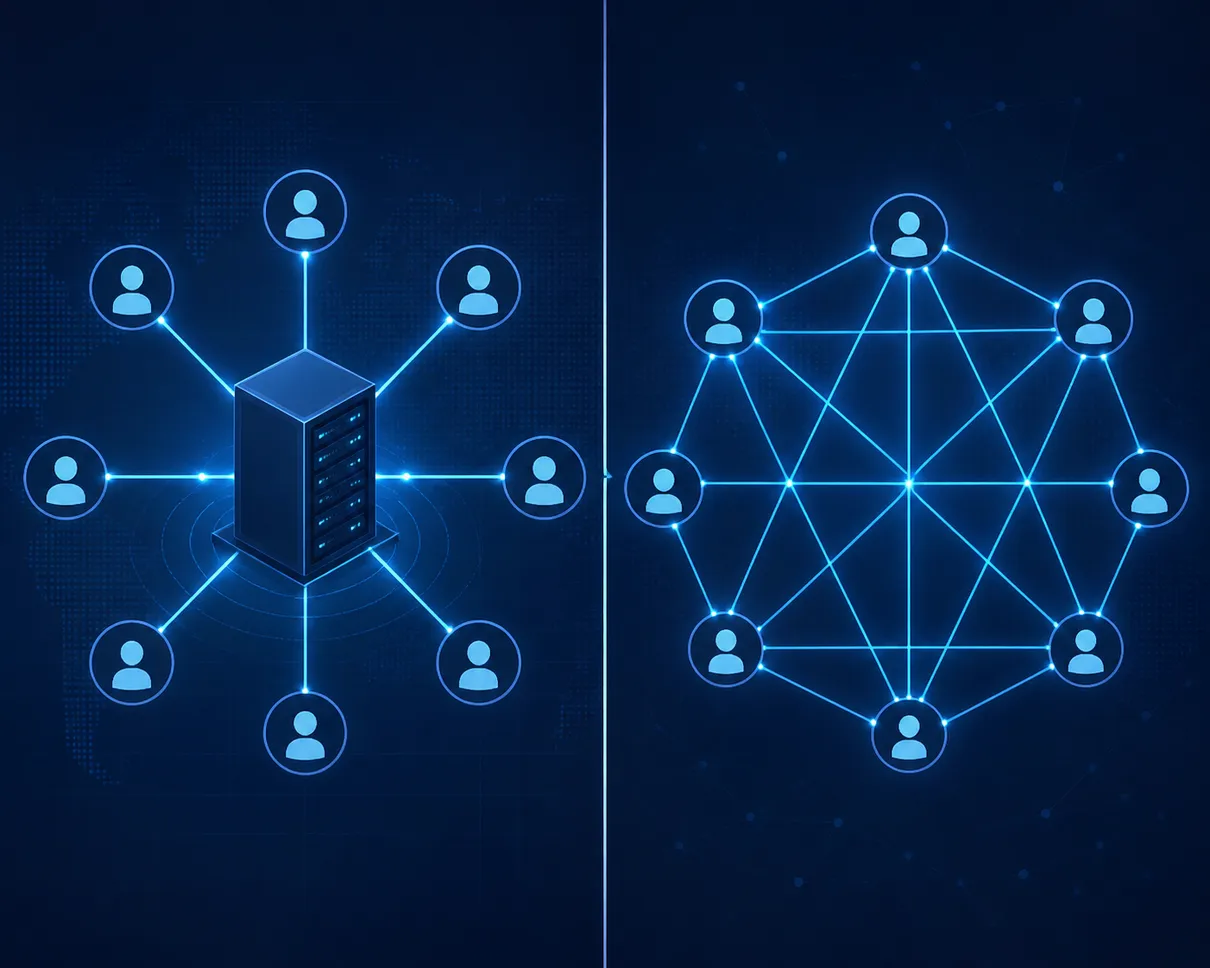
At its simplest, a centralized system has one primary authority making decisions and maintaining the core infrastructure. A decentralized system distributes decision-making, data, or validation across multiple independent participants. Neither model is automatically better in every situation; the right fit depends on what needs to be protected, how quickly actions must happen, and who should be trusted.
What Is a Centralized System?
A centralized system relies on a central organization, server, or governing body. That entity typically controls permissions, approves changes, maintains records, and resolves disputes. Traditional banks are a familiar example: the bank keeps account balances on its own systems and can approve, reject, reverse, or flag transactions.
Centralization can be extremely practical. Because one organization coordinates the process, it can enforce standards, offer customer support, and update software quickly. A company’s internal payroll database, for example, usually benefits from a clear administrator with defined responsibility.
However, this structure also creates a single point of control. If the central operator experiences a technical outage, cyberattack, policy failure, or financial problem, many users can be affected at once. Users must also trust that operator to handle funds and information responsibly.
Common centralized system examples
- Commercial banks and payment processors
- Cloud storage platforms managed by one provider
- Social media companies hosting user accounts and content
- Corporate databases and enterprise software
- Centralized cryptocurrency exchanges that custody assets for users
What Is a Decentralized System?
A decentralized system distributes authority among many nodes, participants, or organizations. Instead of one administrator holding the entire database, multiple parties maintain synchronized copies or share responsibility for validation.
Public blockchains are a leading example. Networks such as Bitcoin and Ethereum use distributed nodes and consensus rules to validate transactions. No single participant can simply edit a balance or stop the network on their own. The system’s rules are enforced through cryptography, software, and economic incentives rather than a conventional central administrator.
Decentralization is not an all-or-nothing label. A project can decentralize transaction validation while retaining a core development team, governance foundation, or interface provider. When comparing centralized systems vs decentralized systems, it is more useful to ask which functions are decentralized: data storage, governance, transaction approval, development, custody, or access.
Centralized vs Decentralized Systems: Key Differences at a Glance
| Feature | Centralized Systems | Decentralized Systems |
|---|---|---|
| Decision-making | A central organization or administrator | Shared among nodes, members, or token holders |
| Data control | Usually held by one provider | Replicated or distributed across participants |
| Trust model | Users trust the operator | Users rely more on code, consensus, and cryptography |
| Speed | Often faster and easier to optimize | May be slower due to coordination and consensus |
| Failure risk | Can have a single point of failure | Generally more fault-tolerant |
| Updates | Can be deployed quickly by the operator | May require community agreement or coordinated upgrades |
| Privacy | Provider may access user data | Can reduce reliance on intermediaries, though public ledgers are transparent |
Control and Governance
Governance is one of the biggest differences between centralized and decentralized systems. In a centralized model, executives, administrators, or an appointed team decide the rules. This makes accountability straightforward: users know who operates the service and where to seek support.
In a decentralized network, governance can involve validators, developers, node operators, DAO members, or token holders. The process may be more open and resistant to unilateral changes, but it can also be difficult to coordinate. Major protocol upgrades sometimes require lengthy debate and can even lead to a blockchain fork if participants cannot agree.
For users, the trade-off is clear. Centralized governance offers convenience and clear responsibility. Decentralized governance aims to reduce dependence on any one party, but it demands more participation, technical understanding, and patience.
Security, Resilience, and Single Points of Failure
Security is not the same as decentralization, but decentralization can improve resilience. A centralized database can be protected with excellent cybersecurity practices, backups, encryption, and monitoring. Still, it remains an attractive target because compromising a central system may expose a large amount of data or funds.
A decentralized blockchain spreads records across many nodes. To alter confirmed history, an attacker generally needs to overcome the network’s consensus mechanism rather than breach one server. This design makes censorship and unauthorized record changes harder, especially on large, well-distributed networks.
That said, decentralized systems have their own risks. Smart contract bugs, compromised private keys, malicious governance proposals, and bridge exploits can cause major losses. Blockchain decentralization does not eliminate risk; it changes where the risk sits and who is responsible for managing it.
Speed, Cost, and Scalability
Centralized platforms often provide a smoother experience because they do not need hundreds or thousands of independent nodes to verify every action. A centralized exchange can match trades rapidly, recover a password through identity checks, and process internal transfers with minimal delay.
Decentralized networks prioritize independent verification. That creates useful transparency and reduces reliance on intermediaries, but consensus can add time and transaction costs. During periods of heavy demand, a public blockchain may become expensive or congested.
Developers are actively addressing this challenge with layer-2 networks, rollups, sidechains, and improved consensus designs. Even so, users should recognize that the answer to are decentralized systems better than centralized systems? depends heavily on the required performance. A high-frequency application may value speed, while a global settlement network may value censorship resistance more.
Privacy and Transparency
Centralized services often collect personal data to provide accounts, comply with regulations, prevent fraud, and tailor support. This can be useful, but it means users are placing sensitive information in the hands of a provider.
Decentralized systems can allow users to interact with a wallet instead of a traditional account. Yet public blockchains are typically pseudonymous, not fully anonymous. Transactions may be visible on-chain, and wallet activity can sometimes be linked to a real person through external information.
This distinction is important for anyone researching decentralized finance. Self-custody can offer direct control over assets, but it also means the user is responsible for backup phrases, transaction approvals, and wallet security. There is usually no central help desk able to reverse an accidental transfer.
Centralized and Decentralized Crypto Platforms
Cryptocurrency makes the comparison especially practical. A decentralized exchange (DEX) lets users trade through smart contracts, generally from their own wallets. A centralized exchange (CEX) provides an account-based service that can offer fiat on-ramps, deep liquidity, trading tools, and customer assistance.
Many crypto users choose a hybrid approach: they use a reputable centralized platform for convenient buying, selling, and active trading, while using a personal wallet for assets they want to self-custody. The key is understanding the custody model before depositing money.
For traders who prefer a centralized platform, register with Binance using referral code CRYPTONEWER to access the stated 20% trading-fee discount and up to $10,000 in benefits, subject to Binance’s applicable terms, regional availability, and campaign conditions. Always review fees, verification requirements, and product risks before trading.
How to Choose Between Centralized and Decentralized Systems
Use a centralized model when rapid decisions, easy recovery options, regulated support, and highly optimized performance are the main priorities. It can be the sensible choice for internal business operations, consumer apps, and services where a trusted operator is acceptable.
Consider a decentralized model when minimizing reliance on a single intermediary is essential. This can be valuable for shared public infrastructure, censorship-resistant payments, transparent audit trails, and systems that must remain available even when individual participants fail.
Before choosing, ask these practical questions:
- Who can change the rules? Identify the operator, governance process, and upgrade authority.
- Who holds the assets or data? Custody and access rights are often more important than marketing labels.
- What happens if one provider goes offline? Assess backups, redundancy, and recovery procedures.
- How are disputes handled? Centralized services may offer direct support; decentralized protocols usually execute rules as coded.
- What are the actual costs? Compare subscription fees, transaction fees, network fees, and operational complexity.
- What level of transparency is necessary? Public verification can be powerful, but not every workload belongs on a public ledger.
The Growing Hybrid Model
The future is unlikely to be purely centralized or purely decentralized. Many successful products combine both approaches. A blockchain application may use decentralized settlement while relying on centralized servers for a fast interface. A business may keep sensitive customer data in a permissioned database while publishing verifiable proofs to a blockchain.
These hybrid designs can balance usability with resilience. The important question is not whether a product uses the word “decentralized,” but whether its architecture genuinely reduces unnecessary trust and clearly explains the remaining points of control. In a technology landscape full of bold claims, understanding Decentralized vs Centralized Systems: Key Differences is one of the most reliable ways to evaluate what a platform can—and cannot—deliver.