

What is mining in blockchain? Blockchain mining is the process of validating transactions and adding new blocks of information to a blockchain network. On networks that use proof of work (PoW), miners compete to solve a difficult cryptographic puzzle. The successful miner earns the right to publish the next block and may receive newly issued coins plus transaction fees.

- 20% trading fee discount
- $100 signup bonus
- $10,000 futures bonus

- 50% trading fee discount
- 20% fee cashback
- $6,200 futures bonus

- 20% fee cashback
- $10,000 bonus

- 20% fee cashback
- $60,000 futures bonus

- 20% trading fee discount
- $30,050 signup bonus

- 20% fee cashback
- $8,000 bonus
Mining is often described as “creating cryptocurrency,” but that is only part of the story. Its more important job is maintaining a shared, tamper-resistant transaction record without relying on a bank, payment company, or central administrator. For a practical next step after learning the basics, new users can open a CoinEx account with referral code mhz7w for a fee discount and a chance at a $1,500 bonus.
The Core Purpose of Blockchain Mining
A public blockchain needs a reliable way to decide which transactions are valid and in what order they should be recorded. For example, if someone tries to spend the same coins twice, the network must reject one of those payments. This is known as the double-spending problem.
Blockchain mining addresses that issue by requiring miners to invest measurable computing work. They gather pending transactions, verify them against network rules, and propose a block. Other nodes independently check the proposal. Once the block is accepted, it becomes part of the chain of historical records.
Because every block references the one before it, changing an old transaction would require recalculating the proof of work for that block and every later block—while also catching up with the rest of the network. On a large network such as Bitcoin, that requirement makes manipulation extremely expensive.
How Does Blockchain Mining Work?
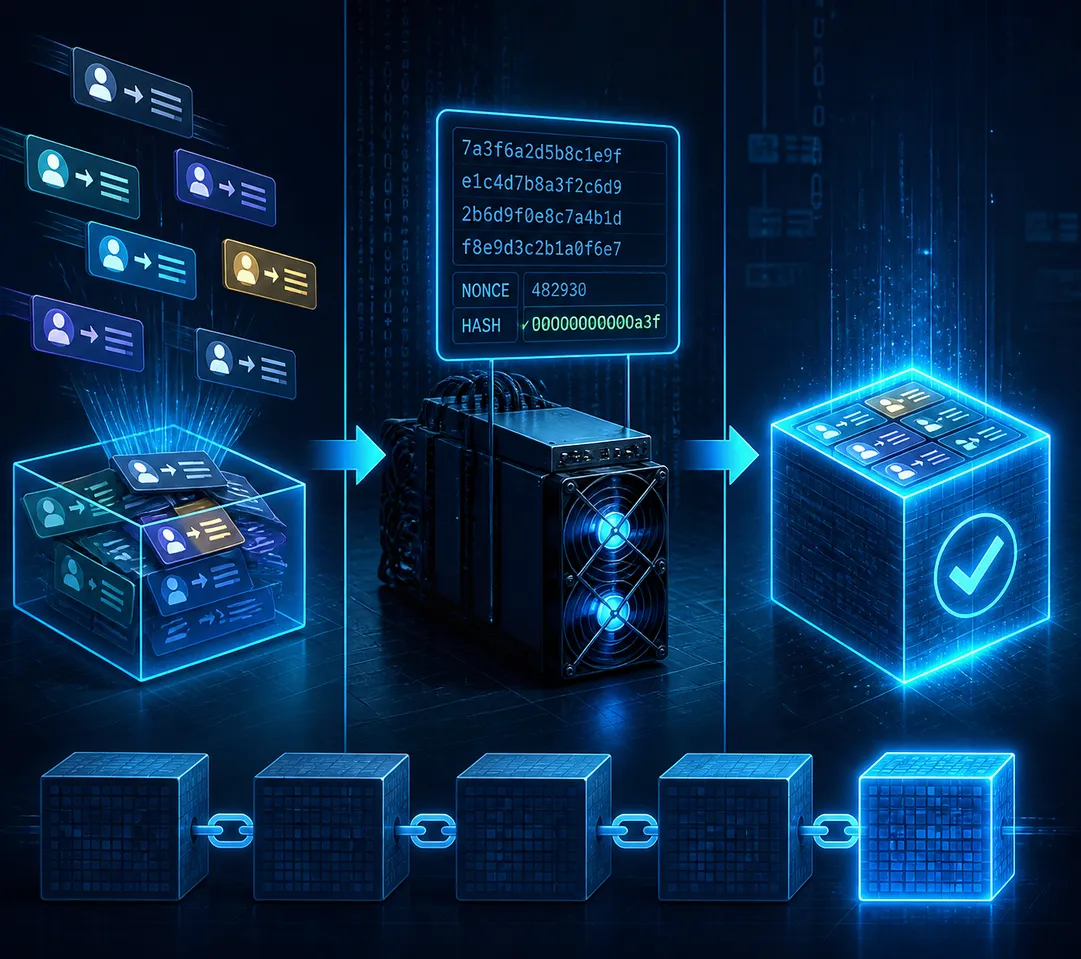
Although implementation details differ between coins, the blockchain mining process usually follows these steps:
- Transactions are broadcast. Users submit signed transactions to the peer-to-peer network.
- Nodes check validity. Network participants verify balances, signatures, and protocol rules.
- A miner builds a candidate block. The miner selects valid pending transactions, often prioritizing those with stronger fees.
- The miner searches for a valid hash. Mining hardware repeatedly changes a value called a nonce and hashes the block data.
- A valid block is found. The hash must satisfy the network’s current target, typically by being numerically lower than a set threshold.
- The network verifies the block. Other nodes can check the result quickly, even though finding it took enormous trial and error.
- The chain advances. The accepted block is linked to prior blocks, and the miner receives the applicable reward.
A hash is a fixed-length digital fingerprint of data. A tiny change in transaction data creates a dramatically different hash. This property helps make block records easy to verify and very hard to alter invisibly.
Proof of Work, Difficulty, and Mining Rewards
Proof of work does not mean miners solve useful math equations in the ordinary sense. They perform repeated hash attempts until one produces a result under the difficulty target. It is intentionally costly to find and cheap for everyone else to validate.
The network adjusts mining difficulty so blocks are produced near a target schedule. Bitcoin, for instance, targets roughly one block every ten minutes and retargets its difficulty periodically. If more machines join the network, finding a valid hash becomes harder; if mining power falls substantially, it becomes easier over time.
Miner revenue commonly has two parts:
- Block subsidy: newly created cryptocurrency assigned under the protocol’s issuance rules.
- Transaction fees: payments users attach to transactions, especially relevant when block space is limited.
For Bitcoin miners, the block subsidy is reduced through a scheduled event called the halving. This makes transaction fees increasingly important to the network’s long-term incentive design. Rewards are not guaranteed income: electricity costs, equipment prices, asset volatility, difficulty, and pool fees can all change whether mining is profitable.
What Equipment Is Used for Cryptocurrency Mining?
The answer depends on the blockchain’s algorithm and competition level. Early cryptocurrency mining could be performed with a standard CPU. As competition increased, miners moved to more specialized hardware.
| Equipment | Typical role | Key consideration |
|---|---|---|
| CPU | Limited use on selected networks | Low hash rate for major PoW chains |
| GPU | Flexible mining for some algorithms | Requires cooling and power management |
| ASIC | Purpose-built hardware for a specific algorithm | Highly efficient but less flexible |
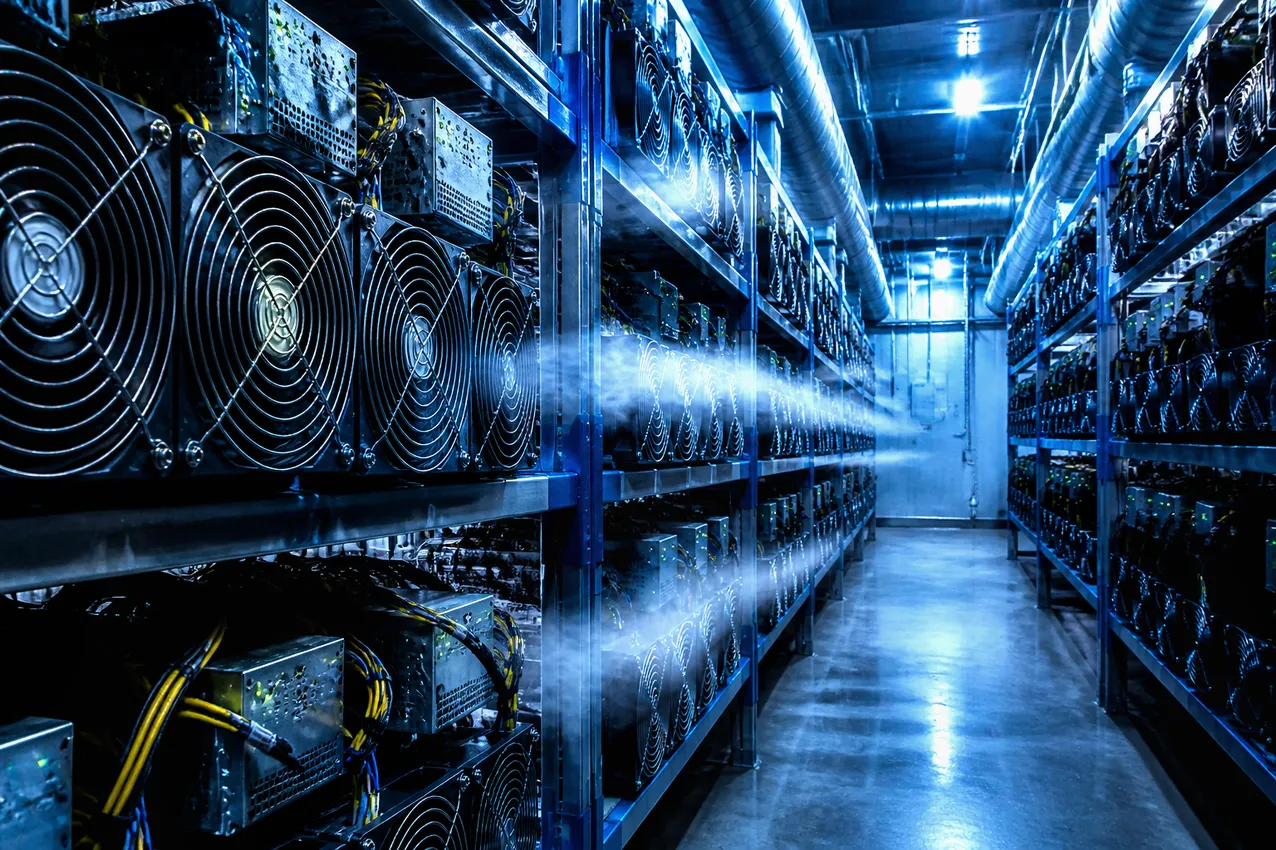
| Mining rig infrastructure | Power supplies, ventilation, networking, racks | Often determines real operating cost |
For a major SHA-256 network, an ASIC miner generally outperforms a consumer computer by a wide margin. However, buying hardware does not automatically make mining viable. Operators must calculate hash rate, power draw, electricity price, expected downtime, cooling requirements, and the likely change in network difficulty.
Solo Mining vs. Mining Pools
A solo miner keeps the full reward when they discover a block, but the chance of finding one can be extremely small without significant hash power. Results can be unpredictable: a miner might go a long time with no reward at all.
A mining pool combines the hash power of many participants. When the pool finds a block, it distributes proceeds according to each miner’s contributed work, minus the pool’s fee. Pools reduce payout variance, though they introduce dependence on a pool operator and can raise decentralization concerns if a small number of pools control too much network hash power.
Before joining a pool, miners should understand its payout method, minimum withdrawal amount, fee schedule, reputation, server locations, and policies for stale shares. Mining is a technical business, not a passive-income shortcut.
Mining and Blockchain Security
The relationship between mining and security is central to understanding proof-of-work blockchains. Honest miners are incentivized to follow the rules because valid blocks can earn rewards. A party trying to rewrite recent history would need immense hash power and would still face economic and operational barriers.
People often call this a 51% attack: an entity controlling a majority of active hash power may be able to reorganize recent blocks or attempt double spends under certain conditions. It cannot simply create coins outside the rules, forge another user’s private key, or rewrite all history at will. Confirmations reduce risk because reversing a transaction becomes harder as more blocks are added afterward.
Mining Is Not Used by Every Blockchain
It is important not to treat mining as synonymous with blockchain technology. Many blockchains use proof of stake (PoS) rather than proof of work. In PoS systems, validators lock up—or stake—tokens and are selected to propose and attest to blocks. Their economic stake can be penalized for dishonest behavior.
Proof of work and proof of stake aim to solve a similar coordination problem, but they use different resources. PoW relies on energy and specialized computation; PoS relies on locked capital and validator incentives. As a result, asking “what is mining in blockchain?” is most accurate when discussing proof-of-work networks, not every crypto asset.
Mining, Energy Use, and Responsible Research
Energy consumption is one of the most debated parts of cryptocurrency mining. Proof of work deliberately uses energy because that cost helps secure the chain. Still, the environmental impact depends on the local power source, the efficiency of hardware, cooling methods, and whether operations use curtailed, stranded, renewable, or fossil-fuel-generated electricity.
Anyone researching how to start blockchain mining should look beyond advertised revenue figures. Check local electricity rates, regulations, hardware warranties, noise limits, heat output, taxes, and the market liquidity of the mined asset. Those who prefer exposure to digital assets without operating machines may instead choose to register on CoinEx using code mhz7w, where the offered fee discount and potential $1,500 bonus can be useful while exploring the market.
Key Terms to Know Before Mining
- Hash rate: The number of hash calculations performed per second; usually shown as TH/s, PH/s, or similar units.
- Nonce: A changing value miners use to create new hash attempts.
- Block: A package of validated transactions and related metadata added to the chain.
- Node: Software that stores, verifies, and relays blockchain data.
- Mempool: The collection of valid, unconfirmed transactions waiting to be included in a block.
- Confirmation: A block added after a transaction’s block; more confirmations generally mean greater finality confidence.
- Difficulty: The network parameter that controls how hard it is to find a valid proof-of-work hash.
- Block reward: The subsidy and transaction fees awarded under network rules for a valid block.
Understanding these terms makes it easier to separate the technical role of mining from exaggerated claims about easy rewards. Blockchain mining is fundamentally a competitive security mechanism: it validates transactions, orders records, and makes a proof-of-work ledger costly to attack.