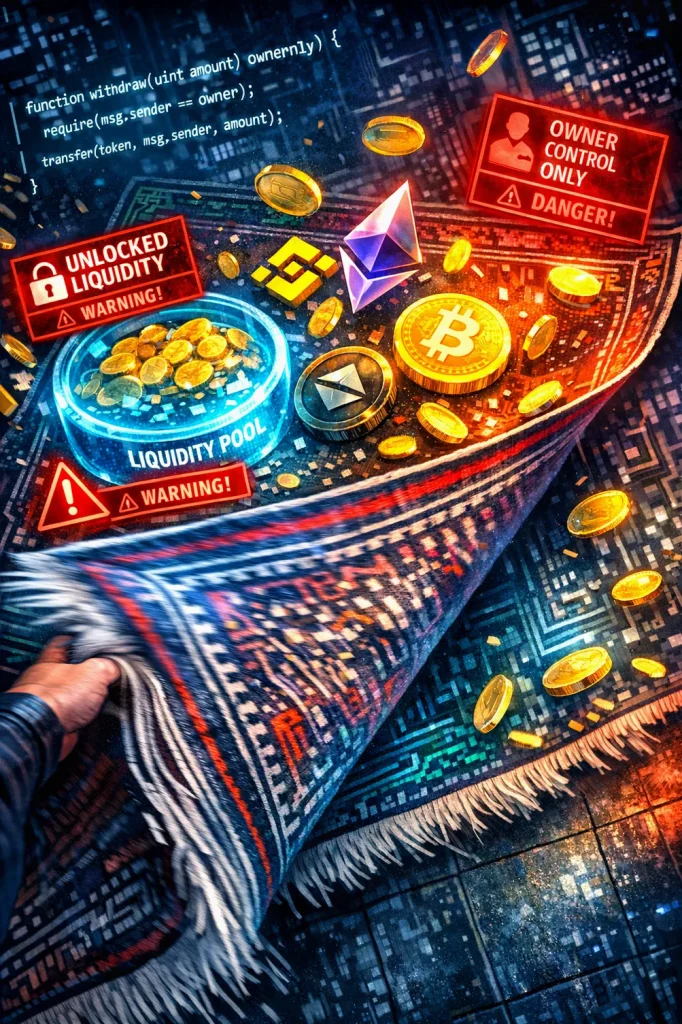
A lot of newcomers first hear the term and wonder, what is a rug pull? In crypto and DeFi, a rug pull is when a project’s creators drain liquidity, abuse hidden code, or abandon the project, leaving holders with worthless tokens. It’s one of the most damaging forms of fraud in Web3—and it thrives on hype, speed, and a lack of due diligence. This guide breaks down how rug pulls work, the types you’ll see in the wild, and the exact steps to avoid them.

- 20% fee cashback
- $60,000 futures bonus

- 20% trading fee discount
- $100 signup bonus
- $10,000 futures bonus

- 20% fee cashback
- $8,000 bonus

- 50% trading fee discount
- 20% fee cashback
- $6,200 futures bonus

- 20% fee cashback
- $10,000 bonus

- 20% trading fee discount
- $30,050 signup bonus
Quick note: This is educational content, not financial advice. Always do your own research (DYOR).
What is a Rug Pull?
A rug pull is a malicious exit by the creators of a crypto project or token. In decentralized exchanges (DEXs), creators often supply a liquidity pool (e.g., a pairing like TOKEN/ETH or TOKEN/USDT). If they can withdraw or siphon that liquidity—or if they embed code to block sales, mint infinite tokens, or redirect fees—they can crash the market and walk away with the funds.
Key points:
– A rug pull is not a market dip; it’s a deliberate act that renders tokens effectively worthless.
– It often happens fast during or after a hype cycle, with minimal transparency.
– Most rug pulls rely on one of a few predictable technical or social tactics.
The Main Types of Rug Pulls
1) Liquidity Rug Pull
– Creators add liquidity to a DEX pool to bootstrap trading.
– The token pumps on buzz; then the team pulls the liquidity, leaving buyers unable to sell without huge slippage.
– Tell-tale sign: Liquidity is unlocked or controlled by the team.
2) Hard Rug (Malicious Backdoor)
– Code-level traps: trading fees set to 100% on sell, blacklists for sellers, or a function to mint unlimited tokens.
– Result: Holders are trapped or diluted instantly.
3) Soft Rug (Abandonment)
– Team ghosts: development halts, social accounts go silent, treasury is drained slowly.
– No single “event,” but the project’s value bleeds out.
4) Honeypot Token
– You can buy, but you cannot sell—or you can sell only to specific wallets.
– The contract includes logic to revert sell transactions for most users.
How Rug Pulls Actually Happen on DEXs
- Step 1: Deploy a token and pair it with ETH/USDT on a DEX like Uniswap/PancakeSwap.
- Step 2: Seed the pool with liquidity and launch heavy marketing (influencers, giveaways, bots).
- Step 3: Price rises as new buyers add liquidity and buy the token.
- Step 4: The team withdraws liquidity or activates a hidden function; price collapses; team exits.
Technical levers used:
– Unlocked liquidity: The LP tokens (proof of pool ownership) are held by the team and can be redeemed.
– Upgradeable proxies: Owners can upgrade logic to malicious code.
– Owner-only controls: Fees, trading limits, or blacklists altered after launch.
– Mint authority: Infinite mint dilutes holders and drains pool value.
Red Flags to Spot Before You Buy
On-chain signals:
– No liquidity lock: If LP tokens aren’t locked in a time-lock or reputable locker, the pool can vanish.
– Centralized ownership: A single wallet holds too much supply or all LP tokens.
– Non-renounced ownership: Not inherently bad, but combined with high privileges is risky.
– Suspicious functions: setTaxFee, blacklist, setMaxTxAmount, mint, pauseTrading, or arbitrary owner controls.
– Proxy/upgradeable design with opaque governance.
– Recent contract without verifiable source code.
Off-chain signals:
– Anonymous team with zero prior track record and no verifiable advisors.
– No real documentation, or copy-pasted whitepaper from another project.
– Fake “audits” or paid badges with no methodology.
– Socials packed with bots, shallow engagement, and price-only talk.
– Overpromises: “Guaranteed 100x,” “no risk,” “elite insider group.”
Tokenomics tells:
– Huge team or treasury allocation with immediate liquidity.
– Unclear vesting schedules and no public lock details.
– Complicated, high taxes on buys/sells with revenue going to a single wallet.
A Practical, Step-by-Step Rug Pull Checklist
Use this quick, repeatable flow for any new token you evaluate:
1) Contract and Ownership
– Find the token on a block explorer (Etherscan/BscScan/Arbiscan/etc.).
– Confirm source code is verified and matches the deployed bytecode.
– Check Ownable/AccessControl roles; note multisig vs single-owner.
– Look for functions that can block selling, change taxes, or mint tokens.
2) Liquidity and Locks
– Identify the main DEX pool and examine LP tokens.
– Confirm LP tokens are locked (time-lock) with a reputable locker; verify the lock period and amount.
– Avoid pools with tiny or newly added liquidity.
3) Holders and Distribution
– Review top 10 holders. Excessive allocation to a single wallet is risky.
– Check if any labeled addresses (team, deployer) have large unlocked balances.
4) Trading Behavior
– Use tools like DEXTools or GeckoTerminal to spot bot-driven candles and unnatural volumes.
– Try a tiny buy/sell test from a fresh wallet; ensure sells succeed and taxes are what they claim.
5) Social Proof and Code Quality
– Audit reports should be from known firms with detailed findings and fixes.
– Team transparency: LinkedIn, GitHub commits, issue trackers, roadmap updates.
– Community Q&A: Are hard questions answered publicly and promptly?
6) Economics and Utility
– What is the token’s actual utility beyond speculation?
– Is there a clear treasury policy and runway disclosure?
– Are emissions and staking yields sustainable, or just circular rewards?
Rug Pull vs Exploit vs Market Crash
- Rug Pull: Insider-driven with control/privileges or liquidity removal.
- Exploit: External attacker abuses a contract vulnerability (re-entrancy, price oracle manipulation). Not always an insider job, though sometimes enabled by poor design.
- Market Crash: Broad sell-off due to macro or sector risk, not project-specific fraud.
Famous Rug Pull Example
- Squid Token (2021): Inspired by a popular TV show, the token soared and then prevented selling for most users. Liquidity was drained; the team vanished. It combined honeypot mechanics with a liquidity exit.
Tools to Help Detect Rug Pulls
- Block explorers: Etherscan, BscScan, Arbiscan
- Real-time DEX analytics: DEXTools, GeckoTerminal
- Contract scanners: Token Sniffer, GoPlus Security
- Audit directories: CertiK Skynet, Code4rena
- Liquidity lock verifiers: Look for time-locked LP via lockers; inspect the on-chain lock contract.
Pro tip: Combine multiple tools; no single scanner is definitive.
How to Investigate a Token Contract Fast
1) Read Code and Ownership
– In the Read/Write Contract tabs, look for trading toggles, fee setters, tax collectors, and blacklist maps.
– If proxy, confirm ProxyAdmin ownership, upgrade timelocks, and governance process.
2) Scan Event History
– Check Transfer and OwnershipTransferred events for stealth mints or ownership flips.
– Look for add/remove liquidity patterns by the deployer.
3) LP and Fee Destinations
– Trace where swap fees or tax wallets lead. Are they personal wallets or multisigs?
4) Simulate a Trade
– Use a small amount to test both buy and sell. Confirm slippage and final amounts match expectations.
Safer On-Ramps and Account Security
If you’re just starting out and want to avoid obscure, illiquid tokens, consider trading established assets and using reputable platforms. For centralized trading, create an account with a major exchange that offers proof-of-reserves, robust security options, and transparent fees.
- Start here: Join OKX with this invite OKX | Join with code CRYPTONEWER
- Use the referral code at signup: CRYPTONEWER
- Why traders like OKX: advanced order types, API access, spot and derivatives markets, and strong security practices.
Remember, even on large platforms, you should follow good security hygiene:
– Enable hardware-based 2FA where possible.
– Use unique passwords and a password manager.
– Be cautious with new listings and always verify contract addresses.
Common Myths and Misconceptions
- “Renounced ownership = safe.” Not always. A renounced contract with malicious logic is still malicious. Also, proxy-admin ownership can sit elsewhere.
- “Locked liquidity means no rug.” It reduces risk but doesn’t eliminate backdoors like mint or blacklist functions.
- “An audit means guaranteed safety.” Audits reduce risk, but findings may be ignored or new versions deployed.
- “Blue-chip chain = no scams.” Rugs can happen on any chain—Ethereum, BNB Chain, Solana, and more.
Governance, Compliance, and Legal Realities
- Jurisdictions differ on whether tokens are securities or commodities. Misrepresentation and fraud can trigger enforcement even if the token isn’t a security.
- Some teams operate through DAOs or offshore entities, complicating recovery.
- If you suspect fraud, preserve on-chain evidence (TX hashes, block numbers) and consider reporting to relevant authorities.
A Field-Tested Pre-Trade Ritual
- Write down your thesis in one sentence. If you can’t articulate value, pause.
- Check contract, LP lock, ownership, and top holders before buying.
- Test a micro-transaction; confirm you can sell.
- Set a max loss and automate alerts. Emotional trading fuels bad decisions.
Quick FAQ: What is a Rug Pull and How Do I Avoid It?
Q: What is a rug pull in crypto?
– A: A project team drains liquidity or abuses contract controls to make your tokens unsellable or worthless.
Q: Is a honeypot the same thing?
– A: It’s a subtype where you can buy but not sell; often combined with liquidity tricks.
Q: What are reliable early warnings?
– A: Unlocked liquidity, centralized owner privileges, opaque tokenomics, fake audits, botted social growth.
Q: Does using a well-known exchange fully protect me?
– A: It reduces exposure to obscure rugs, but risk still exists. Use trusted venues and practice security basics.
Q: What single step cuts the most risk?
– A: Verifying LP locks and owner privileges, then performing a tiny test sell.
Copy-Paste Due Diligence Checklist
- Contract verified on a block explorer
- No suspicious owner-only functions or honeypot logic
- Liquidity locked for a meaningful duration
- Owner is a multisig or DAO with transparent governance
- Top holders reasonably distributed
- Real audit with fixes, not a badge
- Clear utility, tokenomics, and runway disclosures
- Successful micro buy/sell test from a fresh wallet
Additional Learning and Monitoring
- Learn the AMM math basics to understand price impact and slippage.
- Watch governance forums and GitHub for updates that could alter contract behavior.
- Track on-chain notifications for ownership changes and large transfers.
If you’re transitioning from theory to hands-on trading, prioritize safety and liquidity. To get started with a platform many traders rely on, sign up here: Join OKX with code CRYPTONEWER.