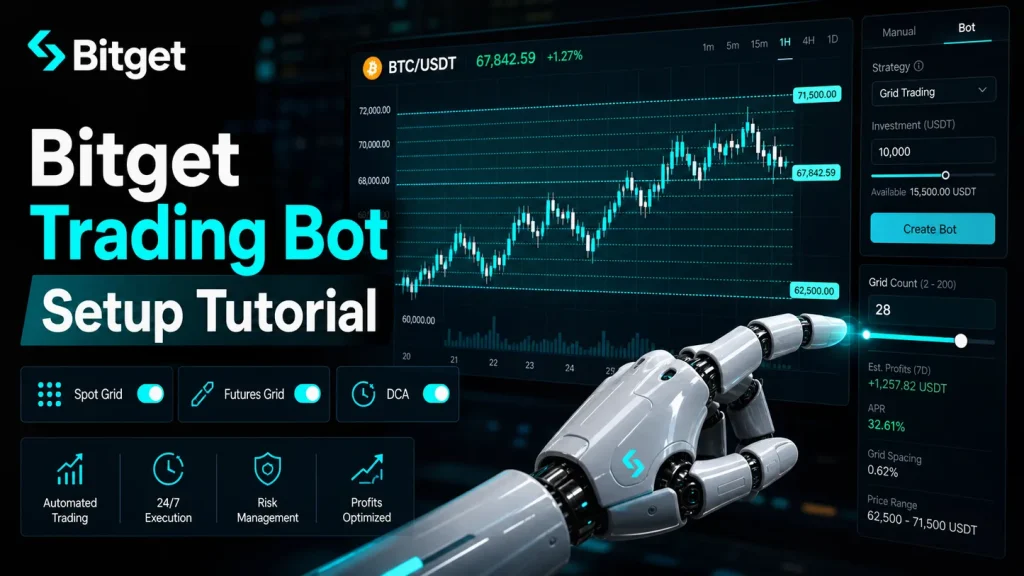
If you’ve ever wished your crypto trades could execute themselves while you sleep, welcome to the world of automated strategies. This Bitget Trading Bot Setup Tutorial walks you through the exact steps to launch profitable-minded bots on Bitget, including Spot Grid, Futures Grid, and DCA. You’ll learn configuration essentials, risk controls, and practical tweaks that real traders use to keep bots running smoothly in both choppy and trending markets.

- 20% trading fee discount
- $100 signup bonus
- $10,000 futures bonus

- 20% fee cashback
- $10,000 bonus

- 20% fee cashback
- $8,000 bonus

- 50% trading fee discount
- 20% fee cashback
- $6,200 futures bonus

- 20% trading fee discount
- $30,050 signup bonus

- 20% fee cashback
- $60,000 futures bonus
Pro tip right from the start: create your account with the best fee incentives so your bot can capture more of each trade’s edge. Use this sign-up link and referral code for enhanced benefits: Join Bitget with code cryptonew0. With that link and code, you’ll get a 50% trading fee discount, 20% fee cashback, and up to $6,200 in futures bonuses (terms apply). Lower fees directly improve the net performance of grid, DCA, and high-frequency strategies.
What You’ll Learn
- How to create and fund a Bitget account with optimal fee perks
- The differences between Spot Grid, Futures Grid, and DCA bots
- Step-by-step setup for each bot type (with practical examples)
- How to choose parameters: price bounds, grid counts, leverage, and risk guards
- Advanced optimization tips, monitoring routines, and troubleshooting
Quick-Start Checklist
- Create your account via Join Bitget with code cryptonew0 and confirm the code “cryptonew0”.
- Complete security setup (2FA) and, if needed, KYC for higher limits.
- Deposit USDT or buy crypto on-ramp inside Bitget.
- Pick a bot type: Spot Grid (range markets), Futures Grid (trending with leverage), or DCA (steady accumulation with smart safety orders).
- Choose a trading pair, define price bounds, grid count (or DCA schedule), and risk controls (TP/SL, leverage, margin mode).
- Backtest/preview, confirm, and monitor performance.
Why Bitget Bots Make Sense for Retail Traders
- Round-the-clock automation: Let your predefined logic act instantly on volatility.
- Discipline by design: Remove hesitation, FOMO, and early exits.
- Structure for any market: Grid excels in ranges; DCA suits long-term accumulation; Futures Grid can follow trends with leverage.
- Fee efficiency: Using Join Bitget with code cryptonew0 helps offset costs via fee discounts and cashback, which is crucial when your bot executes many small trades.
Choosing Your Bot Type
Spot Grid Bot (range-focused)
- Best for sideways or oscillating markets.
- Buys lower in your selected range and sells higher, capturing incremental profits repeatedly.
- Works with spot assets (no liquidation risk), but can underperform in strong one-way trends.
Futures Grid Bot (trend or volatility-focused with leverage)
- Trades perpetual futures with configurable leverage.
- Can outperform in trending markets by deploying grids biased toward long or short.
- Carries funding payments/receipts and liquidation risk; use risk controls and moderate leverage.
DCA Bot (steady accumulation with logic)
- Buys at a fixed schedule or triggered by price dips.
- Ideal for building positions over time and smoothing entry price.
- Add safety orders and dynamic rules to accumulate more on drawdowns.
Account Setup and Fee Optimization
- Sign up using Join Bitget with code cryptonew0. During registration, confirm the referral code “cryptonew0”.
- Enable 2FA for withdrawals and trading security.
- Complete KYC if you need higher limits or want full access to promotions.
- Deposit USDT, USDC, or the base/quote asset you plan to trade. You can also buy crypto directly with a bank card or P2P.
Benefits with the link and code above:
– 50% trading fee discount
– 20% fee cashback
– Up to $6,200 in futures bonus credits
Lower frictional cost is a compounding advantage for high-frequency bots; even 10–20 bps saved per round-trip can materially change long-run outcomes.
Key Parameters You Must Understand
- Trading pair: Example BTC/USDT (Spot) or BTCUSDT (Perps).
- Price bounds (Upper/Lower): The range you expect price to oscillate within for grid bots.
- Grid count: Number of horizontal levels. More grids = more frequent but smaller trades; fewer grids = larger PnL per fill but fewer fills.
- Grid mode (Arithmetic vs Geometric): Arithmetic keeps equal price gaps; Geometric keeps equal percentage gaps.
- Investment amount: Total capital the bot controls; allocates across grid orders or DCA orders.
- Take-Profit (TP) and Stop-Loss (SL): Exit triggers to protect capital and lock in gains.
- Leverage (Futures Grid): Amplifies gains and losses. Choose isolated or cross margin.
- Funding rates (Futures): Periodic payments depending on long/short crowding.
- Min order size: Ensure each order meets exchange minimums to avoid rejections.
Step-by-Step: Spot Grid Bot Setup (BTC/USDT Example)
- Navigate to Trade > Bot Trading > Spot Grid.
- Choose your market, e.g., BTC/USDT.
- Decide Manual vs AI parameters. AI often proposes a sensible range based on recent volatility; Manual gives full control.
- Set Price Bounds:
- Lower: 24,000 USDT
- Upper: 36,000 USDT
- Rationale: Captures a wide historical range to harvest swings.
- Grid Count: 50 (Geometric). With volatility, geometric spacing can better align with percentage moves.
- Invest Amount: 1,000 USDT. The bot divides this into base and quote holdings as needed.
- Fees and Slippage: Check min order size; 1,000 USDT across 50 grids implies small orders. Consider 30–70 grids to balance fill frequency with min size.
- Risk Controls:
- Global TP: e.g., 12% above average entry to exit the entire grid if price breaks out.
- SL: e.g., 10% below the lower bound to avoid catching a falling knife.
- Backtest/Preview: Review historical fills and estimated PnL. It won’t predict the future, but it will sanity-check settings.
- Start and Monitor: Check daily. If price drifts outside your bounds, consider pausing and re-centering.
Order sizing rule of thumb: With geometric grids, the bot often allocates proportionally. Keep each order above the pair’s minimum trade size. If your capital is small, reduce grid count.
Step-by-Step: Futures Grid Bot Setup (ETHUSDT Perpetual Example)
- Go to Trade > Bot Trading > Futures Grid.
- Select ETHUSDT Perpetual.
- Margin Mode: Start with Isolated to hard-limit risk per position.
- Leverage: 2x–3x is conservative for beginners. Higher leverage tightens liquidation prices.
- Price Bounds:
- Lower: 2,600 USDT
- Upper: 3,100 USDT
- Bias: If you’re more bullish, set slightly more grids above the mid-price (or use a long-only bias if Bitget provides the option).
- Grid Count: 25–40 for balanced activity.
- Investment and Initial Margin: Allocate capital that keeps liquidation well outside your bounds. Use the preview to see est. liquidation price.
- Funding: Check current funding rates. If you’re consistently paying high funding, it can eat into grid profits — consider re-centering or reducing leverage.
- TP/SL and Drawdown Controls:
- Global TP at +8%–12% from average entries if trend accelerates in your favor.
- SL if price slices through your lower bound (for long-biased) to avoid cascading losses.
- Start and Monitor: Watch for “insufficient margin” warnings, adjust leverage or reduce grids if fills become too dense.
Note: Futures Grid introduces liquidation risk. Always keep a healthy margin buffer and avoid overlapping too many leveraged bots on correlated assets.
Step-by-Step: DCA Bot Setup (ETH Accumulation Example)
- Navigate to Trade > Bot Trading > DCA.
- Select ETH/USDT (Spot).
- Schedule: Every 12 hours or daily at a fixed time.
- Base Order: $50 per buy.
- Safety Orders: 3–5 levels triggered on dips (e.g., -3%, -6%, -10%, -15%, -20%).
- Multiplier: 1.5x–2x for each safety order to buy more as price falls.
- Max Investment: Cap total at a comfortable level.
- Take Profit: Optionally sell a portion when average cost x target profit is reached (e.g., +8%).
- Start: Review projected allocations and ensure you have enough USDT.
DCA shines for long-term builders. Combining time-based buys with dip-triggered safety orders can reduce average entry price during corrections.
Risk Management Essentials
- Size conservatively: For beginners, keep any single bot position below 10–20% of account equity; adjust by volatility.
- Diversify pairs: Avoid running all bots on tightly correlated assets.
- Respect min order sizes: Too many grids with tiny funds leads to rejected orders and patchy performance.
- Avoid illiquid pairs: Stick to high-liquidity majors for tighter spreads and reliable fills.
- Use stops where appropriate: Especially for Futures Grid to mitigate liquidation risks.
- Event awareness: Pause or widen grids ahead of major news, CPI, FOMC, or protocol events.
Fees, Funding, and Real-World PnL
- Spot Grid PnL comes from buying low/selling high minus fees. With Join Bitget with code cryptonew0, a 50% fee discount plus 20% fee cashback can significantly improve net returns in high-turnover strategies.
- Futures Grid PnL adds funding effects. If you’re paying funding consistently, either rotate bias (long/short), reduce leverage, or shift to a pair with lower funding.
- Slippage and spreads: Liquid markets help. Market depth matters for grid performance.
Simple PnL lens:
– Gross PnL ≈ Sum of (Sell proceeds − Buy cost) across all closed grid cycles ± Funding (futures) ± Unrealized changes in inventory.
– Net PnL = Gross PnL − Fees − Slippage impact.
Monitoring and Optimization
- Daily check-in: Ensure the bot remains within price bounds and orders are filling.
- Re-centering: If price trends out of range, pause and redefine bounds around the new median.
- Grid density: Increase grids when volatility contracts; reduce when volatility expands to avoid overtrading noise.
- Capital rotation: If one bot stagnates, consider reallocating to a more active market.
- Export logs: Review fills and fee impact periodically. Minor parameter improvements compound over time.
Troubleshooting Common Issues
- Insufficient balance: Reduce grid count, increase per-order size, or add funds.
- Below minimum order size: Fewer grids or higher capital per bot.
- Price left the grid: Pause, reassess the range; either widen or recenter.
- Frequent liquidations (futures): Lower leverage, increase isolated margin, add stop-loss, and widen bounds.
- Too few fills: Increase grid count or choose a pair with more volatility.
Advanced Tips Used by Experienced Bot Traders
- ATR-based bounds: Set upper/lower price via recent Average True Range multiples to adapt to volatility regimes.
- Layered grids: Run multiple smaller grids at different ranges instead of one mega-grid to diversify fill behavior.
- Time-boxed bots: Schedule bots around known liquidity windows (e.g., New York/London overlap) and pause during illiquid hours if spreads widen.
- Partial profit locking: Use global TP to bank gains, then re-deploy a fresh grid centered around the new price.
- Futures hedging: If long-biased on spot grid inventory, a small short futures hedge during risk events can smooth equity curves.
Frequently Asked Questions
- Is KYC required? You can start without full KYC, but completing it increases limits and unlocks more features.
- Mobile vs desktop? Bitget offers both; bots are fully configurable in the mobile app.
- Can I copy settings? Yes, you can start from AI or community templates, then adjust to your risk tolerance.
- What about maintenance? During exchange maintenance, bots may temporarily pause order placements; they generally resume after services restore.
Get Started With Optimal Fee Advantages
Set your bots up the right way from day one. Create your account with the highest-value incentives: Join Bitget with code cryptonew0. You’ll unlock a 50% trading fee discount, 20% fee cashback, and up to $6,200 in futures bonuses — powerful perks for any grid, futures, or DCA strategy.