
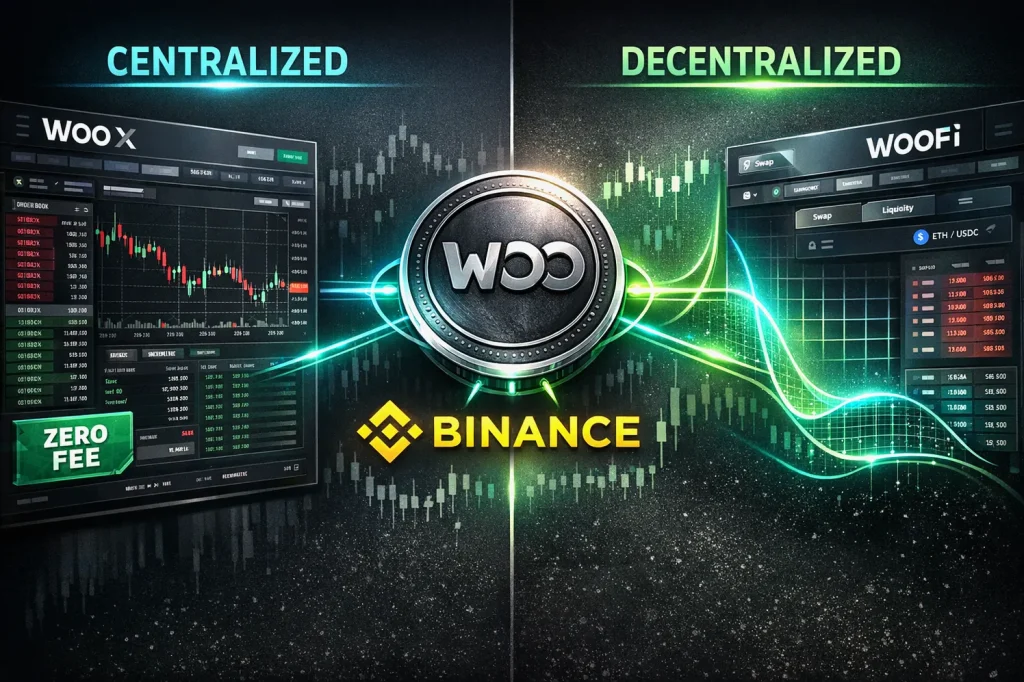
If you’ve heard traders rave about deep liquidity, tight spreads, and zero-fee zones, there’s a good chance they were talking about the WOO Network and its native token, WOO. In this guide, I’ll break down exactly what the WOO (WOO) coin is, how the WOO ecosystem works across centralized and decentralized trading, the latest tokenomics updates (including a major community-approved burn in January 2026), and a step-by-step walkthrough on how to buy WOO on Binance with a fee discount.

- 20% fee cashback
- $8,000 bonus

- 20% trading fee discount
- $30,050 signup bonus

- 20% trading fee discount
- $100 signup bonus
- $10,000 futures bonus

- 20% fee cashback
- $60,000 futures bonus

- 50% trading fee discount
- 20% fee cashback
- $6,200 futures bonus

- 20% fee cashback
- $10,000 bonus
Quick take
– WOO is the utility and governance token of the WOO Network, which powers both the WOO X centralized exchange and the WOOFi decentralized trading suite. It’s designed for staking, fee discounts, governance, and value accrual via buyback-and-burn. (academy.binance.com)
– On-chain, WOOFi uses a Synthetic Proactive Market Making (sPMM) model to simulate order-book style execution with competitive pricing and low slippage. (learn.woo.org)
– WOO’s supply is deflationary through an ongoing buyback-and-burn program; the network executed a large tokenomics revamp in 2023 and the community unanimously approved a permanent burn of 300 million WOO in January 2026. (woox.io)
What is the WOO (WOO) coin?
WOO is the native token of the WOO Network, a liquidity-focused ecosystem incubated by quantitative trading firm Kronos Research. The network connects traders, institutions, and DeFi apps to shared liquidity and execution via its CEX (WOO X) and its DEX suite (WOOFi). The WOO token underpins this with staking rewards, fee discounts, and governance rights across the ecosystem.
- WOO X (CEX): professional trading environment offering deep liquidity, advanced workspaces, and periodic zero-fee initiatives designed to keep costs ultra-competitive. Staking WOO on WOO X influences fee tiers in a dynamic fee schedule. (woox.io)
- WOOFi (DEX): the on-chain side of WOO, featuring Swap, Earn, and Pro (perps) built on the sPMM algorithm that references market data to quote tighter prices than typical AMM curves.
How WOO accrues value in the ecosystem
The WOO token is meant to be more than a passive asset. Its core utilities include:
- Fee benefits and staking on WOO X: WOO X uses a dynamic fee model where staking WOO and reaching volume thresholds can unlock lower fees or zero-fee zones depending on campaigns. (support.woox.io)
- Staking and revenue share on WOOFi: staking WOO within WOOFi is positioned to share a substantial portion of the platform’s net revenue with stakers and grant discounts within WOOFi Pro, aligning on-chain traders with protocol performance. (woox.io)
- Governance: the community participates in proposals that can materially change token economics and platform direction, as seen with the major burn vote in 2026. (paragraph.com)
Tokenomics and supply: the big burns you should know
WOO launched with a maximum supply of 3,000,000,000 WOO, issued initially as an ERC‑20 token. The network has pursued a deflationary path through recurring buybacks and burns sourced from ecosystem revenues. (etherscan.io)
- 2023 tokenomics revamp: WOO Network announced and executed a large restructuring that included burning more than 705 million WOO (about 24% of max supply at the time) by sunsetting certain programs (e.g., WOO Ventures and WOO DAO allocations).
- January 2026 governance burn: the community approved the permanent burn of 300 million previously locked WOO—roughly 15% of the total supply—removing them from future circulation and strengthening the deflationary profile.
- Ongoing buyback-and-burn: the network maintains a recurring program to repurchase WOO on the market and send it to a burn address, providing consistent supply reduction over time. (learn.woo.org)
Note: WOO exists on multiple chains via bridges, but the canonical token originated as an ERC‑20. If you self-custody, always verify you’re interacting with the correct contract on the correct network. The original Ethereum contract for WOO is 0x4691937a7508860f876c9c0a2a617e7d9e945d4b (verify on Etherscan).
WOOFi’s sPMM in plain English
Most DEXs use Automated Market Makers (AMMs) that set prices based on pool ratios. WOOFi’s sPMM is different: it references external market data (via oracles and internal logic) to proactively quote prices that track order-book markets more closely. This design seeks to deliver tighter spreads and lower slippage on-chain while retaining DeFi composability.
Where does WOO fit in a trading stack?
- Active traders can use WOO X for deep liquidity and low fees—with staking tiers and periodic zero-fee campaigns enhancing cost efficiency.
- On-chain traders can route swaps or trade perps with WOOFi, where WOO staking can share protocol revenues and unlock discounts, tying long-term incentives to actual platform usage.
How to buy WOO (WOO) on Binance — step by step
You can purchase WOO on major exchanges, including Binance. Here’s a simple, beginner-friendly path using Binance.
1) Create your Binance account
– Use this partner link to register: Binance. Enter the referral code CRYPTONEWER during signup to unlock a 20% trading fee discount, plus up to $10,000 in bonus benefits for new users (promotions may vary by region).
2) Verify your identity (KYC)
– Complete identity verification for higher limits and access to fiat on-ramp features. This also helps secure your account.
3) Add funds
– Deposit fiat via card, bank transfer, or third-party payment methods supported in your country, or deposit crypto (e.g., USDT) from another wallet or exchange.
4) Find the WOO market
– Go to Trade → Spot, type “WOO” in the search bar, and select a liquid pair (commonly WOO/USDT). Binance Academy’s buying guides follow the same basic flow: log in, head to Spot, search for WOO, and place an order. (academy.binance.com)
5) Choose your order type
– Market order for instant execution at the best available price; or Limit order to set your own price. Consider using small test orders first when you’re new.
6) Store your WOO safely
– For convenience, you can leave assets on Binance with strong account security (2FA, anti-phishing code). For self-custody, use a wallet that supports ERC‑20 tokens and always double-check the token contract you add before transferring.
Pro tip: After purchase, consider whether staking WOO on WOO X or WOOFi aligns with your goals—fee reductions on WOO X or revenue sharing and discounts on WOOFi are key parts of the token’s utility.
Why some traders choose WOO over alternatives
- Liquidity access: WOO’s roots in market making provide robust liquidity and tight spreads, both on WOO X and through WOOFi’s sPMM-powered pricing.
- Fee efficiency: between dynamic fee tiers, staking, and periodic zero-fee campaigns, cost-conscious traders can meaningfully reduce friction.
- Evolving tokenomics: substantial burns in 2023 and a community-validated burn in January 2026 underpin a deflationary trajectory tied to ecosystem performance.
FAQ
- Is WOO a governance token? Yes—WOO holders participate in governance that can shape token economics and product direction (the January 2026 burn vote is a notable example).
- Is WOO an ERC‑20 token? WOO originated as an ERC‑20 token; bridged versions exist on other chains. Always verify you’re transacting with the canonical contract when self-custodying.
- What makes WOOFi different from a typical AMM DEX? Its sPMM model references market data to quote proactive, order-book-like prices, aiming for low slippage and competitive fills.
Security reminder: this is not financial advice. Crypto carries risk, including market volatility and smart-contract or exchange risk. Research before investing, use strong account security, and start small while you learn.
Special offer for readers
- New to Binance? Sign up with the partner link Binance and code CRYPTONEWER for a 20% trading fee discount and up to $10,000 in benefits (subject to Binance’s current promotions and your region’s eligibility).
Related posts:
 What is the BDXN (BDXN) Coin and How to Buy with Confidence — Expert Deep Dive 2026
 What is the $PAAL(PAAL AI) Coin and how to buy — Actionable 2026 Guide
 Essential guide to What is the MAGMA (MAGMA) Coin and how to buy
 What is the UPTOP(UPTOP) Coin, and how to buy Essential guide that actually works