
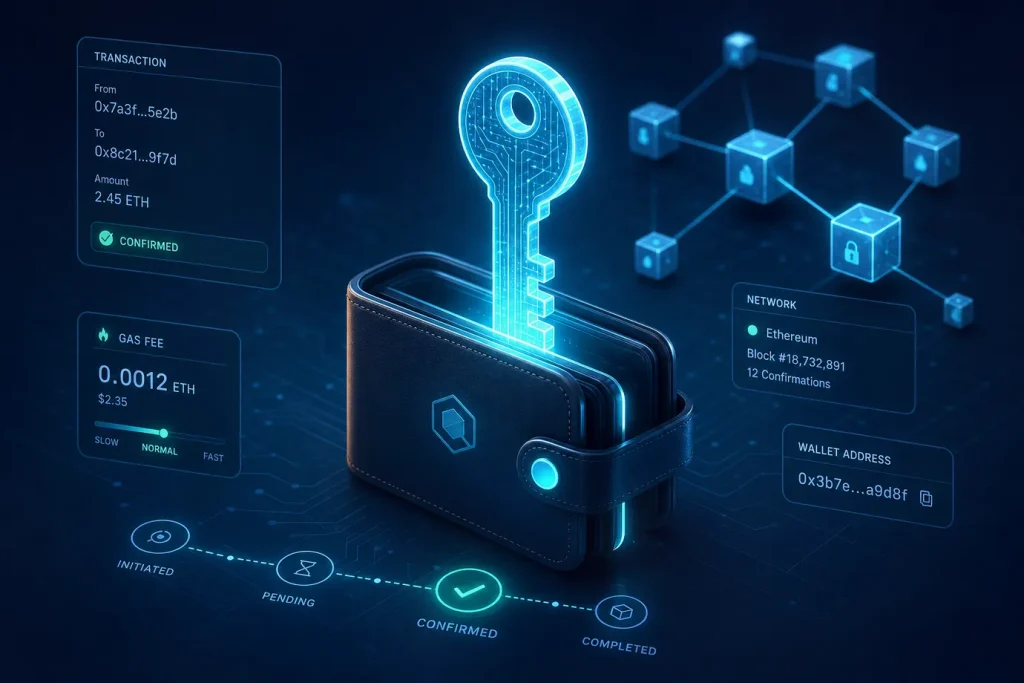
If you’ve ever asked yourself “What Is a Blockchain Wallet?” you’re already ahead of most new crypto users. A blockchain wallet isn’t a purse for coins—it’s a set of tools that let you control cryptographic keys and sign transactions across decentralized networks. With the right setup, a wallet becomes your gateway to Bitcoin, Ethereum, NFTs, DeFi, and beyond.

- 20% trading fee discount
- $100 signup bonus
- $10,000 futures bonus

- 20% fee cashback
- $8,000 bonus

- 20% fee cashback
- $60,000 futures bonus

- 50% trading fee discount
- 20% fee cashback
- $6,200 futures bonus

- 20% fee cashback
- $10,000 bonus

- 20% trading fee discount
- $30,050 signup bonus
- Short answer to “What Is a Blockchain Wallet?”: A blockchain wallet manages your public and private keys, creates addresses, and signs transactions so you can send, receive, and interact with crypto and Web3 apps.
- Power takeaway: Keys are everything. If you control the private key (or seed phrase), you control the funds.
Why wallets matter in crypto
Traditional finance accounts show balances controlled by banks. In crypto, a wallet lets you authorize movements of value directly on the blockchain. That design puts you in control—and it demands good security habits. Losing a password can be reset with a bank; losing a seed phrase usually can’t.
How a blockchain wallet works
- Key pairs: Your wallet generates a private key and derives a public key. The public key (or an address derived from it) is safe to share; the private key must remain secret.
- Addresses: These are like email addresses for money. Bitcoin uses different formats (Legacy, SegWit, Bech32, Taproot), while Ethereum uses 0x-prefixed addresses with checksums.
- Signing: To send funds, you sign a transaction with your private key. Nodes verify your signature and update the ledger.
- Models: Bitcoin uses a UTXO model (unspent outputs), while Ethereum and many Web3 chains use an account model with nonces and gas.
- HD wallets: Modern wallets follow standards like BIP32/39/44 to derive multiple addresses from one seed phrase. One backup can recreate many accounts.
Types of blockchain wallets
- Custodial exchange wallets: Managed by a platform that holds keys on your behalf. Great for convenience, beginners, and active trading.
- Non-custodial software wallets: Mobile, desktop, or browser extension wallets where you hold the keys. Examples include mobile wallets, browser-based Web3 wallets, and desktop clients.
- Hardware wallets (cold wallets): Physical devices that keep private keys offline. They sign transactions in a secure element and are widely considered the gold standard for long-term storage.
- Smart contract wallets: Wallets like Safe or account abstraction wallets that enable features like social recovery, spending limits, and gas sponsorship.
- MPC wallets: Multi-party computation splits a key among several devices/parties; no single device holds the full key. Useful for teams and institutions.
- Multisig: Requires multiple signatures to move funds, improving security for treasuries and shared accounts.
- Paper and watch-only wallets: Niche options; paper is largely outdated, and watch-only is great for monitoring balances without spending capability.
Quick start with a custodial wallet for trading
If you want to start quickly, a custodial exchange account is a low-friction path. Create an account, deposit fiat or crypto, and you’re in.
- Start here: OKX sign-up with code CRYPTONEWER
- Perks for new users: 20% fee cashback and up to $60,000 futures bonus
- Use code: CRYPTONEWER during registration
Custodial wallets like OKX handle backups and key management for you, while giving access to spot trading, staking, and futures (advanced users only; understand the risks). You can later withdraw to a non-custodial wallet you control.
Non-custodial wallet setup in 7 steps
1) Choose your wallet type: mobile, browser, or hardware.
2) Generate a new wallet: follow prompts to create a seed phrase (12–24 words).
3) Back up securely: write the seed phrase on paper or steel—never a screenshot, never cloud notes.
4) Optional passphrase: add a 13th/25th word for extra security, but store it separately.
5) Set a strong local password and enable biometric locks where available.
6) Test a restore: on a spare device, restore from the seed phrase to confirm your backup works.
7) Fund and practice: receive a small amount, send a test transaction, and learn how to view your transaction history on a block explorer.
Security essentials for every crypto wallet
- Seed phrase hygiene: offline backups, duplicate copies, tamper-proof storage. Consider a fireproof metal backup.
- Device security: OS updates, reputable antivirus, and a dedicated device for large holdings.
- Phishing defense: always verify URLs, never sign blind permissions, and beware of fake support.
- Approvals and allowances: for Web3 wallets, regularly review and revoke unnecessary token allowances using reputable tools.
- Transaction simulation: many wallets simulate the outcome before you sign—use this feature.
- 2FA on exchanges: enable TOTP-based 2FA and withdrawal whitelists.
- Multisig and MPC: use for team funds or large treasuries; distribute risk.
Fees 101: gas, miners, and mempools
- Bitcoin fees: depend on byte size and mempool congestion. Replace-By-Fee (RBF) lets you speed up stuck transactions.
- Ethereum and EVM chains: gas measures computation. EIP-1559 introduced base fees that burn and priority tips for miners/validators. Learn to adjust max fee and max priority fee.
- Layer 2s: rollups reduce costs; confirm withdrawal delays and bridging risks.
- Withdrawal fees vs network fees: exchanges charge withdrawal fees; non-custodial sends only pay network fees.
Cross-chain reality check
- EVM vs non-EVM: many wallets support multiple chains, but addresses may differ. Never send to an incompatible chain.
- Bridges: useful but risky; stick to audited bridges, confirm chain IDs, and test with small amounts first.
- ENS and naming: services like ENS map names to addresses—helpful but verify the resolved address.
Smart contract wallets and account abstraction
- Account abstraction (e.g., ERC-4337): enables features like gas sponsorship, session keys, spending limits, and programmable recovery.
- Social recovery: designate guardians who can help you recover access without exposing your seed.
- Paymasters: third parties can sponsor gas, enabling “fee-less” user experiences.
Custodial vs non-custodial: choosing what fits you
- Go custodial if: you need fiat ramps, frequent trades, or simple UX. Great for learning and liquidity.
- Go non-custodial if: you value self-sovereignty, DeFi, and on-chain governance. Requires strong security habits.
- Hybrid path: keep a trading stack on an exchange and long-term holdings in a hardware wallet.
Getting started on OKX in minutes
- Create an account with OKX sign-up with code CRYPTONEWER
- Benefits: 20% fee cashback, up to $60,000 futures bonus for eligible users
- Deposit fiat via card/bank or deposit crypto
- Explore Web3 features and withdraw to your self-custody wallet when ready
Advanced wallet details you’ll see in the wild
- BIP standards: BIP39 for seed phrases, BIP32 for HD derivation, BIP44 for coin/account paths, BIP84 for native SegWit, BIP86 for Taproot.
- Derivation paths: mismatches cause “missing funds” panic—always select the intended path when restoring.
- Nonces and RBF: Ethereum transactions queue by nonce; stuck transactions may require replacing or canceling by sending another with the same nonce and higher gas.
- Change addresses in Bitcoin: leftover value returns to a change address—totally normal.
NFT and DeFi with your wallet
- NFTs: stored on-chain or via pointers (e.g., IPFS). Your wallet holds the keys; the token references the media.
- DeFi: lending, swaps, liquidity pools—careful with smart contract risk and approval scopes.
- Allowance hygiene: limit approvals to the necessary amount and revoke after use.
Privacy pointers
- Address reuse: avoid where possible on Bitcoin to improve privacy.
- Network metadata: wallets can leak IP data; use privacy-preserving features or reputable providers.
- Mixers and compliance: understand the legal landscape in your jurisdiction.
Troubleshooting common issues
- Wrong network: tokens not visible? Check if you’re on the correct chain and add the token contract.
- Stuck transaction: use RBF on Bitcoin or speed up/cancel on Ethereum by resending with the same nonce and higher gas.
- Lost device: restore from seed phrase on a new device; for custodial accounts, use account recovery.
- “Airdrop” scams: don’t interact with unknown tokens—approvals may drain your wallet.
Inheritance and disaster planning
- Document locations of seed backups, passphrases, and hardware PINs for trusted heirs.
- Consider multisig or social recovery to reduce single-point-of-failure risk.
- Store clear, non-technical instructions for executors while keeping secrets uncompromised.
How to pick the right wallet for you
- Security model: open-source code, audits, secure element for hardware.
- Ecosystem support: Bitcoin, Ethereum, Layer 2s, Solana, and the chains you actually use.
- UX fit: do you need a mobile-first wallet, a browser Web3 wallet, or an exchange app?
- Recovery options: pure seed phrase, social recovery, MPC, or custodial account recovery.
- Fees and features: staking, swaps, in-wallet dApp browsers, transaction simulation.
Bringing it all together
Asking “What Is a Blockchain Wallet?” is really asking how you’ll handle power and responsibility in the crypto economy. Custodial wallets prioritize ease; non-custodial wallets maximize sovereignty. Most users blend the two.
When you’re ready to trade, onboard, or explore markets quickly, claim your perks at OKX sign-up with code CRYPTONEWER for 20% fee cashback and up to $60,000 in futures bonuses. When you’re ready to self-custody, graduate to a reputable non-custodial wallet and practice safe key management—because in crypto, your keys are your kingdom.
Related posts:
 What is the COCOS(Cocos-BCX) Coin, and how to buy — a field‑tested guide to the COMBO rebrand
 What is the TOMO(TomoChain) Coin, and how to buy Essential Guide for 2026
 Essential Answer to What Is a Blockchain Fork? Types, Risks, and Real Examples
 High-Impact Top Blockchain Use Cases for Startups That Drive Real ROI