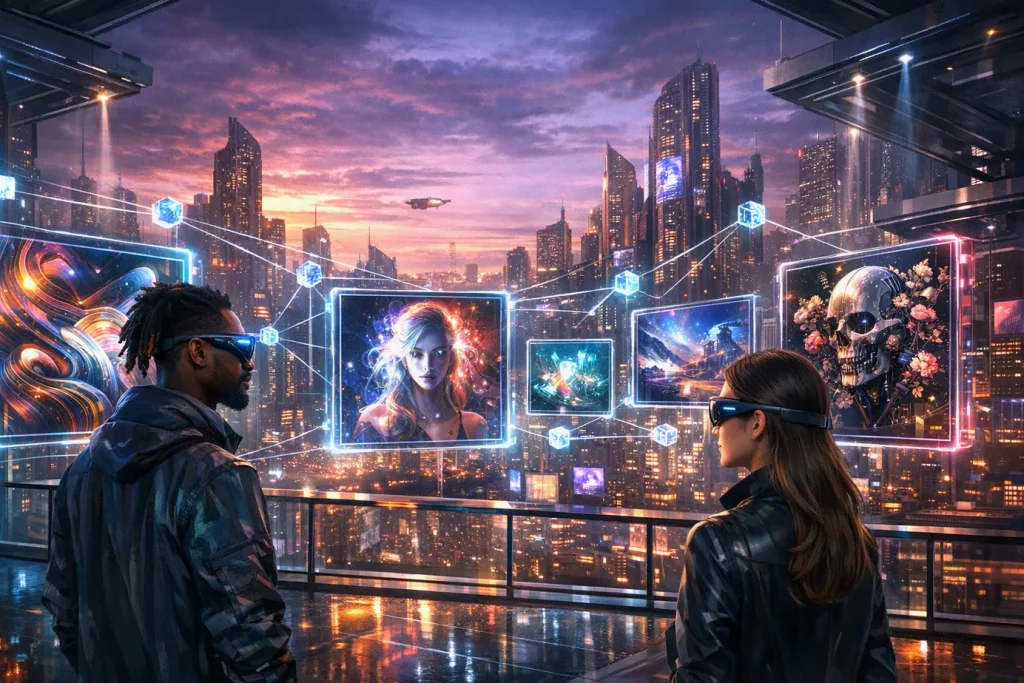
Digital art is no longer confined to screens and galleries—it now travels across wallets, smart contracts, and global communities. “NFTs and the Future of Digital Art” isn’t a passing meme; it’s a structural shift in how art is made, owned, valued, displayed, and funded. From programmable royalties to phygital experiences, NFTs rewire the relationship between creators and collectors while enabling new models for discovery, distribution, and participation.

- 20% trading fee discount
- $100 signup bonus
- $10,000 futures bonus

- 20% fee cashback
- $8,000 bonus

- 20% fee cashback
- $10,000 bonus

- 20% trading fee discount
- $30,050 signup bonus

- 20% fee cashback
- $60,000 futures bonus

- 50% trading fee discount
- 20% fee cashback
- $6,200 futures bonus
Quick takeaway: NFTs turn digital files into verifiable assets with provenance and programmable rights. The future of digital art blends on-chain ownership, interoperable media, and community-led curation.
What NFTs Changed for Digital Art
- Verifiable provenance and scarcity: An NFT’s token ID and contract address publicly anchor authorship and edition size on a blockchain (commonly Ethereum). Standards like ERC‑721 and ERC‑1155 define non-fungible and semi-fungible tokens.
- Programmable economics: Royalties, access rights, and unlockable utilities can be coded at mint. While on-chain enforcement of royalties varies by marketplace, creator-friendly standards like EIP‑2981 formalize how royalty info is reported.
- Global liquidity and reach: Artists can mint from anywhere, collectors can bid from anywhere, and communities can form around collections with clear on-chain history.
- Interoperability: The same NFT can power token-gated websites, in-gallery screens, AR filters, or immersive worlds—no need to re-upload and re-verify ownership.
Storage, Permanence, and “On-Chain” Questions
The art file’s permanence matters. You’ll see:
- On-chain art: The media (often code for generative art) lives fully on-chain. High permanence, small file sizes.
- IPFS and content addressing: Storing media via IPFS or pinning services with content hashes improves resilience vs. a simple URL.
- Permanent storage: Archival layers like Arweave aim at long-term persistence; some projects combine Arweave for media with Ethereum for provenance.
Tip: Always inspect a token’s metadata. If the art URL is a plain web server link, longevity depends on that server. When choosing where to mint, ask how metadata is pinned or persisted.
Royalties, Reality, and Sustainable Creator Income
NFT royalties became a rallying cry—then a debate. Some marketplaces honor them; others make them optional. The future likely blends:
- Protocol-level royalty signaling (EIP‑2981) plus curated marketplaces that commit to paying.
- Utility-driven models: artists offering token-gated drops, events, or allowlists to reward primary and secondary collectors.
- Patronage plus profit: community patrons support artists beyond speculative flips, with perks, votes, or physical editions.
Creators should design for multiple revenue moments—primary sales, limited editions, collaborations, commissions, and experiences—not rely solely on automatic resale fees.
Emerging Formats: Dynamic, Generative, and AI-Native NFTs
- Dynamic NFTs (dNFTs): Art that changes with time, data feeds, or on-chain events; think weather-reactive visuals or evolving traits.
- Generative art: Code as the medium, minted at purchase with unique seeds. Platforms like Art Blocks popularized this model.
- AI x NFTs: Artists train models or co-create with AI, then release editions or one-of-ones with fine-tuned provenance. Disclosure of process, datasets, and rights becomes crucial.
- Soulbound and reputation tokens: Non-transferable credentials may anchor exhibition history, grants, or juried awards on-chain without being tradable.
Marketplaces and Curation: Where Art Meets Order Flow
- General marketplaces: Open markets (e.g., OpenSea, Blur) optimize liquidity and discovery; royalty policies vary.
- Curated galleries: SuperRare, Foundation, and independent storefronts (e.g., Manifold, Zora) emphasize curation, custom contracts, and artist control.
- Vertical platforms: Photography, music, and literary NFTs thrive on niche platforms with tailored collectors and norms.
Curation is moving on-chain via lists, registries, and provenance scores. Expect more reputation graphs: which collectors discovered significant works early, which curators consistently select high-quality art.
Legal and Licensing: From CC0 to Restricted Commercial Rights
Owning an NFT typically grants ownership of the token, not necessarily the underlying copyright—unless licensed explicitly. Common approaches:
- CC0/public domain: Maximizes remixing and meme potential, leaning on brand/community growth.
- Personal use licenses: Display and resale rights, limited commercial use.
- Commercial rights with caps: Allows merchandise or derivative sales up to a revenue ceiling.
Artists should publish clear licenses in metadata or linked documents. Collectors should read them. Jurisdiction, securities law, and consumer protection rules vary globally; consult local counsel if launching a large-scale project.
Environmental Context and Scaling
Ethereum’s move to Proof of Stake reduced its energy footprint significantly. For cost and scale, creators often mint on Layer 2s and sidechains:
- L2s: Arbitrum, Optimism, Base, zkSync, Starknet
- Sidechains and app chains: Polygon, Immutable, Avalanche subnets
Result: lower fees, faster mints, and carbon-light drops—without sacrificing composability.
Creator Playbook: From Idea to Sold-Out Drop
1) Define your narrative
– What is the artistic thesis? Why does it need to be on-chain? Consider series coherence and collector journey.
2) Choose your format and contract
– ERC‑721 for unique 1/1s and small editions; ERC‑1155 for larger edition economics and flexible supplies.
– Consider custom contracts via Manifold or Zora, or commission a developer to implement features like on-chain scripts, allowlists, and royalty signals.
3) Plan supply and release
– Editions vs. one-of-ones vs. generative long-form.
– Dutch auctions or fixed pricing to mitigate gas wars.
– Staggered releases tied to IRL shows, livestreams, or token-gated previews.
4) Archive and metadata
– Store media on IPFS/Arweave; freeze metadata when final.
– Embed license terms and link to a canonical artist statement.
5) Community and distribution
– Announce to mailing lists, social, and Discord; partner with aligned curators.
– Reward early supporters with presale access or claimable prints.
6) Post-mint utility
– Token-gated studio visits, process notes, or behind-the-scenes chats.
– Airdrop companion works or unlocks that extend the series’ narrative.
Collector Strategy: Due Diligence Beyond Hype
- Check provenance: Contract, creator wallet, prior sales, and authenticity.
- Assess permanence: On-chain media vs. IPFS vs. centralized storage.
- Evaluate the artist’s arc: Body of work, exhibitions, and community engagement.
- Use data: Explore dashboards on Dune or Nansen for trader behavior and liquidity.
- Risk framing: Treat NFTs as high-risk cultural assets. Liquidity is not guaranteed, and prices can be volatile.
Not financial or legal advice. Always do your own research.
Funding, Onboarding, and Fiat Ramps for Art Collectors
To mint or collect, you’ll need crypto, reliable fiat on-ramps, and smooth withdrawals to self-custody. A popular route is a large exchange with deep liquidity, fee discounts, and robust compliance.
- Start here to buy ETH or other NFT-native currencies with a 20% fee discount and up to $10,000 in new-user benefits: Sign up on Binance with code CRYPTONEWER
- After purchase, transfer to your self-custody wallet (e.g., Ledger + MetaMask) before minting or bidding.
- Prefer Layer 2? Bridge funds via official bridges or exchange withdrawals directly to L2 when supported.
Why this matters for creators and collectors
- Lower friction: Faster onboarding means more bidders for your drop.
- Cost savings: Fees compound across trades; the 20% discount improves net yields over time.
- Global reach: Liquidity makes it easier to move between currencies, participate in auctions, and settle quickly.
Claim the benefits while available: Join Binance using the referral code CRYPTONEWER for the 20% fee discount and up to $10,000 in promos. Keep records of fees for taxes.
Security First: Protect the Art and the Wallet
- Hardware wallets and multisig: Store grails and high-value editions in cold storage; use multisig for team-managed vaults.
- Transaction hygiene: Double-check contract addresses, simulate transactions, and limit approvals; revoke permissions periodically using tools like Revoke.cash.
- Communication safety: Scammers impersonate mods; verify announcements on official channels and signed messages.
- Custody split: Keep minting funds in a hot wallet with minimal balances; hold long-term pieces in a separate vault.
Beyond JPEGs: Phygital, Displays, and Onsite Curation
- Phygital collectibles: NFC-chipped prints, sculptures, and frames that verify ownership in real time.
- Curated displays: High-fidelity frames (E Ink, OLED), projection installations, or browser-native galleries showing token-verified works.
- Token-gated IRL: Exhibitions where your wallet is the ticket; collectors co-curate shows via on-chain votes.
Interoperability and the Gallery of Everything
Media no longer lives in a single app. Expect:
- Wallet-native galleries that auto-sync works across chains.
- Portable curation lists you can bring to marketplaces or metaverses.
- Identity overlays: pseudonymous reputations with provable collecting taste and patronage.
Metrics That Matter in the Next Cycle
- Provenance quality: Who minted, who collected early, where it exhibited.
- Permanence score: On-chain media, IPFS pinning depth, redundancy.
- Community cohesion: Collector retention, participation in AMAs, IRL events.
- Creative cadence: Consistency without oversupply; narrative arcs that build over time.
Practical Checklist to Launch Your Next Drop
- [ ] Define story, format, and license (CC0, personal-use, or commercial rights)
- [ ] Deploy custom ERC‑721/1155 with royalty signaling (EIP‑2981)
- [ ] Pin media on IPFS and/or Arweave; freeze metadata when final
- [ ] Plan release mechanics (allowlist, Dutch auction, or timed edition)
- [ ] Prepare storefront (Zora, Manifold) and curation partners
- [ ] Publish a collector guide, display recommendations, and care tips
- [ ] Set up operations: hardware wallet, bookkeeping, tax prep
- [ ] Announce presale and main sale; schedule AMAs and studio tours
- [ ] Post-mint: airdrops, token-gated updates, IRL activation
- [ ] Provide transparent royalty and utility roadmaps
Helpful Links and Deep Dives
- Standards: , , EIP‑2981 Royalties
- Storage: ,
- Licensing: Creative Commons, CC0 FAQ
- Creator tools: Manifold, Zora
- Onboarding with benefits: Create a Binance account with code CRYPTONEWER for 20% fee savings
FAQ Snapshot
- Are NFTs dead? No. Speculative cycles cool and heat up, but the rails—provenance, programmable media, interoperable rights—keep improving.
- What about royalties? Treat them as part of a broader creator toolkit. Design for primary revenue, patronage, and experiences.
- Can I mint on Layer 2? Yes. Fees are lower and speeds higher; bridge or withdraw funds directly if your exchange supports it.
- Where do I start collecting? Acquire ETH and stablecoins on a reputable exchange, then move to a wallet you control. New users can get a 20% fee discount and up to $10,000 in promos via Binance with code CRYPTONEWER.
Related posts:
 Breakthrough guide to Binance Web3 tools in 2025 for builders and investors
 Essential Answer to What Is a Blockchain Fork? Types, Risks, and Real Examples
 What is Blockchain? A Beginner-Friendly Explanation with Smart, Practical Examples
 How DAOs (Decentralized Autonomous Organizations) Work Deep Dive for Builders, Investors, and Communities