
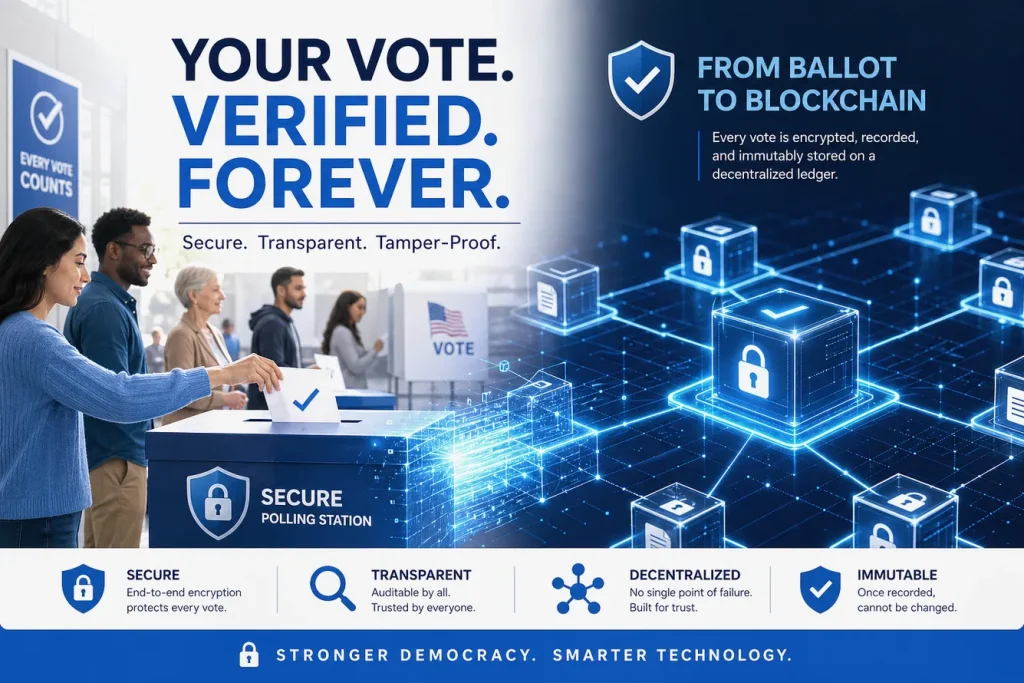
If you’ve ever asked yourself “Can Blockchain Improve Voting Systems?” you’re not alone. Few topics generate as much heat—and confusion—as the idea of casting ballots backed by cryptography and decentralized ledgers. Proponents promise tamper-proof results, instant audits, and a cure for mistrust. Critics warn about coercion risks, broken anonymity, mobile malware, and the hard realities of governing complex networks.

- Bonus pack worth $100–$1,500 USDT
- Fee discount

- 20% trading fee discount
- $100 signup bonus
- $10,000 futures bonus

- 20% fee cashback
- $60,000 futures bonus

- 20% fee cashback
- $10,000 bonus

- 20% fee cashback
- $8,000 bonus

- 50% trading fee discount
- 20% fee cashback
- $6,200 futures bonus

- 20% trading fee discount
- $30,050 signup bonus
This no‑nonsense guide cuts through the hype. We’ll map the real problems elections face, exactly where blockchain helps, and where it plainly doesn’t. We’ll examine field pilots, the trade‑offs between permissioned and permissionless ledgers, and a practical roadmap for governments that want verifiability without reckless risk.
Why Voting Is Hard (With or Without Blockchain)
Elections juggle goals that are famously at odds. Any credible proposal must address these fundamentals:
- Eligibility and integrity: Only eligible voters can vote, and only once.
- Ballot secrecy: No one should link a ballot to a person.
- Coercion resistance: Voters must be free from vote buying or intimidation—and unable to prove how they voted to an adversary.
- End‑to‑end verifiability: Voters and auditors can confirm that all cast votes are counted as cast, and tallies are correct.
- Availability and resilience: The system must function under attack, outage, and high demand.
- Accessibility and usability: The widest range of voters, including those with disabilities and overseas voters, can participate.
The tension is stark: transparency demands public evidence; secrecy demands privacy. Internet and mobile voting add yet more friction: malware on personal devices, phishing, SIM‑swap fraud, and network disruptions all threaten ballot integrity and access.
What “Blockchain Voting” Usually Means
“Blockchain voting” is a catch‑all, but architectures vary widely:
- Permissionless blockchain as a public bulletin board (e.g., using a major public chain). Pros: openness, global timestamping. Cons: fees, congestion, chain governance risks, data permanence.
- Permissioned blockchain maintained by election authorities and independent observers. Pros: performance, governance clarity, lower cost, legal control. Cons: requires trust in the consortium’s rules and key management.
- Hybrid designs: a traditional verifiable tallying system with a blockchain for immutable logging, time‑stamping, or posting commitments and proofs.
In most credible designs, the blockchain is not “where voting happens.” Instead, cryptographic protocols handle ballot secrecy and verifiability, while the ledger acts as an immutable, globally auditable bulletin board for commitments, receipts, or proofs.
Where Blockchain Can Help—Substantively
When you ask “Can Blockchain Improve Voting Systems?” the best answer is “yes, if you use it for the right jobs.” Those jobs include:
1) Immutable audit trails
– Use a ledger to publish hash commitments of ballots, logs, and software builds. This hardens evidence against back‑dating or deletion.
– Immutable time‑stamping helps auditors detect tampering after the fact.
2) Public, append‑only bulletin boards
– Cryptographic protocols for end‑to‑end verifiability require a public place to post data (e.g., encrypted ballots, proofs).
– A well‑governed blockchain provides a transparent publication channel that’s difficult to rewrite.
3) Decentralized oversight
– Multiple independent stakeholders (election authorities, parties, civil society) can co‑manage a permissioned chain via threshold keys.
– Reduces single‑point‑of‑failure risks and lowers the chance of unilateral tampering.
4) Vendor accountability
– Software updates, device certificates, and chain‑of‑custody logs anchored to a ledger can improve forensics and accountability.
Where Blockchain Does Not Magically Fix Voting
- Ballot secrecy and coercion resistance: A ledger doesn’t stop a voter from being coerced at home to reveal how they voted. Strong cryptography and careful protocol design are required; even then, remote voting is inherently hard to make coercion‑resistant.
- Device security: If a voter’s phone or laptop is compromised, a blockchain won’t save them from malware flipping choices before encryption.
- Voter authentication: You still need robust identity proofing that respects privacy and doesn’t disenfranchise voters without easy access to IDs.
- Internet outages and denial‑of‑service: Networks fail; adversaries launch DDoS attacks. Ledgers can be resilient, but access paths must be, too.
- Governance and upgrades: Even blockchains need administrators to update rules or fix critical bugs. Those human processes must be transparent and legally grounded.
Bottom line: blockchain can strengthen auditability and transparency, but it can’t replace secure devices, sound cryptography, paper trails where appropriate, and time‑tested auditing.
Paper, Cryptography, or Both? Practical Combinations
- Paper ballots + risk‑limiting audits (RLA): The current gold standard for many jurisdictions. A blockchain can anchor audit logs and proofs, improving evidence integrity without changing how voters mark ballots.
- Cryptographic E2E verifiable systems (e.g., variants inspired by Helios, Prêt à Voter, ElectionGuard concepts): Combine public proofs of correct tallying with either paper backups or independent bulletin boards. A permissioned blockchain can serve as that bulletin board.
- Remote voting for constrained populations: For overseas military or voters with accessibility challenges, a cautious pilot could use a permissioned ledger to post receipts and proofs, while keeping strict eligibility controls and fallback options.
Public vs. Permissioned Chains for Elections
- Permissionless chains: Offer global visibility and hard‑to‑censor publication, but bring fluctuating fees, congestion, front‑running concerns, and the politics of protocol upgrades. Data permanence complicates privacy.
- Permissioned chains: Controlled validator sets, predictable performance, and explicit governance aligned with election law. However, they require clear rules for membership, key rotation, incident response, and public observability.
For national elections, a permissioned, publicly observable chain—co‑run by nonpartisan authorities, competing parties, accredited observers, and civil society—often fits better than using a public cryptocurrency chain directly.
Lessons from Real‑World Pilots and Controversies
- West Virginia mobile pilot (overseas voters): Early experiments around 2018–2020 faced strong criticism from security researchers citing serious vulnerabilities in mobile voting apps and their ecosystems. Takeaway: mobile voting remains high risk, regardless of a ledger underneath.
- Moscow e‑voting pilots: Used blockchain‑inspired components and encountered cryptographic issues that were publicly analyzed and patched. Takeaway: transparency and rapid, public review are essential.
- Switzerland’s federal e‑voting efforts (not blockchain‑based per se): Independent researchers found flaws in systems with end‑to‑end verifiability claims. Authorities paused and revised programs. Takeaway: verifiable cryptography must survive rigorous public scrutiny before deployment.
- Estonia’s i‑Voting: Often cited as internet voting, but not blockchain‑based. Uses strong national ID, public‑key cryptography, and procedural controls, with ongoing debate about risks and mitigations.
- Sierra Leone 2018 rumor: Contrary to popular claims, there was no national “blockchain election.” A private firm reported results for observation using their own system; the national commission clarified official processes were traditional.
These cases show that the question “Can Blockchain Improve Voting Systems?” must be answered alongside independent audits, public bug bounties, and a legal framework that embraces scrutiny.
Building a Safer, Verifiable Architecture
To leverage blockchain responsibly, design around core security properties—not buzzwords:
- End‑to‑end verifiability: Use homomorphic tallying or mixnets with zero‑knowledge proofs so anyone can verify that the posted ciphertexts tally to the published result.
- Privacy and secrecy: Ensure ballots can’t be linked to identities. Use randomized encryption, re‑encryption mixes, and careful separation of identity verification from ballot handling.
- Coercion resistance: Consider receipt‑freeness techniques, re‑voting (last vote counts), and restricted remote voting contexts where coercion risk is mitigated.
- Threshold cryptography: Split critical decryption keys among independent trustees using threshold schemes. No single party can decrypt or alter results.
- Public bulletin board: Use a permissioned blockchain to post commitments, encrypted ballots, and proofs, with append‑only guarantees and strong logging.
- Transparency by design: Open‑source code, publish reproducible builds, and anchor build hashes on‑chain. Invite academic and community review months before any vote.
- Operational resilience: Redundant network paths, content distribution for ballots and proofs, offline fallbacks, and clear incident‑response plans.
Policy and Governance Must Lead the Tech
- Legal alignment: Define how on‑chain data is treated in court, retention policies, and privacy obligations (e.g., data protection laws).
- Observer access: Give parties, accredited NGOs, and media structured access to observe the chain, node metrics, and posted artifacts.
- Change control: Publish governance charters for validator admission, software upgrades, key rotations, and emergency powers—with public minutes and cryptographic attestations.
- Voter education: Provide simple, plain‑language materials explaining receipts, verifiability, and what voters can and cannot verify.
A Realistic Roadmap for Governments
1) Start with audit logging: Anchor software hashes, device inventories, and chain‑of‑custody events to a permissioned ledger.
2) Pilot E2E verifiable tallying in low‑stakes elections: Publish proofs on‑chain, but retain paper ballots and RLAs.
3) Expand independent oversight: Add diverse validators—election commissions, parties, civil society orgs—and use threshold keys.
4) Commission red‑team studies and public bug bounties: Pay for breakage before it matters.
5) Evaluate remote voting only in constrained contexts: Prioritize accessibility use cases; maintain fallback options and tight controls.
By tackling one verifiability feature at a time, you gain public trust without taking on the full risk of nationwide internet voting overnight.
Practical FAQ
- Is blockchain voting anonymous? Only if the protocol is designed correctly. The ledger alone does not guarantee ballot secrecy.
- Can blockchain stop voter fraud? It can make tampering with posted data harder to hide and easier to audit. It does not solve malware, coercion, or identity fraud by itself.
- What about scalability? Permissioned chains can scale to millions of transactions with appropriate design, but the heaviest work (tally proofs, audits) should be optimized off‑chain and anchored on‑chain.
- Are public chains better because they’re more decentralized? Not necessarily for elections. Governance clarity, legal control, and predictability often favor permissioned, publicly observable chains.
- Do we still need paper? For many jurisdictions, yes—especially during transitions. Paper plus cryptographic verification and on‑chain audit anchors provide layered defense.
Further Reading and Tools
- End‑to‑End Verifiability primers by academic groups and election security researchers.
- Risk‑Limiting Audits (RLA) guidance from election integrity organizations.
- Threshold cryptography and zero‑knowledge proof libraries suitable for verifiable tallies.
Learn, Build, and Test—And If You Trade Crypto, Save on Fees
If you’re exploring the broader blockchain ecosystem—whether for civic tech or investing—reducing costs matters. Get 20% fee cashback and up to $8,000 in bonuses when you sign up with code mexc‑CRYPTONEWER on MEXC. Join via this referral link: Join MEXC with code mexc-CRYPTONEWER. Always do your own research and understand the risks before trading.
Related posts:
 What is the BNBUP (BNBUP) Coin, and how to buy — Essential Guide for Today
 What is a Rug Pull in Crypto? Essential Answers, Red Flags, and Proven Prevention Tactics
 High-Impact Top Blockchain Use Cases for Startups That Drive Real ROI
 Smart guide to What is the $RIF(Rifampicin) Coin, and how to buy on Binance