
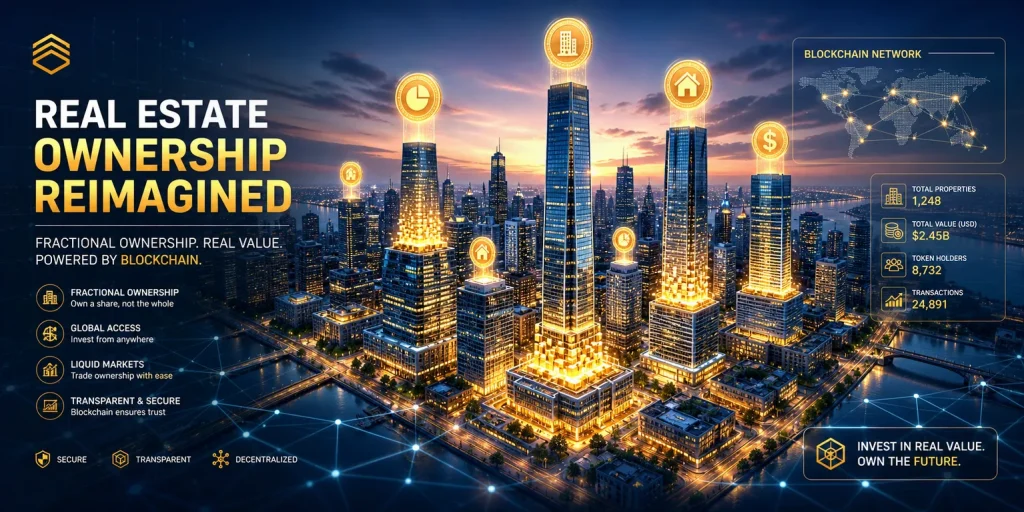
Real estate is stepping onto blockchains, and not as a gimmick. Property interests are being represented as compliant, programmable tokens that can be bought, sold, and held with the same ease as digital assets. This emerging market—often called real-world asset (RWA) tokenization—promises faster settlement, fractional access, and transparent ownership, but it also introduces new risks, regulatory constraints, and technical trade‑offs.

- 20% fee cashback
- $60,000 futures bonus

- 20% trading fee discount
- $100 signup bonus
- $10,000 futures bonus

- 20% fee cashback
- $10,000 bonus

- 20% trading fee discount
- $30,050 signup bonus

- 20% fee cashback
- $8,000 bonus

- 50% trading fee discount
- 20% fee cashback
- $6,200 futures bonus
In this guide, we unpack how Blockchain and Real Estate: Tokenizing Property actually works, why it matters, the questions to ask before participating, and how investors can prepare their on-chain toolkit.
What “tokenizing property” really means
Tokenization converts real-world ownership rights—equity in a building, membership in an LLC that owns a property, or a share of rental cash flow—into digital tokens on a blockchain. In most cases, these are security tokens subject to securities laws. A typical structure looks like this:
- A Special Purpose Vehicle (SPV) or a trust legally owns the property.
- The SPV issues digital securities (tokens) that map to economic rights: equity, revenue share, or debt claims.
- Smart contracts enforce transfer restrictions, distributions, and cap table updates.
- A regulated transfer agent and/or broker-dealer manages KYC/AML and investor records.
In short, the token is not the building; it is a compliant wrapper around the legal rights to the value the building generates.
How on-chain real estate works from asset to investor
1) Asset onboarding and legal structuring
– Property due diligence, appraisal, and title verification.
– Formation of SPV/LLC, operating agreement, and offering documents (PPM or similar).
2) Compliance and investor onboarding
– KYC/AML checks, accreditation where required, geographic restrictions.
– Whitelisting investors’ wallets so only approved addresses can hold or transfer the token.
3) Token issuance
– Tokens minted under a standard like ERC‑1400/3643 (permissioned securities).
– Primary sale via a compliant portal; settlement often in fiat or stablecoins.
4) Post‑issuance operations
– Rental income or interest distributed on-chain, often in stablecoins.
– Cap table and transfer agent records synchronized with blockchain events.
5) Secondary trading and liquidity
– Transfers occur on permissioned venues (e.g., ATS in the U.S.) or whitelisted P2P.
– Smart contracts block transfers to non-compliant wallets and enforce holding periods.
Standards that matter
- ERC‑1400 family: Modular securities tokens, enabling partitioned ownership and transfer rules.
- ERC‑3643 (T‑REX): Permissioned, identity-aware transfers for compliance on EVM chains.
- Off-chain registries and oracles: Sync legal records and NAV data with on-chain state.
These standards balance programmability with the compliance guardrails real estate demands.
Regulatory snapshot (non-legal overview)
- United States: Most tokenized real estate is treated as a security. Offerings frequently use Reg D/Reg S exemptions; secondary trading may require an ATS and transfer restrictions.
- European Union: MiCA covers many crypto assets but national laws and existing securities regimes govern tokenized securities; expect firm KYC/AML and investor protections.
- Singapore, UAE, and others: Generally supportive frameworks with licensing requirements for issuance and trading of digital securities.
Always review offering documents and seek qualified legal/tax advice for your jurisdiction.
Why tokenize property: benefits and trade‑offs
Benefits
– Fractional ownership: Lower minimums enable broader access to institutional-grade assets.
– Liquidity potential: Secondary markets can create exit opportunities between major events.
– Speed and transparency: On-chain settlement and tamper-evident ledgers cut friction.
– Programmable cash flows: Automated rental distributions, escrow, and waterfall logic.
– Global reach: Identity-gated tokens enable cross-border participation where allowed.
Trade-offs and risks
– Regulatory constraints: Transfer restrictions and lockups can limit liquidity.
– Market fragmentation: Liquidity is venue-specific and may be thin in early stages.
– Valuation/oracle risk: NAV updates and appraisals still rely on trusted data sources.
– Operational risk: Property management quality remains the core performance driver.
– Smart contract and custody risk: Code, private keys, and wallet hygiene matter.
Where liquidity really comes from
Tokenization doesn’t magically create demand. Liquidity forms when:
– The underlying asset is high-quality and has clear, consistent cash flows.
– Secondary venues support identity-gated, compliant transfers across jurisdictions.
– Market makers or issuers provide periodic buybacks or NAV-based auctions.
– Transparent reporting builds investor confidence over time.
Investor playbook: evaluate a tokenized offering
Due diligence checklist
– Legal structure: What entity issues the tokens? How do tokens map to rights?
– Security type: Equity, revenue share, or debt? Priority in the capital stack?
– Cash flow model: Rent roll, occupancy, borrower quality, expense assumptions.
– Fees and splits: Management, performance, and token transfer fees.
– Reporting cadence: Audits, appraisals, property management updates.
– Compliance controls: KYC/AML provider, transfer agent, holding periods.
– Secondary path: Which ATS/venues? Settlement assets (fiat or stablecoins)?
– Chain and standard: Ethereum mainnet, L2, or sidechain? ERC‑1400/3643 used?
– Smart contract audits: Who performed them and when?
– Custody: Self-custody vs. qualified custodian; recovery options if keys are lost.
Red flags
– Vague legal rights or no clear mapping from token to the SPV’s cap table.
– Overpromised liquidity claims without named venues and mechanisms.
– Unverified property data, rent projections without third-party support.
– Absence of transfer restrictions where securities laws would require them.
Funding your participation and managing costs
Many compliant real estate tokenization portals accept fiat or stablecoins (USDC/USDT). If you operate a crypto-first portfolio, a liquid, low-fee exchange is useful for on-ramping, swapping into stablecoins, and managing settlement balances.
- Exclusive offer: Register via Binance — 20% fee discount and up to $10,000 in benefits (code CRYPTONEWER) to reduce trading costs when preparing funds for property-backed tokens. Lower friction on your swaps can improve net returns over time, especially when rebalancing between stablecoins and native gas tokens for transaction fees.
- Practical workflow: On-ramp fiat, acquire stablecoins, move funds to a whitelisted wallet, complete KYC at the tokenization portal, and participate in primary sales or secondary trades where permitted.
Note: Always confirm which assets and chains a given portal supports before transferring.
Technical architecture in plain English
- Identity layer: KYC providers issue on-chain attestations or maintain whitelists; only approved wallets can hold the token.
- Compliance engine: Smart contracts check transfer rules (jurisdiction, holding period, investor category) before allowing a transfer.
- Payment rails: Distributions in stablecoins, with oracle-fed FX where needed.
- Data oracles: NAV updates, appraisals, and interest rate feeds push context to contracts.
- Record synchronization: Transfer agents reconcile on-chain events with off-chain registries.
- Corporate actions: Splits, buybacks, and redemptions are executed by callable contract functions subject to governance rules and legal documents.
Yield design: equity vs. debt tokens
- Equity-style tokens: Participate in rental income and appreciation, often with higher variability and longer horizons.
- Debt-style tokens: Fixed or floating coupons secured by property income or collateral; clearer cash flow, priority over equity in defaults.
- Hybrid: Revenue-sharing notes or profit-participating preferred equity, programmed via smart contracts.
Chain selection: why it matters
- Ethereum mainnet: Strong security and tooling; higher fees, mitigated via batched ops.
- Layer 2s (e.g., Arbitrum, Base, zkSync): Lower fees; ensure your venue supports them.
- Sidechains/alt L1s (e.g., Polygon, Avalanche): Cost-effective, broad support; verify custody and institutional adoption.
Interoperability tips
– Ensure your whitelisted wallet is on the same chain as the token.
– Confirm bridge policies; many security tokens disallow bridging to maintain compliance.
Risk management you can implement today
- Wallet segregation: Use a dedicated, hardware-secured address for compliant assets.
- Key backups: Shamir backups or multisig with a trusted custodian.
- Document vault: Store PPMs, operating agreements, and audit reports with version control.
- Liquidity planning: Assume slower exits than public equities; size positions accordingly.
- Governance awareness: Track how redemptions, fees, and major actions are approved.
Tax and accounting quick notes
- Distributions may be taxed differently depending on whether the token is debt or equity.
- Withholding may apply to cross-border investors.
- Fair value marks can be complex; maintain records of NAV updates and appraisals.
Consult qualified tax professionals; treatment varies by jurisdiction and entity type.
Use cases gaining traction
- Income-producing residential portfolios: Stable rental streams, periodic NAV updates.
- Commercial debt: Senior or mezzanine loans with predictable coupons.
- Renovation or development equity: Milestone-based unlocks, higher risk/reward.
- Tokenized REIT-like structures: Basket exposure with periodic redemptions.
Frequently asked questions
- Is this the same as a REIT? Not exactly. REITs are public or private funds with specific tax rules. Tokenized property often uses SPVs per asset, with programmable, identity-gated transfers.
- Will tokenization make real estate liquid like stocks? Not immediately. Compliance and venue fragmentation mean liquidity builds by asset quality, reporting standards, and market depth over time.
- Do I need crypto expertise? Basic wallet security and stablecoin handling help. Many portals abstract complexity, but you remain responsible for custody and compliance.
- What if I lose my keys? Some tokenized securities can be reissued after identity verification via transfer agents, but policies vary. Confirm this before investing.
Actionable next steps
- Learn the stack: ERC‑1400/3643 basics, KYC/AML flows, and chain specifics for your target platform.
- Build your toolkit: Hardware wallet, stablecoins, and a compliant on-ramp.
- Optimize costs: Register with Binance (code CRYPTONEWER) for a 20% fee discount and up to $10,000 in benefits before funding your wallet.
- Practice on test assets: Start with small positions to understand distributions, statements, and secondary trading rules.
- Standardize due diligence: Keep a repeatable checklist across offerings to compare rights, fees, and liquidity pathways.
Glossary quick hits
- Tokenized security: A blockchain-based representation of a regulated financial instrument.
- Whitelisting: Approving wallets for holding/transferring a token after identity checks.
- ATS (Alternative Trading System): A regulated venue that can facilitate secondary trading of securities.
- RWA: Real-world asset, such as real estate or credit, tokenized for on-chain representation.
- Oracle: A service that feeds off-chain data (e.g., NAV, appraisals) to smart contracts.
Related posts:
 Proven strategies to master Binance TradingView for cleaner entries and exits
 Proven Guide to The Only Real Way to Make a Killing with Crypto Trading – Futures Trading
 Top NFT Marketplaces Compared Expert Breakdown of Fees Liquidity Royalties and Chains
 Practical Breakthrough in Blockchain and Crowdfunding Transforming Startup Finance