
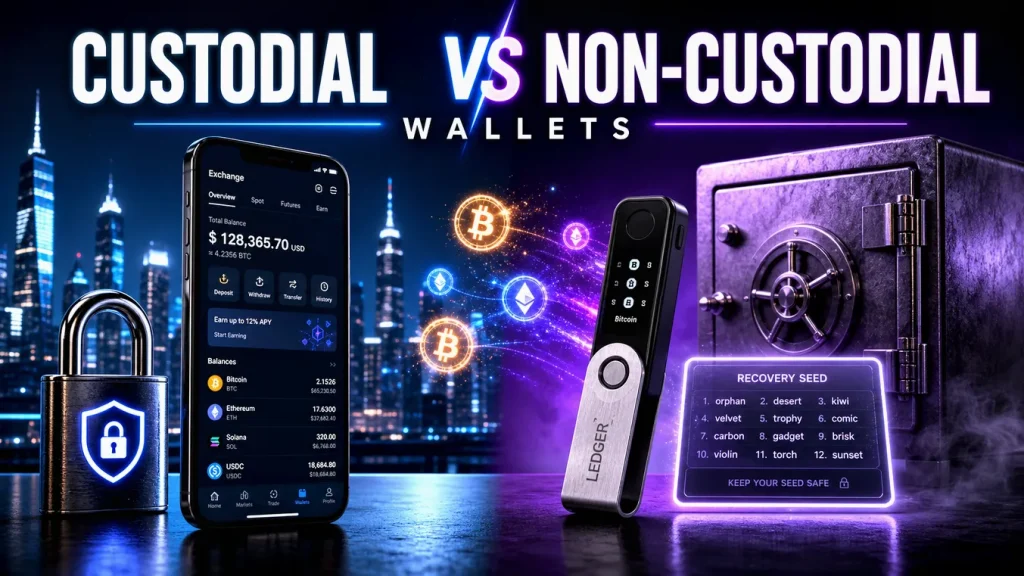
Choosing where your crypto lives determines how safe it is, how quickly you can trade, and how easily you can recover it when something goes wrong. In this Essential Guide to Custodial vs Non-Custodial Wallets, you’ll learn the practical trade-offs, modern security models like MPC and multi‑sig, real-world scenarios, and a clear decision framework for beginners, active traders, long-term HODLers, and teams.

- 20% trading fee discount
- $100 signup bonus
- $10,000 futures bonus

- 50% trading fee discount
- 20% fee cashback
- $6,200 futures bonus

- 20% fee cashback
- $8,000 bonus

- 20% trading fee discount
- $30,050 signup bonus

- 20% fee cashback
- $60,000 futures bonus

- 20% fee cashback
- $10,000 bonus

- Bonus pack worth $100–$1,500 USDT
- Fee discount
TL;DR: If you want speed, convenience, and integrated trading, use a reputable custodial exchange. If you want full control and censorship resistance, use a non-custodial wallet and protect your seed phrase or keys. Many savvy users combine both.
What is a Custodial Wallet?
A custodial wallet is one where a third party (usually a crypto exchange or a specialized custody provider) holds your private keys on your behalf. You log in with a username and password, enable 2FA, and the provider secures your coins using institutional-grade measures. Think of it like a bank account for crypto.
Key characteristics:
– Provider controls your private keys
– Easy password-based recovery and support
– Integrated trading, staking, and fiat on-ramps
– Often requires KYC for compliance
– Potential counterparty risk (platform failure, hacks, or withdrawals paused)
What is a Non-Custodial Wallet?
A non-custodial wallet (self-custody) gives you direct ownership of your private keys. You sign transactions locally on your device; no third party can move your funds without your signature.
Key characteristics:
– You control the private keys/seed phrase
– No platform withdrawal risk
– Broad access to DeFi, NFTs, and on-chain governance
– Recovery depends on your backups (seed phrase, social recovery, multi-sig)
– Greater personal responsibility and learning curve
Custodial vs Non-Custodial Wallets at a Glance
- Control: Custodial = provider; Non-custodial = you
- Recovery: Custodial = customer support + identity checks; Non-custodial = seed/multi-sig/social recovery
- Risk profile: Custodial = counterparty and platform risk; Non-custodial = key loss, phishing, and user error
- Access: Custodial = streamlined trading and fiat ramps; Non-custodial = direct DeFi/NFT/DAO access
- Privacy: Custodial = KYC/AML norms; Non-custodial = pseudonymous on-chain
How Keys and Threat Models Differ
- Custodial wallets: Private keys are stored by the provider, often split with Hardware Security Modules (HSMs), Multi‑Party Computation (MPC), time locks, and layered approvals. You must trust their security, compliance, and solvency.
- Non-custodial wallets: Keys or seed phrases are generated client-side. Threats include malware, phishing, SIM-swap attacks (if using SMS 2FA for related accounts), clipboard hijacking, address poisoning, and physical theft of seed backups.
Practical mitigations:
– Custodial: Enable hardware-based 2FA (U2F keys), anti-phishing codes, withdrawal address whitelists, and delayed withdrawals.
– Non-custodial: Use hardware wallets, verify addresses on a trusted screen, keep an offline metal seed backup, consider multi-sig or MPC wallets, and practice test restores.
Security Architecture Deep Dive
- Hardware wallets (non-custodial): Store keys in secure elements, sign transactions offline, and display transaction details on-device. Best for cold storage and HODLing.
- MPC wallets (both models): Keys are never assembled in full; multiple shards sign jointly. Reduces single-point compromise and can enable flexible recovery.
- Multi-signature (non-custodial): Requires M-of-N approvals to move funds. Ideal for teams, treasuries, and inheritance plans.
- Account abstraction and smart wallets (non-custodial on EVM chains): Enable features like session keys, spending limits, and passwordless recovery via guardians.
User Experience and Recovery
- Custodial recovery: Forgot your password? You can reset with email and KYC. Smooth for newcomers.
- Non-custodial recovery: Protect a 12/24-word seed phrase, use multi-sig with trusted cosigners, or adopt social recovery/guardians. Practice a dry-run recovery on a small wallet to verify your setup works.
Pro tip: Maintain a “recovery letter” with clear instructions for future you or your heirs. Never store plaintext seeds in cloud drives, screenshots, or email.
Fees, Costs, and Hidden Frictions
- Custodial: Trading fees, potential deposit/withdrawal fees, and spreads. Benefits include instant internal transfers and deep liquidity.
- Non-custodial: Network gas fees for each on-chain action. You may pay for hardware wallets and, for teams, multi-sig services.
DeFi, Staking, and NFT Access
- Custodial: One-tap staking and earn products with curated yields, and a simple NFT marketplace if supported.
- Non-custodial: Permissionless access to DEXs, yield optimizers, NFT mints, cross-chain bridges, and governance. Requires diligence to avoid scams and smart contract risk.
Compliance, Privacy, and Taxes
- Custodial: KYC/AML is standard, and tax reports may be easier to export. Expect compliance-driven withdrawal checks at times.
- Non-custodial: Pseudonymous by default. You’ll need to manage your own tax records with explorers and portfolio tools.
Individuals vs Teams and Treasuries
- Individuals: Start with a simple non-custodial wallet plus a hardware wallet for savings; use a custodial exchange for fast swaps and fiat ramps.
- Teams/DAOs: Prefer multi-sig or MPC with role-based approvals. Keep operational hot wallets small and move treasury funds to cold storage.
A Practical Decision Framework
- Newcomer who values simplicity: Start custodial to learn, then migrate part of funds to a non-custodial wallet once comfortable.
- Active trader: Use a custodial exchange for executions and a non-custodial wallet for long-term holdings.
- Long-term HODLer: Hardware wallet with multi-sig or dual-backup strategy; rare use of custodial ramps.
- NFT creator/collector: Non-custodial for mints and marketplace activity; separate wallets for minting vs. vaulting.
- Business/DAO treasurer: Multi-sig/MPC with clear policies and audit trails.
Get Speed and Perks for Trading, Keep Self-Custody for Savings
Many experienced users maintain a hybrid approach. Keep a working balance on a regulated custodial exchange for quick trades and fiat on-ramps, and protect your savings in a non-custodial hardware wallet.
- Exclusive offer for readers: Sign up on Bybit with referral code CRYPTONEWER to get a 20% fee discount and up to $30,050 in benefits. This helps lower trading friction while you keep your long-term stack in self-custody.
Step-by-Step: Set Up Safely with Both Types
1) Create a non-custodial wallet
– Choose a reputable mobile or desktop wallet and generate a seed phrase offline.
– Write the seed on paper and a metal backup; store separately.
– Add a hardware wallet for larger balances and verify addresses on-device.
2) Open a custodial exchange account
– Register on Bybit and enter code CRYPTONEWER for perks.
– Enable U2F hardware keys, anti-phishing code, and withdrawal whitelists.
– Test a small deposit and withdrawal between your exchange and non-custodial wallet.
3) Create your operating rhythm
– Keep an on-exchange amount only for near-term trades.
– Move profits to your non-custodial vault on a set schedule.
– Document your recovery process and rehearse a small restore annually.
Common Myths and Clear Answers
- “Custodial means unsafe.” Not necessarily. Strong custodians employ HSMs, MPC, cold storage, and insurance. Risk is concentrated, so pick reputable providers and enable all protections.
- “Non-custodial is too hard.” Modern wallets, account abstraction, and social recovery make self-custody far easier than before—if you follow basics.
- “Hardware wallets are invincible.” They greatly reduce risk but rely on you verifying addresses and securing backups.
- “Seed phrases are old news.” They’re still foundational. MPC and smart wallets help, but you still need a robust recovery plan.
Mistakes to Avoid
- Storing your seed phrase in cloud notes, screenshots, or email
- Signing transactions you don’t read on a trusted screen
- Ignoring withdrawal address whitelisting and 2FA on exchanges
- Using the same wallet for experimental DeFi and your cold vault
- Skipping test transactions and recovery drills
Real-World Lessons
- Exchange blowups: Counterparty risk is real. Diversify custody and don’t keep more on an exchange than you need for near-term activity.
- Phishing and address poisoning: Always verify the first and last characters of addresses on your hardware wallet screen, not just your computer.
- SIM-swaps: Avoid SMS 2FA. Prefer app-based 2FA plus security keys and email aliases.
Tools and Practices to Consider
- Hardware wallets with secure elements
- Metal seed backups with tamper-evident storage
- Multi-sig or MPC for high-value wallets and teams
- Dedicated “hot” wallet for DeFi, separate “vault” wallet for savings
- On-chain portfolio and tax tools with CSV exports
FAQs
- Which is safer, custodial or non-custodial? Safest depends on your discipline. Custodial reduces user error but adds counterparty risk. Non-custodial removes counterparty risk but requires secure key management.
- Can I use both? Yes—this is common. Trade on a reputable exchange and store long-term funds in hardware-protected self-custody.
- What if I lose my seed phrase? Without recovery methods like multi-sig or social recovery, funds may be irretrievable. Set up resilient backups now.
- How do I minimize fees? Use fee discounts and VIP tiers on exchanges and batch on-chain transactions when possible.
Reader Perks and Next Steps
- Create or upgrade your trading account on Bybit with referral code CRYPTONEWER for a 20% fee discount and up to $30,050 in benefits.
- Establish a non-custodial vault with a hardware wallet, metal backup, and a simple checklist you’ll actually follow.
- Keep your operating balance small and mobile, your savings slow and safe, and your records tidy.
Not financial advice. Do your own research, and validate security setups with small test transactions before moving significant funds.
Related posts:
 How to Launch Your Own Token with an Actionable Step-by-Step Playbook for 2026
 What Is DeFi (Decentralized Finance)? Essential Guide with Risks, Yields, and Real Use Cases
 High-Impact Insights on The Role of Blockchain in Metaverse and Digital Ownership
 What Is a Genesis Block? Essential Breakdown of Bitcoin’s Block Zero and Beyond