
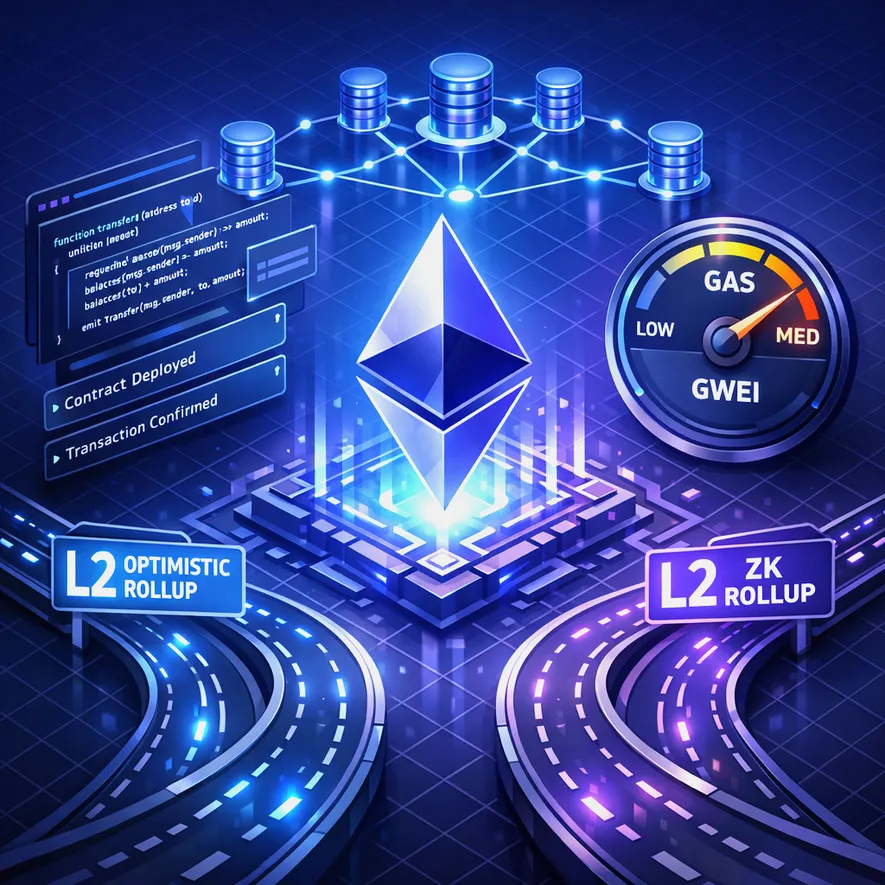
If you’ve been asking yourself “What is Ethereum(ETH)?” and want a practical, no-jargon tour of how it works, you’re in the right place. Ethereum is more than a cryptocurrency; it’s a programmable global computer that lets you build and run applications without centralized gatekeepers. ETH, the native asset, powers these applications by paying for computation, securing the network through staking, and serving as a core building block in decentralized finance.

- 20% trading fee discount
- $100 signup bonus
- $10,000 futures bonus

- 20% trading fee discount
- $30,050 signup bonus

- 20% fee cashback
- $60,000 futures bonus

- 20% fee cashback
- $10,000 bonus

- 20% fee cashback
- $8,000 bonus

- 50% trading fee discount
- 20% fee cashback
- $6,200 futures bonus
This guide covers how Ethereum works, what makes ETH valuable, how smart contracts and the EVM fit together, where gas fees come from, why Layer 2 matters, and how to get started safely.
- Focus keyword: What is Ethereum(ETH)
- Short-tail keywords used: Ethereum, ETH, smart contracts
- Long-tail keywords used: Ethereum gas fees explained, how to stake ETH, Layer 2 Ethereum guide
Table of contents
- Quick definition
- Why Ethereum matters
- How Ethereum works under the hood
- Smart contracts and real use cases
- ETH the asset: utility, burn, and supply
- Staking ETH: validators, rewards, and risks
- Wallets and security basics
- Layer 2 scaling essentials
- Gas fees explained and how to save
- How to get ETH
- Regulation, taxes, and record-keeping
- Common myths and FAQs
- For builders: a 60-second smart contract tour
- A practical Ethereum starter checklist
Quick definition
What is Ethereum(ETH)? Ethereum is a decentralized platform where anyone can deploy code—called smart contracts—that run exactly as programmed. ETH is the native currency that pays for computation (gas) and secures the network via Proof of Stake. Think of Ethereum as an open, neutral settlement layer for digital value and logic.
Why Ethereum matters
Ethereum ushered in the idea of a “world computer.” Instead of trusting a single server owned by a company, smart contracts run across thousands of nodes and reach consensus on the result. This enables:
- Digital ownership you control with a private key, not an account password
- Permissionless finance (DeFi): borrow, lend, swap, earn yields without banks
- NFTs: verifiable digital items, memberships, media rights, and identity primitives
- DAOs: internet-native organizations that govern treasuries with on-chain votes
- Composability: apps plug into each other like money Legos, creating new products
How Ethereum works under the hood
Ethereum’s execution engine is the EVM (Ethereum Virtual Machine). It’s a deterministic runtime where every node can re-run transactions and reach the same result.
Key building blocks:
– Accounts: Externally Owned Accounts (EOAs) controlled by private keys, and Contract Accounts controlled by code
– Transactions: Messages that move ETH or call contract functions
– Gas: A fee paid in gwei (a fraction of ETH) to compensate validators for computation and storage
– Blocks, slots, and epochs: Validators propose and attest to blocks in timed intervals
– Proof of Stake: Since the Merge, Ethereum uses validators staking ETH instead of miners
About fees: EIP-1559 introduced a base fee (burned) and a priority tip (goes to validators). This makes fees more predictable and can make ETH more scarce when usage is high.
Smart contracts and real use cases
Smart contracts are programs you can’t silently change once deployed. They enable trust-minimized functionality such as:
- DeFi: automated market makers (AMMs), lending markets, liquid staking
- NFTs and gaming: provable ownership, in-game economies, secondary market royalties
- Stablecoins: crypto-native dollars that fuel on-chain commerce
- Payments and remittances: low-friction global transfers
- Identity and access: token-gated content, credentials, reputation
Ethereum’s open design allows developers to compose protocols. A vault can deposit into a lending market, then route rewards through a DEX, all under transparent rules.
ETH the asset: utility, burn, and supply
ETH isn’t just a speculative token. It plays multiple roles:
- Gas token: Pay to execute transactions and smart contracts
- Staking asset: Lock ETH to secure the network and earn rewards
- Collateral: Back loans, liquidity provision, stablecoin minting
EIP-1559 burns the base fee, removing ETH from circulation. During periods of heavy usage, the burn can outpace issuance, reducing net supply growth.
Staking ETH: validators, rewards, and risks
With Proof of Stake, validators help finalize blocks and earn rewards. You can participate in a few ways:
- Solo staking (32 ETH): Run a validator, keep full control, handle operations and uptime
- Pooled staking: Contribute any amount via decentralized protocols or custodians
- Liquid staking tokens (LSTs): Receive a token representing your staked position for added liquidity, but accept smart contract and protocol risks
Considerations:
– Rewards depend on network conditions and your setup
– There’s slashing risk for misbehavior or extended downtime
– Operational complexity (for solo stakers) and smart contract risk (for pooled/LST)
Wallets and security basics
Your wallet manages keys to your ETH and tokens. Types:
- Non-custodial (self-custody): You hold the seed phrase; best paired with a hardware wallet for larger amounts
- Custodial: A company holds keys for you; easier UX but requires trust
Best practices:
– Never share your seed phrase; store it offline with redundancy
– Use hardware wallets for meaningful balances
– Double-check contract addresses and chain IDs
– Approve only what you need; revoke stale permissions regularly
– Beware phishing; bookmark official sites and verify URLs
Layer 2 scaling essentials
Ethereum Layer 2 (L2) solutions increase throughput and lower gas by moving execution off the main chain while inheriting Ethereum security.
- Optimistic rollups: Assume transactions are valid unless challenged (e.g., Arbitrum, Optimism)
- ZK-rollups: Prove correctness with zero-knowledge proofs (e.g., zkSync, Starknet, Scroll)
Bridges connect L1 and L2. Treat them cautiously: bridge smart contracts and message relays can be targets. Prefer official bridges and audited routes.
Why L2 matters:
– Lower fees and faster confirmations
– Keeps Ethereum’s base layer lean and maximally secure
– Enables mainstream user experiences and app design not feasible on L1 alone
Gas fees explained and how to save
“Gas fees explained” in one minute:
– Each operation consumes gas; complex contracts cost more
– You pay base fee + optional tip; higher tips prioritize your transaction
– Fees spike during peak demand and drop during off-hours
Ways to save:
– Use L2s for frequent or small transactions
– Batch actions where possible; some wallets auto-bundle
– Schedule transactions during low-demand periods
– Favor efficient protocols; some contracts are more gas-optimized than others
How to get ETH
There are three common routes:
- Centralized exchanges (CEX): On-ramp from fiat, straightforward KYC process
- Decentralized exchanges (DEX): Swap tokens on-chain if you already hold crypto
- Peer-to-peer and on-ramps: Brokerage apps, P2P marketplaces, and payment integrations
If you prefer a streamlined CEX experience, you can register with BTCC and use referral code NEWER when you sign up. After purchasing ETH, transfer to a self-custodial wallet for long-term holding or to interact with DeFi and NFTs, if that’s your goal. Always test with a small amount first and confirm the correct network.
Regulation, taxes, and record-keeping
Crypto regulations vary by country and evolve quickly. Keep good records of:
– Purchases and sales (date, price, quantity)
– Transfers between your wallets and exchanges
– On-chain activity that may count as taxable events in your jurisdiction
Consult local guidance or a tax professional if unsure. Using a portfolio tracker or exportable CSVs from your exchange can simplify annual reporting.
Common myths and FAQs
- Isn’t Ethereum the same as Bitcoin? No. Bitcoin focuses on sound money and secure settlement; Ethereum generalizes programmability for dApps and smart contracts. ETH and BTC can complement each other.
- Are Ethereum transactions anonymous? They’re pseudonymous. Addresses are visible on public explorers. If privacy is critical, learn about best practices and legal constraints before transacting.
- What is an ERC-20 or ERC-721? These are token standards on Ethereum for fungible tokens (ERC-20) and non-fungible tokens (ERC-721) that ensure interoperability across wallets and dApps.
- Can Ethereum scale? Yes, via Layer 2 rollups today and roadmap upgrades like data availability improvements and danksharding in the future.
- Will fees always be high? Demand drives fees on L1. L2s already make many actions affordable, and continued roadmap upgrades target scalability.
For builders: a 60-second smart contract tour
Smart contracts are typically written in Solidity and compiled to EVM bytecode. Here’s a tiny example to illustrate the flow. Don’t deploy this as-is on mainnet.
“`solidity
// SPDX-License-Identifier: MIT
pragma solidity ^0.8.24;
contract Greeter {
string private greeting;
event GreetingChanged(string newGreeting, address indexed changer);

constructor(string memory initial) {
    greeting = initial;
}

function greet() external view returns (string memory) {
    return greeting;
}

function setGreeting(string calldata next) external {
    greeting = next;
    emit GreetingChanged(next, msg.sender);
}
}
“`
How it works:
– Deploy with an initial string; the constructor stores it on-chain
– Anyone can call greet() to read the value
– setGreeting() updates the state and emits an event for easy indexing
Deployment tips:
– Start on a testnet or an L2 test environment
– Use a known framework (Hardhat, Foundry) and audited libraries (OpenZeppelin)
– Write tests and consider formal verification for high-stakes logic
A practical Ethereum starter checklist
- Learn the basics: EVM, gas, keys, and addresses
- Pick a wallet: start with a reputable non-custodial wallet; add a hardware wallet later
- Get ETH: consider CEX on-ramps; you can register at BTCC using referral code NEWER
- Practice on testnets or with tiny amounts first
- Explore L2s for daily use to save on fees
- Verify contracts and URLs before interacting; revoke unnecessary approvals periodically
- Document transactions for taxes and compliance
Educational note: This guide is for informational purposes only and is not financial, legal, or tax advice. Crypto assets are volatile and carry risk. Do your own research and never risk more than you can afford to lose.