
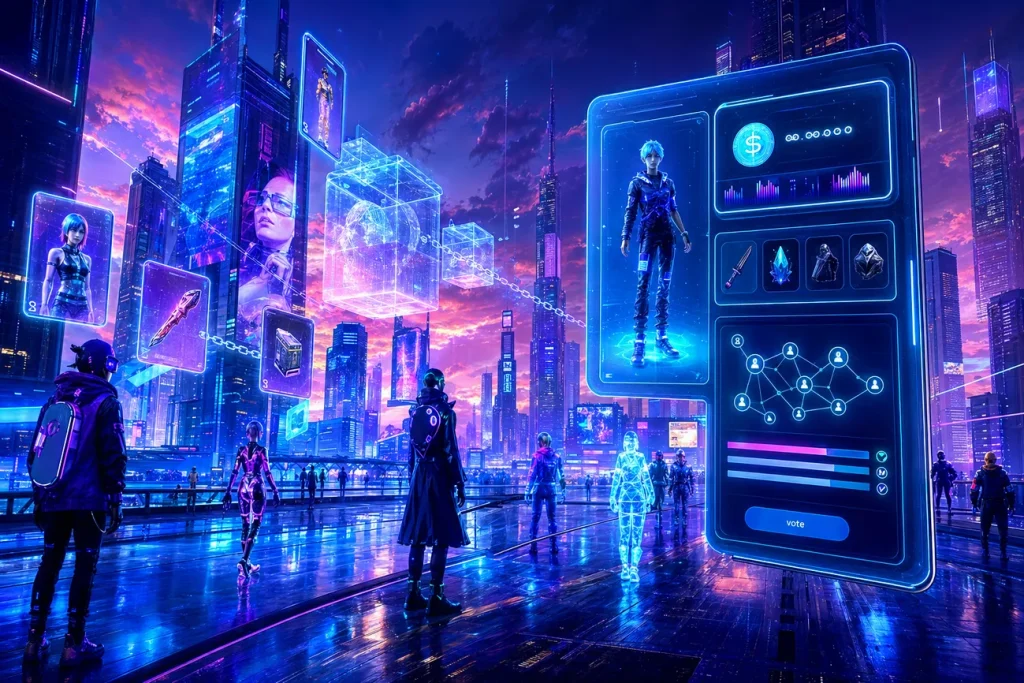
The Role of Blockchain in Metaverse is not a buzzword pairing. It is a blueprint for how value, identity, and participation are structured in persistent virtual worlds. Without blockchain, a metaverse looks like a collection of siloed games and social apps controlled by centralized platforms. With blockchain, it becomes an open, programmable economy where digital objects are owned by users, portable across experiences, and governed by transparent rules. This post explores how blockchain provides the trust, liquidity, and composability layers the metaverse needs to scale beyond marketing hype.

- 20% trading fee discount
- $100 signup bonus
- $10,000 futures bonus

- 20% fee cashback
- $8,000 bonus

- 20% trading fee discount
- $30,050 signup bonus

- 50% trading fee discount
- 20% fee cashback
- $6,200 futures bonus

- 20% fee cashback
- $60,000 futures bonus

- Bonus pack worth $100–$1,500 USDT
- Fee discount

- 20% fee cashback
- $10,000 bonus
Why blockchain is foundational to the metaverse
- True ownership of assets instead of licenses that can be revoked
- Neutral settlement across worlds and platforms
- Composability that lets developers build on top of existing assets and logic
- Transparent, machine-verifiable rules for scarcity, royalties, and governance
- Open standards that reduce platform lock-in
Short tail keywords that matter here are blockchain, metaverse, NFTs, DeFi. Long tail keywords include decentralized identity in the metaverse, metaverse interoperability standards, and cross-chain asset portability. Together, these capture the core capabilities that make the metaverse more than a walled garden.
Digital ownership and scarcity through NFTs
NFTs provide a cryptographic certificate of ownership for digital items like avatars, wearables, land parcels, tickets, and art. Standards such as ERC‑721 and ERC‑1155 mean any wallet or marketplace can recognize assets. This standardization unlocks:
- Portable assets that follow the user, not the app
- Secondary markets with transparent histories and provenance
- Programmable royalties to reward creators on resales
- Dynamic NFTs that evolve with gameplay or achievements
We are also seeing token-bound accounts like ERC‑6551, which let an NFT own other assets or even run logic. Imagine a racing car NFT that stores its upgrades, tournament records, and sponsor badges directly, then travels intact between racing worlds. This is composability in action.
Identity, reputation, and privacy
A metaverse identity should be portable, pseudonymous when desired, and provable. Decentralized identifiers and verifiable credentials align with this need. The W3C DID standard supports user-controlled identifiers that can anchor attestations like age checks, professional licenses, or in-game ranks.
- Verifiable credentials let users prove facts without sharing raw data
- Soulbound or non-transferable tokens can represent membership or reputation
- Zero-knowledge proofs enable selective disclosure and privacy-preserving verification
This stack solves a core tension. The metaverse needs safety and trust signals, but users deserve privacy and data sovereignty. Blockchain-based identity provides the middle path.
Payments, stablecoins, and DeFi rails
Microtransactions, creator payouts, cross-border commerce, and in-world lending all require robust payment rails. Stablecoins and Layer 2 rollups deliver fast, low-cost transactions suited for high-velocity environments. DeFi primitives such as decentralized exchanges, lending pools, and streaming payments can power in-world economies without custody risk.
On- and off-ramps remain essential for everyday users. If you are new to crypto or want to optimize fees before diving into a metaverse project, consider a leading exchange with deep liquidity and a strong security track record. You can join Binance with code CRYPTONEWER for a 20% fee discount and up to $10,000 in benefits. This can materially reduce your transaction costs when acquiring stablecoins, NFTs, or governance tokens used across virtual worlds.
Interoperability and asset portability
An open metaverse thrives on common standards and cross-chain bridges. Portability requires:
- Shared asset schemas and metadata conventions so items render consistently
- Name resolution and identity mapping between chains and worlds
- Secure bridging and messaging layers that avoid trusted custodians
As multi-chain adoption grows, developers should design assets to degrade gracefully. If a game cannot read a custom shader, it can still recognize core attributes like edition number, creator, and ownership history. That way, items retain meaning even outside their original context.
Governance and community alignment
DAOs enable stakeholder governance over metaverse rules, content moderation processes, and treasury allocations. Token-weighted votes are only a starting point. Best practice blends:
- Quadratic or conviction voting to reduce whale dominance
- Multisig or timelocks for critical upgrades
- Delegate systems to scale decision-making
- Reputation-based checks that reward positive contributions
In virtual land projects, DAOs can set zoning rules, allocate grants for public goods like transit hubs, and manage brand partnerships with transparency.
Performance and scalability for real-time worlds
High-performance experiences demand throughput beyond what mainnet L1s can provide. Options include:
- Optimistic and ZK rollups for cheap, fast settlement
- App-specific chains that specialize in gaming or media
- Hybrid models where fast game state is off-chain but settlement and ownership are on-chain
Account abstraction simplifies UX by enabling session keys, gas sponsorship, and social recovery. Users can play without juggling seed phrases, while still retaining self-custody.
Security, fraud prevention, and integrity
Blockchain’s transparent ledger supports:
- Provenance to detect counterfeit assets
- Automated escrow to reduce trade scams
- Programmable dispute mechanisms
- Open auditing of marketplaces, treasuries, and reward systems
That said, risk does not vanish. Smart contract bugs, oracle manipulation, and phishing are real. Projects should prioritize audits, formal verification where possible, bug bounties, and in-client safety prompts that warn users before risky actions.
Storage and data layers for rich media
Storing large assets entirely on-chain is costly. A common pattern is to store hashes and critical metadata on-chain while using content-addressed networks like IPFS or Arweave for media. This ensures that what users see matches what the token claims, and that content can be recovered independently of any single server.
- Content addressing locks media to a hash, preventing silent edits
- Bundles and manifests help composite complex assets like scenes or skins
- Redundancy planning is crucial to avoid broken experiences years later
Compliance and consumer protection
The metaverse will touch payments, gaming, and media law. Teams should anticipate:
- KYC and AML requirements at fiat on-ramps and off-ramps
- Rules for loot boxes, gambling-like mechanics, and prize promotions
- Jurisdictional differences for securities, commodities, and digital collectibles
A pragmatic approach is to keep settlement, ownership, and interoperability on open networks while ensuring compliant access through reputable ramps. Again, exchanges with robust compliance programs can reduce friction for mainstream users. If you need a starting point, create your Binance account with the code CRYPTONEWER and secure a 20% fee discount plus up to $10,000 in sign-up benefits to fund your first NFTs or metaverse tokens.
Practical roadmap for builders and brands
- Start with user stories. What does ownership unlock in your world that a database cannot do
- Choose chains and rollups based on user experience and dev tooling, not just headline TPS
- Design assets with forward compatibility. Favor widely adopted standards and explicit metadata
- Implement account abstraction or wallet-as-a-service to hide crypto friction
- Use verifiable credentials for age-gating and reputation without harvesting PII
- Prototype economic loops. Model emissions, sinks, and value accrual for sustainability
- Budget for audits and post-launch monitoring with attack simulations
- Provide clear creator terms and enforce royalties sensibly at the protocol or marketplace layer
Metrics that matter for metaverse economies
- Unique active wallets and authenticated identities, not just raw wallet counts
- Retention cohorts and session-level engagement
- On-chain transaction throughput and cost to users
- Secondary market health price stability, organic trade volume, and depth
- Creator earnings distributions and sustainability of revenue share
- Governance participation rates and the concentration of power among top holders
Future-facing trends to watch
- Interoperable identity spanning social graphs, gaming, and commerce
- AI agents as wallet-bearing participants in virtual worlds
- Real-world assets that bridge retail finance and virtual economies
- Zero-knowledge proofs for age verification and regional compliance without doxxing
- Token-bound accounts and composable avatars that carry skills, items, and reputations between worlds
Getting started with the metaverse stack
- Install a reputable wallet and enable account abstraction features when available
- Acquire a small amount of stablecoins on a low-fee network
- Explore marketplaces that support open standards and verify contract addresses before buying
- Join communities early to understand culture, contribution paths, and governance
- Keep a learning mindset and practice good security hygiene
If you need a secure on-ramp with competitive fees, you can sign up for Binance using code CRYPTONEWER. New users can enjoy a 20% fee discount and up to $10,000 in benefits, which helps stretch your budget as you explore NFTs, governance tokens, and metaverse experiences.
In short, The Role of Blockchain in Metaverse is to provide the substrate for ownership, identity, payments, governance, and interoperability. With the right standards and user experience, we can move from closed, ephemeral worlds to persistent economies where players, creators, and brands co-own the value they help build.