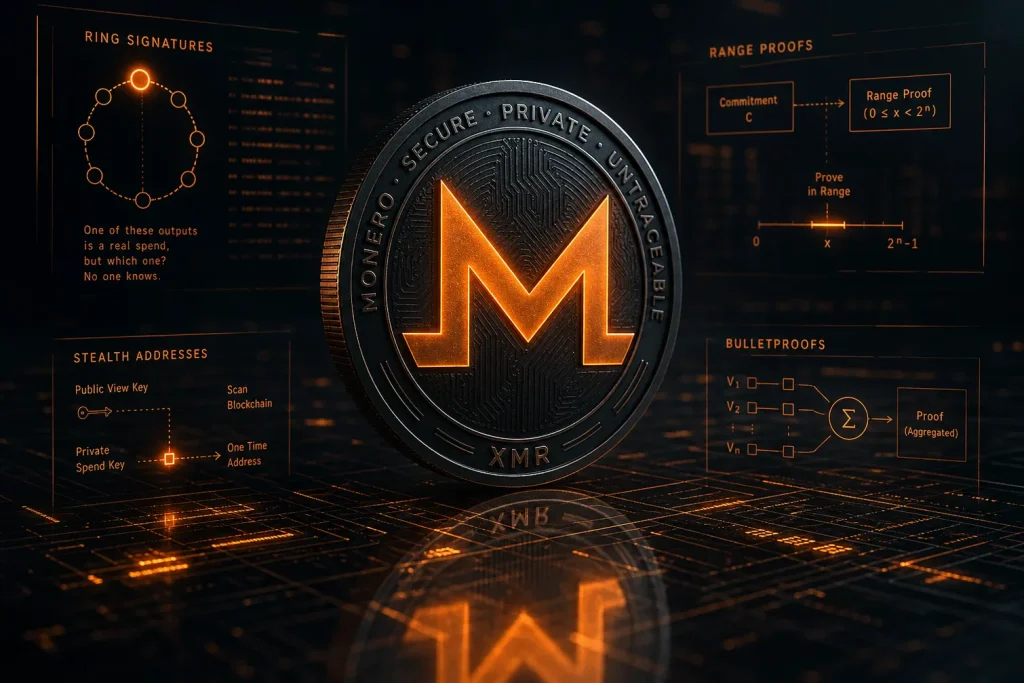
Monero (ticker: XMR) is the best‑known privacy‑by‑default cryptocurrency. Where Bitcoin shows who paid whom and how much, Monero hides the sender, receiver, and amount in every transaction, making XMR highly fungible and cash‑like for digital payments. It achieves this with a stack of cryptography: ring signatures to hide the true spender among decoys, stealth addresses so the recipient’s public address never appears on‑chain, and RingCT to conceal amounts. These are not optional add‑ons—they’re always on. (coinmarketcap.com)

- 20% trading fee discount
- $30,050 signup bonus

- 20% fee cashback
- $60,000 futures bonus

- 20% trading fee discount
- $100 signup bonus
- $10,000 futures bonus

- 50% trading fee discount
- 20% fee cashback
- $6,200 futures bonus

- Bonus pack worth $100–$1,500 USDT
- Fee discount

- 20% fee cashback
- $10,000 bonus

- 20% fee cashback
- $8,000 bonus
Monero launched in 2014 from the CryptoNote family and has evolved through regular network upgrades. Important milestones include CLSAG signatures (October 2020) that made transactions smaller and faster to verify, and the August 13, 2022 upgrade that raised the mandatory ring size to 16 and adopted Bulletproofs+, trimming proofs and verification overhead. At the network level, Monero also implemented Dandelion++ to better decouple broadcasts from IP addresses. (web.getmonero.org)
Beyond privacy, the protocol focuses on resilience and accessibility:
– Proof‑of‑Work: Since November 2019, Monero has used RandomX, a CPU‑friendly PoW designed to resist ASIC centralization.
– Block cadence: A new block is found roughly every 2 minutes.
– Tail emission: Since late May 2022, block rewards no longer decline toward zero. Instead, they remain at a fixed 0.6 XMR per block, ensuring perpetual miner incentives and predictable security. (web.getmonero.org)
Quick answers first
- Can I still buy XMR on Binance directly? No. Binance delisted Monero on February 20, 2024. However, you can still use Binance as a fast fiat on‑ramp for BTC/USDT and then swap or trade into XMR elsewhere (see routes below). (en.cryptonomist.ch)
- Is Monero legal? In most countries, owning and using Monero is legal, but exchange listings vary and some regions discourage or restrict privacy coins; always check local rules. (finance.ec.europa.eu)
How to buy Monero (XMR) in 2026: three reliable routes
There are three main paths people use today. Which one is “best” depends on the balance you want between privacy, convenience, and regional availability.
Route A — On‑ramp with Binance, then swap or P2P into XMR (most accessible)
1) Create your account on Binance and complete any required verification. If you don’t already have an account, consider joining via my referral link—Join Binance with code CRYPTONEWER—to get a 20% fee discount plus up to $10,000 in benefits (Binance terms apply).
2) Buy BTC or USDT with your preferred payment method on Binance.
3) Withdraw your BTC/USDT to your own non‑custodial wallet. Don’t leave funds on an exchange longer than necessary.
4) Convert to XMR via one of these options:
– A Bitcoin↔Monero atomic swap (trustless, no account needed; details below).
– A decentralized P2P exchange like Bisq (XMR/BTC market).
– A centralized exchange that still lists XMR in your region (verify availability before sending).
Why this works: Even though Binance no longer lists XMR itself, it remains a popular fiat on‑ramp. You acquire BTC/USDT there, then step off into non‑custodial, privacy‑preserving rails to obtain your XMR.
Route B — Atomic swaps: trustless BTC↔XMR trades (max privacy)
Atomic swaps let you exchange BTC for XMR directly with another peer using cryptographic guarantees—no centralized exchange, no account, and no custody by a third party. Monero’s community has supported mainnet BTC–XMR atomic swaps since 2021 (COMIT implementation), and tools continue to mature. At a high level, you run a swap client, negotiate a rate with a market maker, and the protocol ensures that either both sides get paid or the funds are refunded. (web.getmonero.org)
Typical high‑level steps (exact commands vary by tool):
– Prepare a BTC wallet and a Monero wallet with fresh addresses.
– Start the swap client (for example, COMIT’s xmr‑btc‑swap), connect to a market maker, and create an offer.
– Fund the swap when prompted; the protocol completes the trade or refunds according to the atomic‑swap logic if the counterparty fails to proceed.
– Receive XMR in your wallet, then spend privately. (gitmemories.com)
Tip: Atomic swaps are the most censorship‑resistant path but can be less “point‑and‑click” than exchanges. Read tool docs carefully, test with small amounts, and verify refund procedures. (monero.observer)
Route C — Exchanges that still list XMR (check first, then withdraw immediately)
Some centralized platforms continue to list XMR pairs in 2026. Availability is region‑specific and can change, so always verify on the exchange before sending funds. Examples observed in 2026 include MEXC (XMR/USDT) and Bitfinex. Regardless of where you trade, withdraw to your own wallet right away. (mexc.fm)
Note: Many large exchanges have delisted or restricted Monero in recent years due to regulatory pressure, so liquidity can be fragmented and policies change quickly. Always double‑check current status and fees. (cryptotimes.io)
Wallets: where to hold your XMR (and how to stay private)
You’ll want a non‑custodial wallet before you buy, so you can withdraw directly to your own keys.
- Monero GUI/CLI (official desktop wallets). Best for maximum control and full‑node use. Beginners can start with the GUI; advanced users often like the CLI.
- Monero.com by Cake Wallet (iOS/Android) and Cake Wallet (multi‑coin version). Popular mobile choices that integrate easily with Tor/I2P nodes.
- Monerujo (Android). Long‑standing open‑source Android wallet for XMR.
- Ledger hardware + Monero GUI. For hardened key storage; manage via the Monero GUI with a Ledger Nano S Plus or Nano X.
Whatever you choose, write down your 25‑word seed, use a strong device PIN/password, and, if possible, connect through Tor and your own node for best privacy. (docs.getmonero.org)
Wallet hygiene checklist:
– Generate a fresh subaddress for each payment request to avoid linkability.
– Don’t paste addresses into public places; share payment requests (with integrated payment IDs) via private channels.
– Keep wallet software updated; Monero upgrades come with real privacy/performance gains. (web.getmonero.org)
Why Monero’s design matters (in plain English)
- Ring signatures hide the true input among a group of decoys; since 2022, every spend is indistinguishable among 16 plausible inputs by default.
- RingCT conceals amounts while proving they’re valid via range proofs; since 2018 these are “Bulletproofs,” and in 2022 Monero adopted Bulletproofs+ for additional efficiency.
- CLSAG signatures (2020) shrank typical transactions and sped up verification, helping Monero stay private without sacrificing performance.
- Dandelion++ improves network‑layer privacy during transaction broadcast.
Together, this makes XMR act more like digital cash: anyone’s coin is as good as anyone else’s coin.
Technical footnotes for the curious:
– RandomX makes mining accessible (especially on CPUs), which can help decentralize hashrate.
– Monero’s dynamic block size adapts capacity over time, while a 2‑minute target block time keeps confirmations snappy.
– Tail emission (0.6 XMR per block) ensures miners always have baseline revenue, so network security isn’t forced to depend solely on fees in the long run.
Regional landscape and delistings (so you’re not surprised)
Regulators worldwide increasingly scrutinize anonymity‑enhanced coins. In the EU, the MiCA framework and evolving AML expectations have pushed many exchanges to reduce or remove privacy‑coin listings; South Korea banned privacy‑coin trading on local exchanges back in 2021. Binance removed XMR spot markets on February 20, 2024. This doesn’t make Monero illegal to own in most places, but it does affect where you can buy and sell on centralized venues—hence the growing interest in P2P markets and atomic swaps. (esma.europa.eu)
Also note: two longstanding P2P brands, LocalMonero and AgoraDesk, announced a complete shutdown by November 7, 2024, which has pushed liquidity toward Bisq, new P2P communities, and atomic swaps. Verify any P2P service’s current operational status before use. (agoradesk.com)
Step‑by‑step: a clean flow to get your first XMR
Below is a practical path that balances convenience with privacy.
1) Set up your wallet
– For desktop, install the official Monero GUI, create a new wallet, write down your 25‑word seed, and let it sync. For mobile, install Monero.com by Cake Wallet or Monerujo and back up your seed.
– Optional but recommended: route your wallet through Tor and connect to your own node for best privacy.
2) On‑ramp funds
– Buy BTC or USDT on Binance. If you’re new, join through this invite—Binance code: CRYPTONEWER—to reduce trading fees by 20% and unlock up to $10,000 in extra benefits (per Binance promos; terms apply).
– Immediately withdraw your BTC/USDT to your self‑custody wallet.
3) Convert to XMR
– Prefer maximum privacy? Do a BTC↔XMR atomic swap using a reputable tool (e.g., COMIT’s implementation). Start small, confirm refund paths, and only scale when confident.
– Want a GUI P2P experience? Use Bisq’s XMR/BTC market over Tor.
– If regulation allows in your country, you may opt for an exchange that still lists XMR (e.g., MEXC; some users also report Bitfinex availability). Trade, then withdraw immediately.
4) After you receive XMR
– Send a small test transaction to ensure your wallet is operating correctly.
– Use fresh subaddresses for different payers.
– Keep your seed safe and offline; never share it.
Compliance tip: Know your local rules. Some jurisdictions impose extra checks on privacy‑enhanced assets when moving through regulated platforms.
FAQs
-
What’s Monero’s block time and monetary policy?
Monero targets ~2‑minute blocks and uses a “tail emission” of 0.6 XMR per block (since May 2022), meaning miner rewards never drop to zero. This supports long‑term security without relying entirely on transaction fees. (getmonero.org) -
How private is Monero in practice?
Strong by default, thanks to ring signatures, stealth addresses, RingCT, and network‑layer protections like Dandelion++. Upgrades like CLSAG and Bulletproofs+ improved efficiency while maintaining privacy guarantees. Operational security still matters: avoid linking your identity to addresses, and keep your device secure. (web.getmonero.org) -
Where can I follow technical developments?
The official docs and Moneropedia are excellent starting points for deeper dives into RandomX, transaction structures, and consensus rules. (docs.getmonero.org)
Recommended resources (learn more)
- Moneropedia and the official docs for protocol concepts and wallet usage. (getmonero.org)
- The network‑upgrade notes (ring size 16, Bulletproofs+, view tags) for what changed in 2022.
- Atomic swaps announcement and repositories to study the BTC–XMR swap flow.
Friendly reminder
Use exchanges as bridges, not vaults. Withdraw promptly, verify addresses carefully, and keep your seed phrase offline and secure. If you value privacy, consider running your own node and routing over Tor.
Promoted on‑ramp: If you need a quick fiat→crypto starting point, register with Binance using my referral—Sign up on Binance with code CRYPTONEWER—for a 20% fee discount and up to $10,000 in platform benefits (per current Binance promos; regional availability and terms apply).
Related posts:
 Actionable Guide to Carbon Credits and Blockchain Integration: On‑Chain MRV, Markets, and Compliance
 Smart guide to What is the $RIF(Rifampicin) Coin, and how to buy on Binance
 Essential guide to What is the MAGMA (MAGMA) Coin and how to buy
 What is the BOME (BOOK OF MEME) Coin, and How to Buy — An Actionable 2026 Guide