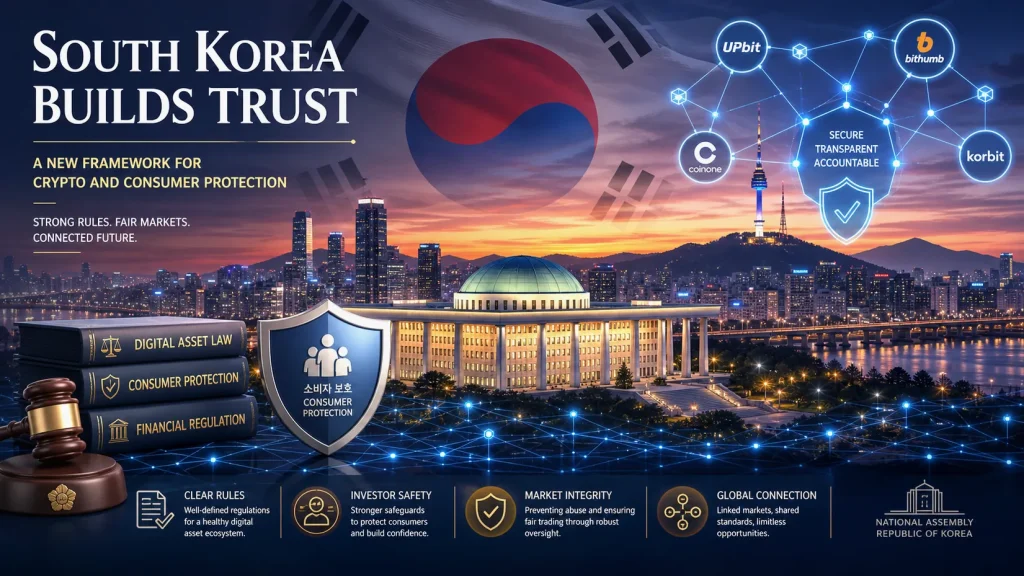
South Korea is shaping one of Asia’s most detailed crypto and blockchain regulatory frameworks. If you’re trying to understand the Current Blockchain Policies in South Korea, this comprehensive guide breaks down what’s in force, what’s pending, and how founders, investors, and service providers can operate compliantly without sacrificing innovation.

- 20% trading fee discount
- $100 signup bonus
- $10,000 futures bonus

- 20% trading fee discount
- $30,050 signup bonus

- 20% fee cashback
- $8,000 bonus

- 50% trading fee discount
- 20% fee cashback
- $6,200 futures bonus

- 20% fee cashback
- $60,000 futures bonus

- 20% fee cashback
- $10,000 bonus
This is an informational overview, not legal advice. Regulations evolve quickly, so always verify with official notices from the Financial Services Commission (FSC), the Financial Intelligence Unit (KOFIU), the Ministry of Economy and Finance, and your legal counsel.
Why South Korea’s framework matters now
- A large, sophisticated retail investor base with high digital adoption
- Clearer rules for virtual asset service providers (VASPs) following several market events
- Strong consumer protection focus paired with pragmatic innovation tracks like security tokens and CBDC pilots
- Enforcement teeth against market abuse and non-compliance
For anyone evaluating market entry or compliance upgrades, tracking the Current Blockchain Policies in South Korea is essential for risk management and growth.
The regulatory map in South Korea
- Financial Services Commission (FSC): Primary policy maker and regulator defining “virtual assets,” setting conduct rules, and coordinating enforcement with other agencies.
- Korea Financial Intelligence Unit (KOFIU): AML/CFT oversight, reporting of suspicious transactions, VASP registrations under the Act on Reporting and Using Specified Financial Transaction Information.
- Financial Supervisory Service (FSS): Supervisory and investigative support.
- Bank of Korea (BOK): Payments system oversight and leadership on central bank digital currency (CBDC) pilots.
- Ministry of Economy and Finance (MOEF) and National Tax Service (NTS): Tax policy and administration.
Virtual Asset User Protection Act at a glance
South Korea consolidated much of its crypto conduct and consumer protection measures into a dedicated law often referred to as the Virtual Asset User Protection Act. Key pillars include:
- Definitions and scope: Establishes what counts as a “virtual asset” and what does not (e.g., truly unique NFTs and certain game items may be outside scope, subject to case-by-case analysis).
- User asset protection: Mandates segregation of customer funds, secure custody, and risk management standards. Exchanges and custodians must hold adequate reserves or insurance to compensate for incidents.
- Market integrity rules: Explicit bans on market manipulation, wash trading, and use of undisclosed material information. Penalties include heavy fines and potential criminal liability in severe cases.
- Operational requirements: Governance, internal controls, cybersecurity, and record-keeping obligations scaled to the size and risk of the business.
This act complements the AML regime already in effect and sets out clearer expectations for exchanges, broker-dealers of virtual assets, custodians, and other VASPs operating in South Korea.
AML, Travel Rule, and real-name banking
- AML/CFT compliance: VASPs must implement robust KYC, CDD/EDD, ongoing monitoring, and suspicious transaction reporting to KOFIU.
- Travel Rule: The FATF Travel Rule is enforced, requiring VASPs to exchange originator and beneficiary information for qualifying transfers. Many Korean platforms interconnect via Travel Rule solutions to streamline compliance.
- Real-name bank accounts: Since the 2018 policy shift, exchanges that handle fiat on/off ramps generally need partnerships with domestic banks to issue real-name verified accounts. Banks conduct their own risk reviews before onboarding exchanges.
- Registration and ISMS: VASPs must register with KOFIU and hold Information Security Management System (ISMS) certification.
These controls significantly reduce anonymous cash-out risks and align the jurisdiction with global standards.
Listing, delisting, and disclosure discipline
Exchanges in Korea have progressively formalized listing and delisting criteria, initially via industry alliances and now increasingly under regulatory expectation. Practical themes include:
- Documented due diligence before listing, with periodic reviews post-listing
- Clear disclosure of token economics, governance, vesting schedules, and conflicts of interest
- Heightened scrutiny for stablecoins, privacy coins, and tokens with complex emission mechanics
- Transparent delisting procedures and investor notices during suspension or termination of trading
For token projects, this translates to a need for enterprise-grade documentation and ongoing communication with exchange partners.
Taxation of virtual asset income
Tax policy for virtual assets has been legislated but the effective start date has been postponed more than once. The core architecture anticipates separate taxation of gains above a threshold, with reporting obligations for residents.
- Headline point: Implementation has been deferred, most recently to 2025, with additional delays under discussion in policy debates. Final dates and thresholds can change as new bills move through the National Assembly.
- Practical takeaway: Individuals and entities should monitor MOEF/NTS announcements and prepare reporting processes, cost-basis tracking, and exchange data exports in advance.
If you actively trade, mine, stake, or earn yield, expect record-keeping to be crucial once the effective date is fixed.
Security tokens and capital markets alignment
South Korea is also aligning tokenized securities with its Capital Markets framework. Regulatory guidance has been introduced to recognize when a token is a “security,” enabling compliant Security Token Offerings (STOs) and secondary trading under securities law.
- Expect disclosures, custodial standards, and suitability rules akin to traditional securities
- Intermediaries may need licenses similar to broker-dealers
- Issuers benefit from legal clarity on tokenized debt, equity, and fractionalized rights
For enterprises, tokenization of real-world assets (RWA), receivables, and funds is becoming feasible within an established capital markets perimeter.
NFTs, DeFi, staking, and custody
- NFTs: Many NFTs are viewed as outside the “virtual asset” definition when they are truly unique and non-fungible, but regulators may treat large-scale, payment-like or fractionalized NFT programs differently.
- DeFi: Protocol-level activities raise issues around who the “service provider” is for AML, custody, and consumer protection. South Korea, like many jurisdictions, takes a functional approach—if a party exercises control or earns fees, compliance obligations may attach.
- Staking and yields: Where platforms offer staking-as-a-service, lending, or yield products, regulators look closely at disclosures, principal protection claims, and risk segregation.
- Custody: Institutional-grade custody is expected to meet high standards of segregation, cold storage, incident response, and insurance.
Builders should map each feature to its regulatory surface area before launch.
CBDC and payments innovation
The Bank of Korea has advanced CBDC research and pilots, including wholesale settlement trials with commercial banks and technology partners. Retail-focused experiments have also been discussed, with an eye toward programmable payments, efficiency, and financial stability.
While separate from crypto assets, CBDC developments influence the overall digital asset landscape, especially in settlement, remittances, and tokenized asset delivery-versus-payment workflows.
Compliance checklist for founders and VASPs
- Corporate structure: Choose an entity type and governance that support regulatory audits and information security.
- KOFIU registration: Ensure ISMS certification readiness and AML program maturity before filing.
- Banking: Secure real-name account partnerships for fiat ramps; expect stringent due diligence.
- Travel Rule connectivity: Integrate with interoperable Travel Rule solutions.
- Asset segregation: Implement clear on-chain and off-chain segregation, cold storage controls, and incident compensation plans.
- Risk and controls: Establish market surveillance, trade surveillance, key management, and access control policies.
- Disclosures: Maintain up-to-date whitepapers, risk summaries, token unlock schedules, and conflict-of-interest statements.
- Record-keeping: Prepare exportable logs for tax, audits, and customer disputes.
- Legal review: Classify tokens as utility vs. security using the latest FSC criteria; reassess when features change.
Investor rights and protections
- Segregated assets: Client assets are separate from the platform’s own funds.
- Transparent incidents: Material incidents should trigger prompt disclosure and remediation processes.
- Fair market rules: Explicit prohibitions on manipulative practices and insider dealing aim to protect retail investors.
- Redress and insurance: Reserve funds and insurance policies help compensate users after qualifying events.
Investors should still practice self-custody best practices when feasible, enable 2FA, and diversify liquidity risk across platforms.
Market entry timeline and milestones
- 2018–2020: Real-name accounts required for fiat interactions; early AML measures gain traction.
- 2021–2022: KOFIU registration and ISMS certification become standard; Travel Rule implementation ramps.
- 2023: Virtual Asset User Protection Act passes, consolidating consumer protection and market integrity rules; security token guidelines released.
- 2024: User protection rules phase in; policy debate intensifies over tax start date and listing standards; CBDC pilots broaden.
- 2025 and beyond: Taxation slated to take effect unless delayed; more comprehensive listing/disclosure standards expected; STO infrastructure matures; continued refinement of DeFi, NFT, and staking guidance.
What’s coming next in South Korea’s crypto policy
- Finalized listing and disclosure playbooks for exchanges that codify market surveillance and token information updates
- Potential allowance of IEOs under strict exchange responsibility and disclosure controls
- Clarification on staking-as-a-service and earned yield products for retail investors
- Further CBDC pilot outcomes that may influence payment rails for tokenized assets
- Continued international alignment with FATF AML standards and cross-border Travel Rule interoperability
Market participants should design for adaptability—build systems that can update to meet evolving reporting, surveillance, and disclosure requirements without major re-architecture.
Practical tips for teams expanding into Korea
- Local partnerships: Collaborate with domestic compliance consultants and legal counsel familiar with FSC and KOFIU expectations.
- Tech readiness: Architecture should support audit trails, chain analytics, and Travel Rule messaging out of the box.
- Product scoping: Treat every new feature—referrals, points, yield—as a potential regulatory trigger and document your control rationale.
- Consumer clarity: Plain-language risk summaries in Korean increase trust and reduce support load.
Binance promotion for Korean and global traders
For traders seeking deep liquidity and advanced features while staying mindful of compliance, consider opening an account on Binance. New users who register with our referral code enjoy notable savings.
- 20% fee discount on eligible trades
- Up to $10,000 in additional benefits during promotional periods
Join with this special referral now: Join Binance with code CRYPTONEWER
When you sign up, enter code CRYPTONEWER to secure your fee discount and promotional benefits.
Frequently asked questions about the Current Blockchain Policies in South Korea
- Is crypto legal in South Korea? Yes. Trading and holding virtual assets are legal, subject to AML, consumer protection, and market integrity rules.
- Do I need a license to run an exchange? You need to register as a VASP with KOFIU, hold ISMS certification, implement AML/Travel Rule, and typically partner with a bank for real-name accounts.
- What about taxes on crypto gains? A separate tax regime for virtual assets has been legislated but repeatedly delayed. The latest policy discussions point to an effective date around 2025, with additional postponement debated. Monitor MOEF/NTS updates.
- Are NFTs regulated the same as fungible tokens? Often not. Unique, non-fungible items may be outside the virtual asset scope, but program design can bring NFTs under financial rules, especially when they resemble payment instruments or fractionalized securities.
- Can projects do ICOs in Korea? Traditional ICOs remain highly restricted. However, compliant alternatives—such as security tokens under the Capital Markets Act or potential exchange-offered sales (IEOs) under strict rules—are the developing paths.
- How safe are Korean exchanges? The framework mandates segregation, cybersecurity, and unfair-trading prohibitions. However, users should still apply best practices and consider diversified custody.
Key SEO takeaways for readers
- Focus term: Current Blockchain Policies in South Korea
- Supporting phrases: South Korea crypto regulation, Virtual Asset User Protection Act, South Korea Travel Rule, KOFIU registration, FSC crypto rules, crypto tax in Korea 2025, security tokens in South Korea, CBDC Korea, Korean exchange listing standards
If you’re building or investing in the Korean market, bookmark this guide and revisit it as new FSC notices and National Assembly updates land. And if you need a global venue with robust liquidity as you navigate this landscape, remember to unlock your trading discounts with Join Binance with code CRYPTONEWER.
Related posts:
 Blockchain in Insurance: Use Cases That Deliver Strategic Impact
 Essential Answer to What Is a Blockchain Fork? Types, Risks, and Real Examples
 Proven insights About Pepe coin history, tokenomics, risks, and how to buy PEPE in 2026
 What is the 客服小何(客服小何) Coin, and how to buy — No‑Hype Deep Dive for 2026