
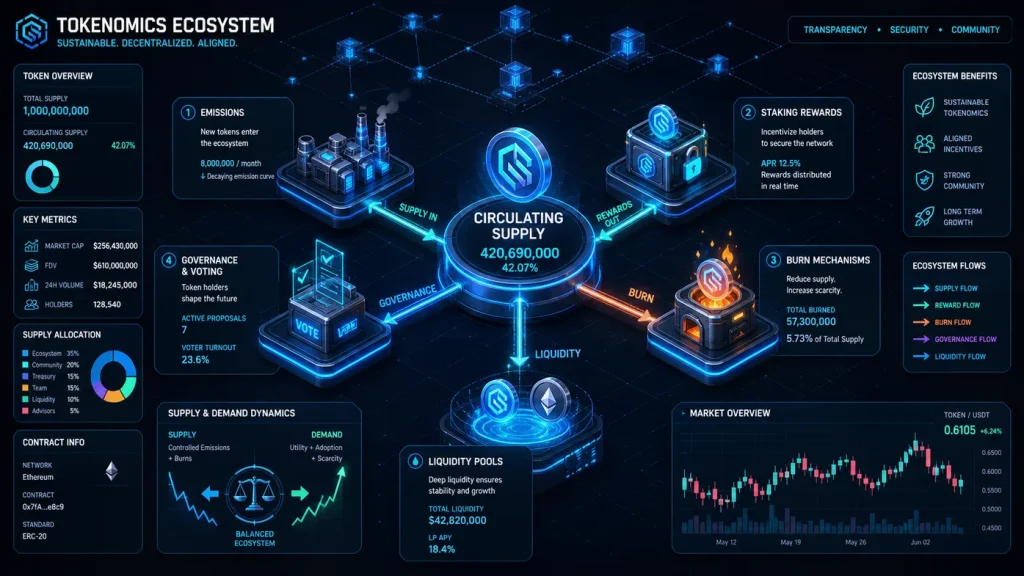
Token prices rise and fall, but the invisible engine under every cryptoasset is its token design. If you’re serious about Understanding Tokenomics, you need a clear framework for how supply, demand, distribution, incentives, and governance interact over time. This playbook gives you actionable ways to evaluate any token economy before you buy, stake, farm, or vote.

- 20% trading fee discount
- $100 signup bonus
- $10,000 futures bonus

- 20% trading fee discount
- $30,050 signup bonus

- 20% fee cashback
- $8,000 bonus

- 20% fee cashback
- $60,000 futures bonus

- 20% fee cashback
- $10,000 bonus

- 50% trading fee discount
- 20% fee cashback
- $6,200 futures bonus
Quick win
– New users can reduce trading friction while researching and executing token strategies. Get a 20% fee discount and up to $30,050 in bonuses when you join Bybit with code CRYPTONEWER. Terms apply, availability varies by region.
TL;DR
- Tokenomics is the economic blueprint of a cryptoasset: emissions, utility, incentives, and governance.
- Favor tokens with transparent supply mechanics, strong demand sinks, fair distribution, and credible vesting.
- Study emissions schedules, burn mechanisms, staking rewards, treasury policies, and liquidity depth.
- Use exchanges with deep liquidity and fair fees when testing strategies. Consider Bybit code CRYPTONEWER for discounted fees.
What tokenomics really means
“Tokenomics” blends token + economics. It’s how a protocol designs:
– Supply mechanics: fixed, capped, inflationary, or deflationary; halving, burns, or buybacks.
– Demand drivers: utility, staking, governance, collateralization, fee discounts, or access rights.
– Distribution: allocations to team, investors, community, treasury; airdrops; launch models.
– Incentives: staking APY, liquidity mining, reward multipliers, penalties, fee sharing, token sinks.
– Governance and treasury: voting power, proposal thresholds, security budgets, runway.
– Market structure: liquidity, market makers, AMMs, order books, volatility regimes.
If you ignore these, you’re guessing. If you understand them, you can frame risk, conviction, and timing.
Supply mechanics that set the ceiling and floor
- Fixed or capped supply: Bitcoin’s 21M cap is the classic example. Predictability is strong, but demand must persist.
- Programmatic inflation: Some networks pay validators with new issuance. Ask whether inflation funds a necessary “security budget” or just dilutes holders.
- Deflationary pressure: Fee burns (e.g., EIP-1559 style), regular buybacks from protocol revenue, or periodic token burns reduce circulating supply.
- Emissions schedule: Linear, decaying, or halving-style. A front-loaded emission can cause short-term sell pressure; a long vesting tail can slowly bleed price.
- Velocity vs. scarcity: High token velocity (tokens rapidly changing hands) can suppress price under MV=PQ style thinking; strong sinks can cap velocity.
Checklist
– Is total supply fixed, capped, or elastic?
– How is circulating supply calculated today versus fully diluted valuation (FDV)?
– Are there predictable burns or buybacks?
– When do emissions decay meaningfully?
Demand drivers that actually matter
- Utility tokens: Payment for network services, gas, or discounts. Example utilities include fee reductions, collateral for loans, or staking for access to premium features.
- Governance tokens: Voting rights on protocol parameters, treasury spending, and listings. Real value needs real control.
- Staking rewards and security: Staking can create “synthetic dividends,” but ask where yield comes from—fees, inflation, or both.
- Token sinks: Locking for higher APY, fee rebates, boosted governance weight, or redemption/burn events.
- Network effects: More users → more fees → stronger burns or buybacks → reinforcing demand.
Ask
– Does the token capture protocol value or is it a passive spectator?
– Are there durable reasons to hold or lock the token beyond speculation?
Distribution and launch fairness
- Pre-mine vs. fair launch: Pre-mines fund teams and investors but concentrate supply. Fair launches boost decentralization but may struggle raising capital.
- Allocations: Team, investors, treasury, community rewards. Look for caps and rationale.
- Airdrops and retroactive rewards: Great for users but can cause post-drop sell pressure.
- Launch models: IDO, IEO, launchpad, or fair launch. Each has trade-offs for liquidity and price discovery.
Red flags
– Over 40–50% controlled by insiders without long lockups.
– Opaque investor terms or missing vesting details.
Vesting, cliffs, and emissions timing
- Cliff: Period where tokens cannot be sold at all; after the cliff, vesting may begin monthly or linearly.
- Linear vs. step vesting: Linear smooths sell pressure; step unlocks can cause predictable dumps.
- Emissions alignment: Community rewards that taper over time can help long-term stability.
Pro tip
– Build a personal “unlock calendar.” Significant unlocks often create volatility. Position around them carefully.
Liquidity and market structure
- Order books vs. AMMs: Order books can offer tighter spreads with market makers; AMMs offer continuous liquidity but may suffer from impermanent loss and slippage.
- Liquidity mining: Incentivizes LPs to seed pools. Sustainable only if fees or utility keep LPs after rewards decline.
- Depth across venues: Shallow liquidity magnifies volatility and whale impact.
Execution tip
– When testing token strategies, fees and depth matter. Deep order books can help reduce slippage on entries/exits. If you need a low-friction venue, join Bybit with code CRYPTONEWER for a 20% fee discount and up to $30,050 in benefits.
Incentive design and game theory
- Positive-sum incentives: Rewards funded by real revenue, not just inflation.
- Guardrails against mercenary capital: Longer locks, boosts for loyal participants, slashing for malicious behavior.
- Token velocity control: Lock-to-boost, bonding, or escrow mechanisms slow down sell pressure.
- Penalty design: Early withdrawal penalties, cooldowns, or vote-escrow to shape holder time horizons.
Governance and treasury management
- Voting rights: One token, one vote vs. quadratic voting; delegation quality; turnout.
- Treasury sustainability: How many years of runway? What assets back the treasury? Clear policy for diversification?
- Security budget: Does inflation pay validators or guardians adequately without over-dilution?
- Upgrade path: Transparent on-chain process or off-chain committees? Emergency powers documented?
Governance signal
– Healthy DAOs publish budgets, audits, and monthly reports. If you can’t find them, proceed cautiously.
Valuation frameworks for tokenomics
- Cash-flow analogs: If a token entitles holders to fee shares or buybacks, you can model implied yields.
- Usage metrics: Active addresses, TVL, transaction count, fees paid. Evidence of product-market fit.
- Relative valuation: Market cap vs. revenue, FDV vs. adoption curve, EV/Revenue stand-ins using protocol fees.
- Scenario analysis: Stress test emissions, unlocks, and demand shocks. What happens in a bear market?
- Sensitivity to velocity: Tokens used only for gas with no lock incentives may exhibit higher velocity and weaker price support.
Due diligence checklist you can use today
- Whitepaper and docs: Clear tokenomics section, numbers add up.
- Supply: Max supply, circulating supply, FDV, emission rate, burn policy.
- Demand: Real utility, token sinks, fee capture or revenue share.
- Distribution: Team/investor/community splits, fairness, unlocks.
- Vesting: Schedules, cliffs, linearity, unlock calendar.
- Governance: Voting mechanics, quorum, delegation, treasury transparency.
- Liquidity: Depth across CEX/DEX, market maker support, stable pairings.
- Security: Audits, bug bounties, on-chain incident history, upgrade keys.
- Legal and disclosures: Jurisdiction, terms, disclaimers, risk factors.
How to read a tokenomics page in 10 minutes
- Skim total vs. circulating supply. Calculate FDV.
- Find emissions chart and highlight next 6–12 months of unlocks.
- Identify demand sinks: staking locks, fee burns, discounts.
- Check distribution pie chart; note insider share and vesting.
- Scan governance docs for treasury policy and voting power.
- Verify liquidity on major pairs and exchanges; estimate slippage on your typical trade size.
- Compare protocol revenue to potential token value accrual.
- Note catalysts: mainnet launches, halving, fee switch, incentive tweaks.
- Build a risk list and a watchlist of dates.
- Decide if you need to observe longer or size small and iterate.
Tools and data sources
- On-chain explorers: Etherscan, Solscan, Arbiscan for holder concentration and unlock tracking.
- Analytics: Dune, Token Terminal, DeFiLlama for fees, revenue, TVL.
- Governance hubs: Tally, Commonwealth, Snapshot for proposals and turnout.
- Research: Token Engineering Academy, protocol docs, credible audit firms.
Case snapshots
- Bitcoin as hard-cap design: Predictable halving schedule creates scarcity narratives. No governance token; security budget depends on fees plus block subsidy, decaying over time.
- Ethereum’s ultrasound dynamics: Post-merge issuance reduction plus fee burns can net-reduce supply at high activity. Utility as gas creates constant demand; staking locks can damp sell pressure.
- DeFi governance token with fee switch potential: If protocol can redirect fees to holders later, optionality can be valuable—but watch for governance alignment and legal risks.
Market microstructure and your bottom line
Even brilliant tokenomics can trade poorly in illiquid markets. Slippage, spreads, and funding rates affect realized P&L.
– Spot vs. derivatives: Derivatives introduce funding and basis; strong tokenomics doesn’t immunize you from volatility.
– Maker-taker fees: High fees erode edge for active strategies; low fees and rebates help.
– Risk controls: Staggered entries, stop ranges, and sizing to survive volatility clusters.
When you’re ready to test ideas with smaller fees and deeper books, claim your benefits on Bybit with code CRYPTONEWER. You’ll get a 20% trading fee discount plus up to $30,050 in promotional rewards, subject to terms.
Common pitfalls and red flags
- Emissions outpace adoption: Inflation-funded yields without fee growth.
- Governance theater: Votes that can be ignored by multisig signers.
- Perpetual unlock overhang: Constant sell pressure from insiders or grants.
- Misaligned incentives: LPs, stakers, and token holders rewarded in ways that conflict.
- Hidden dependencies: Oracles, bridges, or external treasuries that add systemic risk.
Advanced topics worth exploring
- MEV and protocol design: Can the token capture part of MEV via auctions or buybacks?
- Bonding curves and ve-models: Vote-escrow systems to align time horizons and enhance governance.
- Security budget math: Calibrating issuance to validator costs without over-diluting holders.
- Cross-chain tokenomics: Bridged supply accounting, wrapped tokens, and liquidity fragmentation.
Practical workflow for investors and builders
- Pre-research: Define your thesis in one sentence. Example: “This L2’s fee burn plus staking lock can counter new emissions.”
- Data pull: Fees, revenue, user growth, supply expansion, unlock schedule for the next year.
- Narrative check: Does the story match the math? If not, lower conviction.
- Trade design: Identify catalysts, size positions conservatively, set risk limits.
- Review cadence: Monthly KPI check, governance votes summary, and treasury updates.
Quick FAQ on Understanding Tokenomics
- Is deflation always better? No. Secure networks may need some inflation. What matters is whether value accrues faster than dilution.
- Do governance tokens have cash flow? Only if there’s a fee switch, revenue share, or buyback-and-burn. Many do not.
- Are high APYs sustainable? Only if funded by real fees or steady external demand; emissions-only yields tend to fade.
- Should I ignore FDV? Never. FDV reveals long-term dilution; compare it to realistic adoption curves.
Where execution meets research
You can spend hours modeling token flows—and you should—but your results also depend on quality execution. If you’re combining research with live testing:
– Favor venues with deep liquidity for major pairs.
– Lower fees are not a luxury; they compound into real edge over time.
– Keep records of slippage versus modeled expectations.
If that resonates, consider starting with Bybit using code CRYPTONEWER. The 20% fee discount and up to $30,050 in benefits can help you preserve edge while you iterate. Always check current terms, eligible regions, and risk disclosures.
Further reading and resources
– Token Engineering Academy – concept libraries and frameworks
– Ethereum Foundation’s research blog – issuance and burn mechanics
– Token Terminal – protocol revenue, fees, and fundamentals
Risk reminder
– Digital assets are volatile and can lose value rapidly. This content is educational and not financial advice. Always do independent research and comply with applicable laws in your region.
Related posts:
 Essential Insights on Bitget Trading Fees and Reductions
 What is Blockchain? A Beginner-Friendly Explanation with Smart, Practical Examples
 Proven Bitget Account Creation Guide with Security Tips and Bonus Maximization
 Top NFT Marketplaces Compared Expert Breakdown of Fees Liquidity Royalties and Chains