
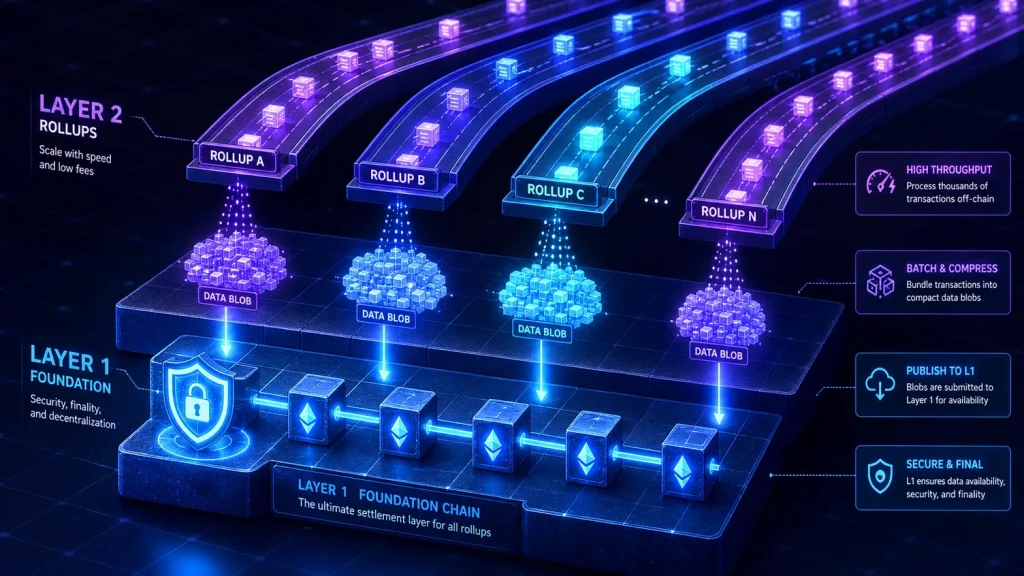
The pressure to scale blockchains without breaking security or decentralization is real. Fees spike, blocks fill, and users bounce when experiences lag. That’s why the most important question in crypto infrastructure today isn’t just “which chain,” but “Layer 1 vs Layer 2 Blockchain Solutions—when and why?” This guide gives you a practitioner’s view of the trade-offs, the architectures behind them, and how to match the right layer to your use case—whether you’re deploying a DeFi protocol, building a game, or simply trying to trade efficiently.

- 20% trading fee discount
- $30,050 signup bonus

- 50% trading fee discount
- 20% fee cashback
- $6,200 futures bonus

- 20% trading fee discount
- $100 signup bonus
- $10,000 futures bonus

- 20% fee cashback
- $60,000 futures bonus

- 20% fee cashback
- $10,000 bonus

- 20% fee cashback
- $8,000 bonus
Along the way, you’ll also find a practical onboarding path that avoids many common pitfalls, including safe asset movement and exchange on-ramps.
The framing: What “layers” really mean
- Layer 1 (L1): The base blockchain that secures consensus and data availability (e.g., Bitcoin, Ethereum, Solana, Avalanche, Cosmos app-chains, Near, Polkadot relay chain). It’s where blocks are finalized, validators secure the network, and core protocol rules live.
- Layer 2 (L2): A network that executes transactions off the L1 to increase throughput and reduce fees, while anchoring security and/or data to the L1. Common forms include optimistic rollups and zero-knowledge (zk) rollups. Some solutions marketed as L2s are actually sidechains—faster, but with distinct trust assumptions.
In modern “modular blockchain” design, you break the stack into:
– Execution (where transactions run)
– Settlement (where disputes resolve and state roots finalize)
– Data Availability (DA, where data is posted so state can be reconstructed)
Most rollups use an L1 (like Ethereum) for settlement and DA; some offload DA to specialized layers (e.g., Celestia, EigenDA) to cut costs further.
Why it matters: The scalability trilemma made practical
You’ve seen the triangle: security, decentralization, scalability. Different L1s and L2s optimize different corners. In practice, here’s what to watch:
- Security: Does the chain inherit L1 security (rollups) or rely on its own validator set/economic security (sidechains, app-chains)?
- Decentralization: Who can produce blocks? Are there upgrade keys, admin controls, or sequencer monopolies?
- Scalability: TPS, gas costs, latency, and how performance holds under load.
Your user experience depends on the layer’s exact choices across those three.
Layer 1 vs Layer 2 Blockchain Solutions, at a glance
- L1 strengths:
- Native finality and economic security
- High liquidity and composability on large ecosystems
- Simpler trust model—no bridge needed if you stay on-chain
-
L1 trade-offs:
- Congestion and higher fees during demand spikes
- Complex protocol upgrades; scaling takes time
-
L2 strengths:
- 10–100x lower fees versus L1 in many market regimes (accelerated by EIP-4844 data blobs on Ethereum)
- Faster UX for end-users, better for microtransactions, gaming, social, and high-frequency DeFi
- Innovation speed: upgradable execution environments, app-specific L2s, custom fee markets
- L2 trade-offs:
- Bridging complexity and risks between L1 and L2 (and L2↔L2)
- Centralized sequencers, censorship risk, and upgrade keys in early phases
- Withdrawal delays on optimistic rollups; proof system maturity on some zk-rollups
Types of L2s (and near-L2s) you’ll encounter
- Optimistic rollups (e.g., Arbitrum, Optimism, Base): Assume transactions are valid by default; fraud proofs challenge bad batches. Typical 7-day withdrawal window to L1 (can be fast-bridged via liquidity providers with minor trust trade-offs).
- zk-rollups (e.g., zkSync Era, Starknet, Polygon zkEVM): Prove correctness with succinct zero-knowledge proofs; faster finality to L1 and trust-minimized exits. Complexity: proving systems and compatibility layers require careful engineering.
- Validiums: Off-chain data availability but on-chain proofs. Cheaper, higher throughput; DA committees/trust assumptions differ from full rollups.
- Sidechains (e.g., Polygon PoS, some Cosmos app-chains): Sovereign security model—faster and cheaper, but not inheriting L1 security by default. Often mislabeled as L2; still valuable if trust assumptions fit your use case.
- State channels and payment channels (e.g., Lightning Network for Bitcoin): Great for rapid, repeated microtransactions between parties; require channel management and liquidity.
L1 strategies to scale without L2s
- Monolithic scaling (e.g., Solana): Big blocks, fast confirmation, high throughput on the base layer. Fewer cross-domain complexities, but robust hardware and network optimizations required.
- Sharding and DA improvements (e.g., Ethereum’s EIP-4844 as a step toward full danksharding): Make it cheaper for L2s to post data, dramatically reducing L2 fees.
- App-specific L1s (e.g., Cosmos SDK chains, Avalanche Subnets, Polkadot parachains): Tailor performance and fee markets to your app, accept new security assumptions.
Security and trust checklists
When evaluating a Layer 1 vs Layer 2 Blockchain Solution, run this mental model:
- Security inheritance: Does the solution derive security from a trusted L1, or is it sovereign?
- Data availability: On L1 (rollup), specialized DA layer, or committee? What happens if the DA layer fails?
- Sequencers: Centralized or decentralized? Are there shared sequencers or failover plans?
- Upgrades and admin keys: Who can pause the network, change parameters, or upgrade contracts?
- Bridges: Are you using the canonical bridge? What are the risks of third-party fast bridges?
- Exit guarantees: How do you exit to L1 if everything goes wrong?
Fees, throughput, and finality in plain terms
- Fees: L2s batch many transactions into a single L1 post. Ethereum’s proto-danksharding (EIP-4844) introduced blob space that significantly cut L2 data costs. Expect dynamic pricing—fees still rise in peak times, but the baseline is far lower than L1.
- Throughput: L2s offload execution from L1, so they can process far more transactions per second, especially during demand spikes.
- Finality: Optimistic rollups have quick soft-confirmations but longer economic finality due to challenge windows. zk-rollups can finalize faster once proofs are accepted on L1. Monolithic L1s offer fast native finality by design.
Use-case mapping
- DeFi with deep liquidity and composability: Large L1s or leading L2s with robust bridges/liquidity hubs.
- High-frequency trading, perps, and market-making: L2s or high-throughput L1s to minimize latency and gas.
- Gaming and social: L2s (particularly zk-rollups or validiums) for ultra-low fees and massive event volume.
- Micropayments and tipping: Payment channels or low-cost L2s to keep fees negligible.
- Enterprise/consumer apps: App-specific L2s or subnets with predictable fees, role-based permissions, and auditability.
Interoperability is the new frontier
- L2↔L2 messaging: Native bridges, shared sequencers, and interoperability layers are reducing fragmentation.
- Restaking and shared security: Emerging designs aim to extend L1 security properties to many rollups.
- Intents and order flow: New coordination layers promise better UX and MEV-aware transaction routing across domains.
Practical onboarding: safer, cheaper, and faster
Bridging is the point of maximum user risk. Reduce hops whenever possible.
- Exchange on-ramp directly to your target network: Many exchanges now support L2 deposits/withdrawals. This avoids third-party bridges and extra approvals.
- When you do bridge: Prefer canonical bridges or widely-audited options. Double-check chain IDs, token addresses, and official docs.
- Wallet hygiene: Use separate wallets for experimentation, revoke allowances periodically, and set sane spending caps.
Pro tip for traders and builders: If you’re moving between L1 and multiple L2s frequently, minimize slippage and gas by funding directly on the target layer.
Promo: Start on the right foot with low fees
If you’re planning frequent swaps, staking, or funding across layers, lower exchange fees compound into real savings. Get a 20% fee discount and up to $10,000 in benefits when you register through this link:
After signup, you can deposit straight to supported L2 networks when available, bypassing extra bridge risk and saving time.
Case studies: matching layers to goals
- Ethereum L1 + Rollups (Arbitrum, Optimism, Base): Keep core settlement and DA on Ethereum while scaling execution off-chain. Best for teams who value Ethereum’s security and ecosystem network effects.
- zk ecosystems (Starknet, zkSync, Polygon zkEVM): Faster finality to L1 and strong security properties; great for consumer apps needing low fees and instant confirmations.
- Solana (monolithic L1): High throughput and fast confirmation on a single layer, great for real-time trading, onchain order books, and games that need low latency.
- Cosmos app-chains: Tailor-made chains with IBC interoperability. Ideal for projects that need custom logic and predictable fee markets, willing to manage sovereign security.
- Avalanche Subnets and Polkadot parachains: App-optimized environments with shared infrastructure; good for teams wanting sovereignty with lower bootstrapping friction.
- Bitcoin + Lightning: Ultra-cheap, instant payments across channels; ideal for microtransactions and merchant payments with careful liquidity management.
Risk landscape you shouldn’t ignore
- Bridge exploits: The largest losses in crypto often happen on bridges. Prefer first-party bridges or top-tier alternatives with substantial audits and battle-tested TVL.
- Sequencer downtime/censorship: Understand liveness guarantees and whether the rollup has decentralized sequencing on its roadmap.
- Upgrade trust: Early-stage L2s might retain admin keys; read the docs on timelocks and multisigs.
- Data availability failures: If data isn’t retrievable, you can’t reconstruct state. Rollups that post data on L1 minimize this risk at higher cost; validiums are cheaper but add trust assumptions.
- MEV and sandwiching: Consider flow-protection (private mempools, MEV-aware RPCs) and the chain’s native defenses.
Developer and investor checklists
Developer fit:
– EVM compatibility vs. custom VMs
– Tooling maturity (indexers, oracles, subgraphs, devnets)
– Transaction limits, calldata constraints, blob pricing dynamics
– Audit ecosystem and bug bounty culture
– Liveness under load and sequencer failover plans
Investor/user fit:
– Liquidity depth and bridge costs
– Historical uptime and incident response
– Fee predictability and withdrawal timelines
– On/off-ramp coverage (can you deposit/withdraw directly to the L2 from your exchange?)
Metric cheat sheet for due diligence
- Median/95th percentile gas fees in peak hours
- Time-to-inclusion and time-to-finality
- Sequencer decentralization roadmap and status
- DA strategy (on-chain, blobs, external DA) and associated costs
- Canonical bridge usage, audits, and TVL distribution
- Upgrade governance: timelocks, multisig members, transparency reports
Roadmap watchlist (research and upgrades)
- Ethereum data availability: From proto-danksharding (EIP-4844) toward more scalable DA for rollups
- Decentralized/shared sequencers: Reducing single-operator risk across many rollups
- Cross-rollup composability: Faster, safer L2↔L2 messaging
- Proving systems: Hardware acceleration and novel zk techniques driving cheaper proofs and quicker finality
Action steps to pick your stack today
1) Choose your security model: Rollup with L1 DA for maximum safety, or validium/sidechain for cost and performance.
2) Map your UX: Latency-sensitive apps favor L2s or high-throughput L1s; capital-intensive DeFi prefers liquidity hubs.
3) On-ramp smartly: Sign up on Binance with code CRYPTONEWER for a 20% fee discount and up to $10,000 in benefits, then deposit directly to your target network if supported.
4) Minimize bridges: When you must bridge, use canonical routes and double-check contract addresses.
5) Monitor in production: Track fees, inclusion times, and error rates. Set alerts for sequencer incidents and DA price changes.
Quick FAQ on Layer 1 vs Layer 2 Blockchain Solutions
-
Is an L2 always more secure than a sidechain?
- Not automatically. Rollups that post data on L1 inherit strong security, but implementation details matter. Sidechains can be secure for certain risk profiles but have different trust assumptions.
-
Do L2s increase the base layer’s throughput?
- They increase effective user throughput by moving execution off-chain and compressing data to L1. The L1 becomes a settlement and DA hub, enabling many more transactions overall.
-
Are zk-rollups always better than optimistic rollups?
- They offer faster finality and strong security, but proofs can be complex and costly. Optimistic rollups are simpler and mature today, with distinct UX (e.g., withdrawal windows).
-
How do I move assets safely between layers?
- Prefer direct exchange deposits/withdrawals to the target layer. Otherwise, use canonical bridges and verify every step. Keep a small test transfer before moving size.
Related posts:
 What is the DAI (Dai) Coin, and how to buy — Essential Guide for 2026
 Top NFT Marketplaces Compared Expert Breakdown of Fees Liquidity Royalties and Chains
 What is the PAX (Paxos Standard) Coin, and how to buy — Proven steps for 2026
 What is Bitcoin(BTC) — Essential Breakdown for Curious Minds and First‑Time Buyers