
Modern teams face a painful reality: data leaks, insider abuse, and brittle infrastructures have become the norm. If you’ve ever asked yourself how blockchain ensures data security without sacrificing usability or auditability, this deep dive is for you. We’ll map the security properties you care about—integrity, availability, authenticity, and privacy—to the core mechanisms that make blockchains resilient, then translate that into pragmatic patterns you can deploy today.

- 20% fee cashback
- $60,000 futures bonus

- 20% trading fee discount
- $100 signup bonus
- $10,000 futures bonus

- 20% fee cashback
- $8,000 bonus

- 50% trading fee discount
- 20% fee cashback
- $6,200 futures bonus

- 20% trading fee discount
- $30,050 signup bonus

- 20% fee cashback
- $10,000 bonus
Quick note for builders and traders: If you want hands-on exposure to secure custody, multi-chain assets, and industry-grade defenses, register on Binance (use code CRYPTONEWER for 20% fee discount and up to $10,000 benefits).
Why “How Blockchain Ensures Data Security” Matters Now
Data security isn’t just about encryption. It’s about provable guarantees across the full lifecycle of information. In blockchain systems, those guarantees are encoded into the protocol, validated by a distributed network, and hardened through cryptography and economic incentives. That means you can build systems where integrity is observable, tampering is immediately detectable, and accountability is baked-in rather than bolted-on.
When stakeholders ask how blockchain ensures data security in production, they’re usually looking for four outcomes:
- Integrity: No one can alter records without detection.
- Availability: The ledger remains accessible, even under network or infrastructure stress.
- Authenticity: Only authorized parties can initiate state changes or sign transactions.
- Privacy: Sensitive data is protected or selectively disclosed, without undermining auditability.
The Core Security Primitives That Deliver the Guarantees
Blockchain’s security posture derives from a few canonical building blocks.
1) Cryptographic Hashing and Merkle Trees
- Hash functions (e.g., SHA-256, Keccak-256) map data to a fixed-size digest that is collision-resistant and preimage-resistant.
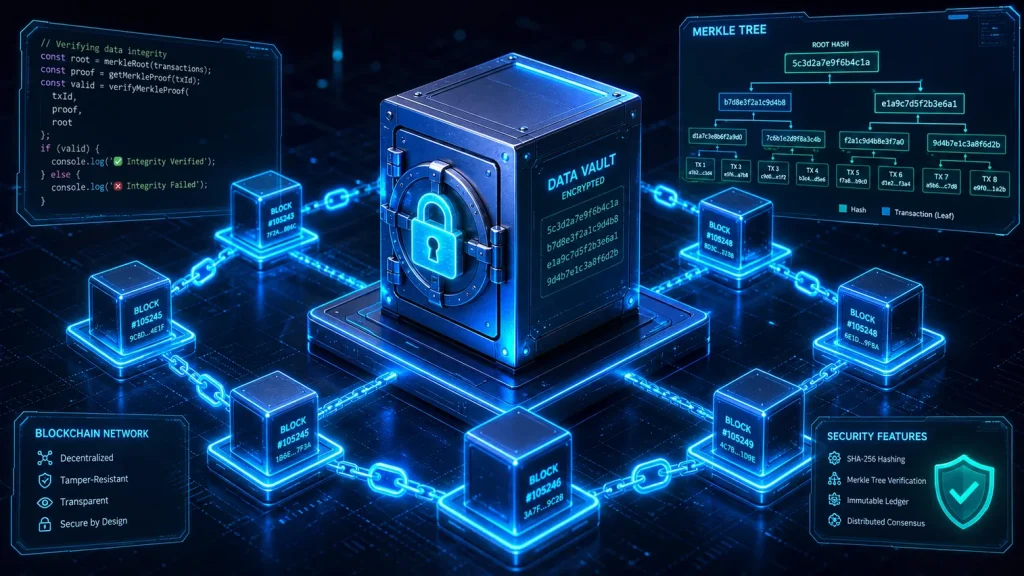
- Merkle trees let you commit to vast datasets with one root hash. Any change in any leaf flips the root, making tampering visible.
- Practical payoff: Light clients verify inclusion proofs without downloading full blocks. See Ethereum’s Merkle Patricia Trie overview.
2) Public-Key Cryptography and Digital Signatures
- ECDSA/EdDSA signatures prove transaction authorship. If the signature is valid, the network accepts the state change.
- Multi-signature (multi-sig) and threshold signatures distribute control, reducing single-points-of-failure.
- MPC (multi-party computation) wallets keep private keys split across devices or services for stronger operational security.
3) Decentralized Consensus and Finality
- Proof of Work (PoW) and Proof of Stake (PoS) align node incentives and make history-rewrites economically or statistically prohibitive.
- BFT-style finality (e.g., Casper FFG, Tendermint) assures that once a block is final, reverting it requires extraordinary, often detectable, coordination.
- The result: Append-only ledgers with predictable immutability windows.
How Blockchain Ensures Data Security Across the CIA Triad
- Integrity: Immutable blocks chained via hashes and secured by consensus give you tamper-evidence by default.
- Availability: Distribution across many nodes eliminates single points of failure and supports fault tolerance.
- Confidentiality: Public blockchains are transparent by design, but confidentiality can be layered via encryption, off-chain storage, commit–reveal schemes, and zero-knowledge proofs.
Key idea: On-chain is your integrity anchor and audit trail; off-chain is where you keep private payloads. The two are connected by cryptographic commitments and proofs.
Practical Privacy Patterns Without Losing Auditability
- Commit–reveal: First commit to a value’s hash, then reveal the plaintext later. Ensures ordering fairness and protects sensitive bids or votes.
- ZK proofs (zk-SNARKs/zk-STARKs): Prove statements (e.g., “I am over 18,” “balance >= X,” “transaction valid”) without revealing the underlying data. See a gentle intro via Zcash technology and modern zk research ecosystems.
- Selective disclosure: Use verifiable credentials and DIDs to show only what’s necessary. Learn more from W3C Verifiable Credentials.
Threat Models You Must Consider
Even strong primitives don’t remove the need to model threats honestly. If you’re exploring how blockchain ensures data security under real adversaries, focus on the following:
- 51%/Majority attacks: Applicable to smaller PoW/PoS networks; mitigated by high economic cost, deep finality, and confirmations.
- Sybil attacks: Countered by stake, identity, or admission controls in permissioned settings.
- Eclipse and network-layer attacks: Defend with diverse peers, network monitoring, and robust client implementations.
- Smart contract bugs: Reentrancy, integer overflows, access-control mistakes, price-oracle manipulations.
- Key compromise: Social engineering, SIM swaps, device theft, and poor seed handling.
- MEV and ordering attacks: Mitigated with commit–reveal, private mempools, and fair ordering protocols.
Mitigations and Secure Design Patterns
- Confirmation policies: For probabilistic finality, wait N confirmations based on your risk tolerance and transaction value.
- Key management: Use hardware wallets for individuals; HSMs or MPC for organizations with role-based approvals.
- Contract security lifecycle: Audits, formal verification, bug bounties, pause/guardian roles, upgradability with transparent governance.
- Rate-limiting and circuit breakers: Protect treasuries and protocol-critical flows.
- Strong monitoring: On-chain analytics, anomaly detection, and automated alerting.
If you trade or manage treasury, pairing these practices with an exchange that implements strong custody controls is pragmatic. Consider setting up with Binance (enter code CRYPTONEWER at signup) for a 20% fee discount and access to up to $10,000 in platform benefits.
On-Chain vs Off-Chain Data: Getting the Split Right
To reconcile privacy with integrity:
- Store sensitive data off-chain in encrypted form (HSM-backed KMS, secure enclaves, or encrypted storage such as S3 with SSE-KMS).
- Put data hashes, metadata fingerprints, or CID references on-chain. Consider IPFS or Arweave for content-addressed persistence.
- Use versioned hashes: Every document revision emits a new hash, preserving the audit trail while ensuring tamper-evidence.
This strategy explains, in practice, how blockchain ensures data security without making private data universally visible.
Layer 2, Rollups, and Data Availability
Scalability brings new considerations:
- Optimistic rollups rely on fraud proofs and challenge windows to ensure correctness.
- ZK-rollups rely on validity proofs (e.g., zk-SNARKs) for immediate correctness guarantees.
- Data availability (DA): Critical for rollups. If data is withheld, users can’t reconstruct state. DA committees, erasure coding, and specialized DA layers help.
Takeaway: Your security analysis must include the DA layer; it’s central to how blockchain ensures data security at scale.
Permissionless vs Permissioned: Security Trade-offs
- Permissionless: Open participation, censorship-resistance, and large validator sets. Transparency is high; privacy must be layered.
- Permissioned: Access control, known validators, and often BFT consensus (e.g., Hyperledger Fabric, Tendermint). Easier compliance and privacy tooling, but different trust and governance assumptions.
For regulated environments, permissioned chains can enforce privacy and identity policies while anchoring critical checkpoints to a permissionless chain for added integrity.
Post-Quantum Roadmaps and Future-Proofing
ECDSA/EdDSA could be threatened by large-scale quantum computers. To safeguard long-horizon data:
- Use hybrid signatures: Combine classical and PQC primitives during transition.
- Prefer hash-based signatures for archival integrity commitments.
- Track NIST PQC standardization for KEMs and signatures (see NIST PQC).
This is the long game for how blockchain ensures data security that remains valid for decades.
Governance, Compliance, and Auditability
- Policy as code: On-chain governance makes changes traceable, with public or permissioned votes.
- Selective transparency: Use ZK proofs and permissioned queries to satisfy audits without leaking customer data.
- Data lineage: Every state transition is logged, enabling forensic-grade audit trails.
Regulators increasingly accept cryptographic proofs as compliance artifacts. That’s a shift from paper compliance to math-backed assurance.
When Not to Use a Blockchain
It’s equally important to know when a database is enough. If you don’t need:
- Multi-party write access with low trust,
- A tamper-evident, independently verifiable ledger,
- And verifiable auditability across jurisdictions,
then a well-configured database with append-only logs (e.g., immutability controls, WORM storage, cryptographic logging) may be more efficient.
A Field-Tested Checklist for Teams
Use this as a practical guide to ensure your design aligns with how blockchain ensures data security in the real world.
Architecture
– Define threat actors and assets: insiders, external adversaries, compliant-but-curious third parties.
– Choose chain type: permissionless for neutrality and reach; permissioned for access control and data residency.
– Decide data placement: on-chain hashes; off-chain encrypted payloads.
Cryptography and Keys
– Enforce hardware-backed key storage (HSM, secure enclaves, hardware wallets).
– Use multi-sig or MPC for treasury and critical admin keys.
– Rotate keys; maintain secure backups; use social recovery for end-users where appropriate.
Smart Contracts
– Adopt secure patterns: checks-effects-interactions, access modifiers, invariant checks.
– Commission at least two independent audits; add a bug bounty.
– Consider formal verification for high-value logic.
Consensus and Finality
– Calibrate confirmation depth to value-at-risk.
– Monitor reorg rates and chain health.
Privacy and Compliance
– Selective disclosure with verifiable credentials and ZK proofs where needed.
– Maintain audit trails that don’t expose secrets.
Operations and Monitoring
– Continuous on-chain monitoring with alerting for anomalous transfers.
– Incident response runbooks; rate limits; pause/guardian mechanisms.
Supply Chain Security
– Pin exact compiler versions; verify library integrity.
– Reproducible builds; signed releases.
Education and Culture
– Phishing-resistant access for admins (FIDO2 keys, phishing-resistant MFA).
– Security training focused on key handling and social engineering.
Tools and References to Go Deeper
- Whitepaper foundation: Bitcoin (Nakamoto, 2008)
- Ethereum docs: Security best practices
- Formal verification: Certora, OpenZeppelin Contracts
- Privacy tech: ZK proofs overview, Semaphore
- Key management: MPC wallets overview
- Data availability research: Celestia
- Post-quantum: NIST PQC Project
Special Offer for Readers Building Secure Stacks
If you’re experimenting with custody, on-chain analysis, and secure trading workflows, set up an account on Binance (use code CRYPTONEWER for a 20% fee discount and up to $10,000 in benefits). Beyond the savings, you’ll get access to battle-tested infrastructure, proof-of-reserves transparency reports, and a broad set of security controls that align with the principles discussed here about how blockchain ensures data security.
Quick FAQ on How Blockchain Ensures Data Security
-
Isn’t everything public on a blockchain?
- Transaction metadata is public on permissionless chains, but payload confidentiality is preserved via encryption, off-chain storage, and zero-knowledge proofs.
-
Can’t a majority attack rewrite history?
- On smaller networks, theoretically yes. Large networks raise the cost. Deep finality and economic disincentives make attacks impractical, observable, and often self-defeating.
-
Are smart contracts safe by default?
- No. Treat them like high-risk code. Use audits, formal methods, and staged rollouts.
-
What about quantum threats?
- Plan migrations to PQC. Use hybrid schemes for long-lived data now, and follow NIST guidance for standardized primitives.
-
How do I get hands-on without risking poor security choices?
- Start with best practices, sandbox small amounts, and leverage reputable venues like Binance — code CRYPTONEWER for robust custody and monitoring tools.
Related posts:
 What is the PAX (Paxos Standard) Coin, and how to buy — Proven steps for 2026
 Top NFT Marketplaces Compared Expert Breakdown of Fees Liquidity Royalties and Chains
 High-Impact Top Blockchain Use Cases for Startups That Drive Real ROI
 What is the BNBUP (BNBUP) Coin, and how to buy — Essential Guide for Today