
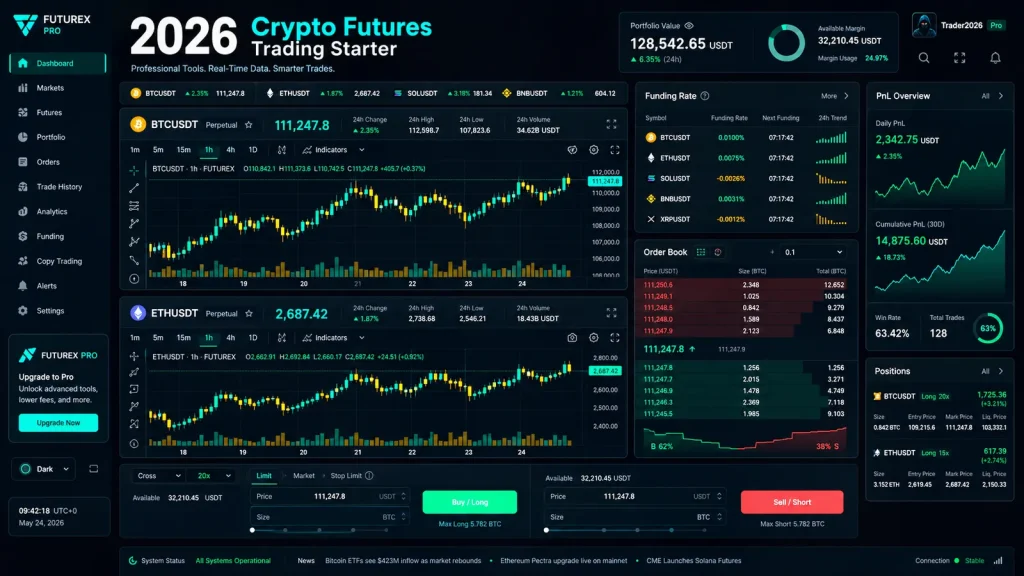
If you’ve been waiting for the cleanest path to begin crypto derivatives, 2026 is your window. Markets have matured, liquidity is deeper on top venues, and retail toolkits—risk calculators, automated alerts, and journaling dashboards—are better than ever. This 2026 Crypto Futures Trading Starter is a practical, step-by-step walkthrough to help you move from curiosity to confident execution, with guardrails that keep risk in check.

- 50% trading fee discount
- 20% fee cashback
- $6,200 futures bonus

- 20% fee cashback
- $60,000 futures bonus

- 20% trading fee discount
- $100 signup bonus
- $10,000 futures bonus

- 20% fee cashback
- $10,000 bonus

- Bonus pack worth $100–$1,500 USDT
- Fee discount

- 20% fee cashback
- $8,000 bonus

- 20% trading fee discount
- $30,050 signup bonus
Along the way, I’ll point to a vetted venue for beginners and advanced users alike. If you choose to start on Binance Futures, join via this referral for a fee cut and stacked perks: Claim 20% fee discount + up to $10,000 in benefits with code CRYPTONEWER. It’s one small change that compounds in your favor.
Why 2026 is different for crypto futures beginners
- Liquidity and spreads: Tighter spreads and higher depth make entries, exits, and stop execution more reliable.
- Instrument quality: Perpetual swaps on majors (BTC, ETH) and strong alts trade around the clock with robust risk engines.
- Data and tooling: Real-time funding analytics, aggregated order books, and mobile-native risk dashboards are plug-and-play.
- Education flywheel: A critical mass of open strategies, transparent PnL journaling, and simulation tools lower the learning curve.
The short version: execution risks are lower, information is faster, and the infrastructure around crypto futures is no longer the Wild West. That’s exactly why a disciplined starter framework can work.
Futures 101 in one page
- What are crypto futures? Contracts that track a coin’s price, letting you long or short with margin (leverage). No need to own the underlying.
- Perpetual swaps vs dated futures:
- Perpetuals (perps) never expire and use a funding rate to tether price to spot.
- Dated futures have expiry (e.g., quarterly) and can trade at a premium/discount (basis).
- Margin models:
- Isolated margin: Risk is ring‑fenced per position.
- Cross margin: Shares margin across positions (more flexible, can be riskier if unmanaged).
- Leverage: Magnifies PnL. Respect it. A 1% move against you at 50x can wipe the position.
- Fees: Maker/taker fees, funding payments (perps only), and potential liquidation penalties. Fee discipline is edge.
Pro tip: Start with isolated margin and conservative leverage (1x–3x) until your journal shows consistent process quality.
Your exchange setup checklist
- Create an account with two‑factor auth (2FA) and withdrawal allowlists.
- KYC completed for higher limits and better support.
- Enable anti‑phishing code and device management.
- Fund in stablecoins (USDT/USDC) for simplicity when you begin.
- Learn the testnet or paper mode if available.
If you want reduced friction on fees and solid liquidity from day one, consider Joining Binance with code CRYPTONEWER for a 20% trading fee discount plus up to $10,000 in benefits. Lower fees extend your runway while you iterate.
Funding rates demystified (perpetual swaps)
- Funding is a periodic payment between longs and shorts to keep perp price near spot.
- Positive funding: Longs pay shorts. Negative funding: Shorts pay longs.
- Practical uses:
- If funding is extremely positive, perp price may be locally overheated—be cautious chasing longs.
- If funding is deeply negative, there may be fear-driven dislocations—fade carefully or wait for reversal signals.
- Don’t trade funding in isolation. Use it to filter setups or size slightly smaller/larger within your risk cap.
Risk and position sizing you can actually use
A workable, beginner‑friendly template:
- Risk per trade: 0.5%–1.0% of account equity.
- Max open risk at once: 2%–3% total.
- Daily loss cap: 2R–3R (R = your per‑trade risk). Stop trading if hit.
- Timeouts: After 2 consecutive losing trades, step back and reassess plan quality.
Position sizing formula for linear USDT futures:
– Position size (contracts) ≈ (Account equity × Risk%) ÷ (Entry price × Stop distance in %)
Example:
– Account $5,000, risk 1% = $50.
– You long BTCUSDT at 60,000 with a 1% stop (stop at 59,400 factoring slippage).
– Stop distance in $ = 600. Position size ≈ $50 ÷ $600 ≈ 0.083 BTC notionally.
– With 2x leverage, margin needed ≈ $2,490; with 5x, ≈ $996. Choose the leverage that keeps liquidation far from your stop.
Always place a hard stop. Use “reduce‑only” to ensure exits don’t flip you accidental net short/long.
Liquidation risk—keep it distant
- Liquidation price is where the exchange closes your position to protect system risk.
- The tighter your stop is to your liquidation price, the higher your chance of slippage‑induced wipeout.
- Use lower leverage or wider, structure‑based stops if liquidation is within striking distance of noise.
A practical guardrail: target liquidation at least 3–5 average true ranges (ATR) beyond your stop for majors like BTC/ETH.
Order types you’ll actually use
- Limit: Name your price. Use “post‑only” to avoid taker fees and slippage when appropriate.
- Market: Fast execution, more slippage. Use in fast conditions or to cut losers.
- Stop‑market: For hard risk exits when precision is less important than certainty.
- Stop‑limit: Tighter control but can miss in fast markets.
- Reduce‑only: Prevents reversals on exit. Use it on all stops and targets.
Three starter strategies for 2026 you can paper test now
1) Trend pullback continuation (1H–4H)
– Tools: 20/50 EMA, swing structure (higher highs/higher lows), volume confirmation.
– Long setup: Price above 50 EMA, a shallow pullback to 20 EMA, bullish reaction candle, funding not extremely positive.
– Entry: Limit near 20 EMA with wick‑catch tolerance; stop below last higher low.
– Target: 2R base; trail below swing lows for extended runs.
– Notes: Avoid when funding spikes excessively positive or into major resistance on daily chart.
2) Range mean reversion with funding skew (15m–1H)
– Tools: Range highs/lows, VWAP, funding rate panel.
– Short setup: Price near range high, funding flips positive and expands, bearish reaction candle.
– Entry: Scale in 2–3 legs within 0.25% bands; stop just beyond range high.
– Target: VWAP midline first, then range mid or opposite bound.
– Notes: Cut faster on breakout volume through the range edge; switch mindset to breakout if acceptance holds.
3) News‑follow breakout on high volume (5m–15m)
– Tools: Real‑time news alerts, volume spikes, breakout levels from pre‑news consolidation.
– Long setup: Price bases, news catalyst hits, volume 2–3x baseline, clean break and hold above level.
– Entry: Market or limit on first retest; stop just under the breakout base.
– Target: 1.5R–3R; trail under higher lows.
– Notes: Keep size smaller to respect volatility. Slippage is real—funding can whip quickly post‑news.
Backtest and forward test on small size. Journal each trade with screenshots, rationale, and whether you followed your plan.
Basis and hedging basics (for when you’re ready)
- Dated futures can trade at a premium (contango) or discount (backwardation) to spot.
- Cash‑and‑carry (advanced): Long spot, short futures to capture premium while hedged. Low directional risk but operationally heavier.
- Perp vs quarterly basis trades can diversify your edge once you’ve mastered execution on a single instrument.
If you eventually expand, ensure your venue offers both perps and quarterlies with robust order types and risk controls. Binance registration with CRYPTONEWER gives access to both, with a 20% fee discount to help basis trades pencil out.
Fees, funding, and slippage—your silent PnL killers
- Maker/taker fees: Favor limit orders when liquidity allows. Use post‑only to avoid taker surprises.
- Funding: Track it hourly; avoid paying extreme funding unless the setup justifies it.
- Slippage: Wider on low‑liquidity alts. Keep starters to BTC/ETH until your process is stable.
- Discounts: Every bp matters. The 20% cut via this Binance link with code CRYPTONEWER compounds especially if you scale.
A 30‑day starter plan you can follow
Week 1 — Foundation
– Open account, enable all security features, and learn the interface.
– Build your risk template: per‑trade risk, daily loss cap, and allowed timeframes.
– Paper trade 10 setups across the 3 strategies; record screenshots and reasons.
Week 2 — Micro‑size live trades
– Trade BTC/ETH only. Size so a loser is emotionally “boring.”
– Take 6–10 trades. Journal every decision. Grade yourself on plan adherence, not PnL.
– Run nightly review: Were entries on plan? Were exits disciplined?
Week 3 — Sharpen execution
– Introduce post‑only and reduce‑only habits. Tighten stop placement to structure.
– Eliminate one recurring mistake (e.g., chasing breakouts late).
– If your grade is ≥80% plan adherence, nudge size up 10%.
Week 4 — Scale what works
– Focus on your best‑performing setup by R‑multiple.
– Add alerting and a pre‑trade checklist.
– Consider fee optimizations and advanced order routing.
CTA for runway: If you plan to place more than a handful of trades per week, lock in the 20% discount and up to $10,000 benefits using Binance code CRYPTONEWER.
Pre‑trade checklist (print this)
- Market context: Trending, ranging, or choppy? Any macro or coin‑specific news ahead?
- Funding and liquidity: Any extremes or thin books?
- Entry plan: Trigger, invalidation level, and reason for the trade.
- Risk: Position size, exact stop, and liquidation distance.
- Execution: Order type chosen and why; reduce‑only set.
- Review: What would make you exit early? Where is your 1R/2R/3R map?
Journaling and performance math
- Expectancy: E = (Win% × Avg Win) − (Loss% × Avg Loss). Positive E requires discipline more than prediction.
- R‑multiple: Normalize outcomes to your risk per trade so you compare apples to apples.
- Equity curve rules: If your drawdown hits 6R–8R, cut size by half and pause to review.
A simple spreadsheet and screenshot habit beats a fancy tool you won’t use. Consistency is the strategy.
Psychology that keeps you in the game
- Process > outcome: Grade yourself on following the plan, not the last trade’s PnL.
- Fewer screens, less noise: Curate data. Alerts beat doom‑scrolling.
- Recovery rules: After a loss streak, take a mandatory reset walk. You can’t out‑click tilt.
Common beginner mistakes to avoid in 2026
- Oversizing because the setup “looks perfect.” The market does not owe you a perfect fill.
- Trading alts with poor depth while learning. Execution matters more than potential R.
- Ignoring funding. It changes your cost basis over time.
- Averaging into losers without a plan. Scaling is a tool, not a bailout.
- Skipping stops. If you can’t define where you’re wrong, you’re not trading—you’re hoping.
Tool stack that actually helps
- Alerts: Level-based and funding‑based notifications on your phone.
- Risk calculator: Pre‑trade size and stop distance—no guessing.
- Journaling: Screenshots and tags (setup type, reason, emotion).
- Education: One or two trusted sources; more is noise.
Quick FAQ for the 2026 Crypto Futures Trading Starter
- Is 100x leverage a good idea for beginners?
- No. It narrows your margin for error to near zero. Start 1x–3x.
- Should I begin on BTC or alts?
- Start with BTC/ETH for depth and tighter spreads, then branch out.
- How many strategies should I run at first?
- One to two. Journal them deeply. Add more only after you’ve proven consistency.
- How do I cut fees?
- Limit orders when appropriate and use a referral discount. The 20% reduction via Binance CRYPTONEWER is material over time.
Final nudge: get set up with smart incentives
If you’re serious about the 2026 Crypto Futures Trading Starter plan, align the details in your favor—fees, tools, and structure. Start with protective habits, keep your journal honest, and trade only when your edge is present. When you’re ready to place your first live trade, secure lower friction via this referral: Register on Binance using code CRYPTONEWER for 20% off fees and up to $10,000 in benefits. Small advantages add up—especially when compounding discipline is your real edge.
Related posts:
 Proven Insights: How Blockchain Enables Peer-to-Peer Transactions at Internet Speed
 What is the MSTRon (MicroStrategy (Ondo)) Coin, and how to buy — a smart 2026 guide
 How to Start Trading on OKX Spot Market with Proven Steps to Trade Confidently
 Actionable Guide to Using the CoinEx Web Interface Effectively