
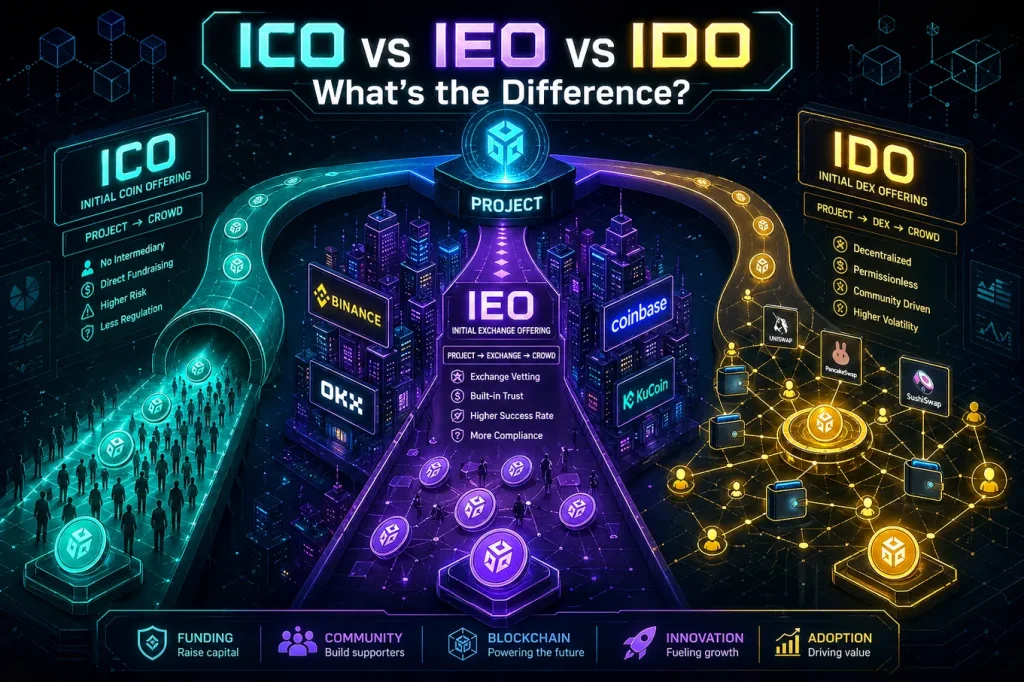
The crypto funding landscape has evolved from the wild-west days of 2017 ICOs to today’s more structured IEOs and decentralized IDOs. If you’ve ever wondered “ICO vs IEO vs IDO: What’s the Difference?”—and which path suits you as an investor or a builder—this guide unpacks the mechanics, risks, and real-world trade-offs in clear, actionable terms.

- 20% trading fee discount
- $100 signup bonus
- $10,000 futures bonus

- 20% fee cashback
- $10,000 bonus

- Bonus pack worth $100–$1,500 USDT
- Fee discount

- 50% trading fee discount
- 20% fee cashback
- $6,200 futures bonus

- 20% fee cashback
- $60,000 futures bonus

- 20% trading fee discount
- $30,050 signup bonus

- 20% fee cashback
- $8,000 bonus
Along the way, you’ll also find a practical walkthrough for participating in an IEO on a major exchange, how IDOs on launchpads actually work, and what to look for to spot quality projects before you commit capital.
At-a-Glance Definitions
- ICO (Initial Coin Offering): A project sells tokens directly to the public, typically through its own website or smart contract, with no centralized exchange intermediary.
- IEO (Initial Exchange Offering): A centralized exchange hosts and facilitates the token sale. Participants buy through the exchange’s launchpad after passing KYC/AML.
- IDO (Initial DEX Offering): A token launches on a decentralized exchange (DEX) or launchpad; investors typically need a Web3 wallet and may stake/hold launchpad tokens to get allocation.
Why These Models Emerged
- ICOs democratized fundraising but had few guardrails, leading to scams, mispricing, and regulatory heat.
- IEOs introduced exchange-driven vetting and smoother user experience (KYC, custody, fiat on-ramps), aiming for better investor protection.
- IDOs rebalanced toward decentralization, offering open participation, on-chain transparency, and immediate liquidity, but with new attack surfaces (bots, MEV, rug risks).
How Each Model Works (Step-by-Step)
ICO: Direct-to-Investor Sales
- Project publishes a whitepaper, roadmap, tokenomics, and sale terms.
- Investors send funds (crypto or fiat) to the project’s address/portal.
- Tokens are distributed either instantly or at TGE (Token Generation Event).
- Listing on exchanges happens later (if at all), and liquidity can be uncertain.
Key notes:
– Minimal intermediaries; the project handles everything.
– Marketing and community trust are critical.
– Regulatory compliance varies widely; KYC may be optional.
IEO: Exchange-Hosted Sales
- Project applies to a centralized exchange’s launchpad; exchange runs diligence.
- Allocation is explained via lottery, subscription, or tier-based systems.
- Users complete KYC/AML on the exchange.
- Funds and token distribution are handled through the exchange UI.
- Listing on the hosting exchange typically follows immediately after the sale.
Benefits:
– Better user experience and custodial support.
– Exchange reputation and initial liquidity.
– Streamlined marketing via the exchange’s user base.
IDO: Decentralized Launches on DEX/Launchpads
- Project partners with a DEX or a launchpad; may require whitelisting or staking launchpad tokens.
- Smart contracts handle sales, vesting, and liquidity pool creation.
- Users connect Web3 wallets (e.g., MetaMask) and participate on-chain.
- Token becomes tradable almost immediately on the DEX.
Traits:
– Permissionless access, transparent on-chain mechanics.
– Susceptible to bots and MEV if not well-designed.
– Liquidity is algorithmic and depends on pool depth.
Pros, Cons, and Typical Use Cases
ICO
– Pros: Maximal autonomy, global reach, no gatekeepers.
– Cons: Higher scam risk, weak investor protections, uncertain listings.
– Best for: Teams with strong reputations willing to go direct and handle compliance.
IEO
– Pros: Exchange vetting, easier UX, immediate listing/liquidity, KYC/AML.
– Cons: Listing and marketing fees, geographic restrictions, centralized oversight.
– Best for: Teams seeking credibility via a top exchange and streamlined retail access.
IDO
– Pros: Open access, on-chain transparency, rapid price discovery.
– Cons: Bot/frontrunning risk, variable security, participants must manage self-custody.
– Best for: Web3-native projects and communities comfortable with DeFi tools.
Security and Trust: What Actually Changes?
- Due diligence: IEOs benefit from exchange screening; ICOs and IDOs put more burden on you.
- Smart contracts: IDOs depend on audited contracts; check audit reports and open-source code.
- Custody: IEO users rely on centralized accounts; IDO users self-custody via wallets.
- Listing certainty: IEOs typically ensure an initial market; ICOs/IDOs may face liquidity gaps unless planned.
Regulatory and Compliance Snapshot
- KYC/AML: Standard for IEOs; mixed for ICOs/IDOs depending on jurisdiction and platform.
- Securities concerns: Tokens may be treated as securities in some regions; frameworks keep evolving.
- Participation limits: IEOs may geo-block certain countries; IDOs can be permissionless but still subject to local laws.
Always check your local regulations before participating.
Tokenomics and Distribution You Must Review
- Supply schedule: Total supply, circulating supply at TGE, emissions curve.
- Vesting/lockups: Founder, investor, advisor, and community vesting; cliff periods.
- Utility and value accrual: How the token captures value (fees, staking, governance, burn mechanics).
- Treasury and runway: How funds will be used; multi-sig and transparency.
Poor tokenomics can undermine price regardless of the launch format.
Costs, Fees, and Hidden Friction
- ICO: Marketing, legal, and technical costs for the project; investors pay network fees and face listing uncertainty.
- IEO: The project may pay listing and marketing fees; investors may need to hold exchange tokens for allocations.
- IDO: Gas fees and potential slippage for investors; projects often need to seed liquidity and pay for audits/launchpad tiers.
Participation Playbook: From Whitelist to TGE
General prep checklist:
– Create secure wallets (hardware wallets for long-term storage).
– Verify official links via multiple channels.
– Read the whitepaper, audit reports, and tokenomics.
– Understand vesting schedules and claim mechanics.
– Never share seed phrases; beware of DM scams.
Joining an IEO on a Major Exchange (Example Flow)
A popular route is using a reputable exchange launchpad that handles KYC, fund custody, and distribution. If you don’t already have an account, you can register on Binance and get extra perks.
- Register: Binance (code: CRYPTONEWER) — get 20% fee discount and up to $10,000 in benefits for trading and promotions.
- Complete KYC/AML: Verify identity to access launchpad sales.
- Fund your account: Deposit or buy the supported assets (often BNB, BUSD, or stablecoins as per the event rules).
- Review the launchpad page: Check allocation rules (lottery, subscription, or tiered system), key dates, and holding requirements.
- Commit funds during the subscription window: Follow on-screen prompts.
- Token distribution and listing: Tokens are allocated, and trading usually starts soon after.
Tip: Set reminders for snapshot times and subscription windows. Read the project’s research report if provided by the exchange.
Participating in an IDO on a DEX/Launchpad
- Choose a reputable launchpad: Look for audits, past launches, and transparent teams.
- Wallet ready: Connect a Web3 wallet and fund it with the required tokens and enough gas.
- Whitelisting/staking: Some platforms require staking their native token to qualify.
- Understand the sale mechanics: FCFS vs. lottery vs. oversubscription, and claim schedules.
- Post-sale liquidity: Confirm that the team locks liquidity for a defined period.
Which Model Fits Which Project?
- Early-stage R&D projects with strong dev communities may prefer IDOs for decentralization and rapid feedback loops.
- Consumer-facing apps targeting mainstream users might favor IEOs for smoother onboarding and brand trust.
- Well-known teams with significant legal resources sometimes run ICOs to retain control, though fewer do so today due to compliance complexity.
Risk Mitigation and Red Flags Checklist
- Anonymous team with no verifiable track record.
- No audit or only superficial audit; unresolved critical findings.
- Vague token utility; heavy reliance on hype or celebrity marketing.
- Extreme unlock schedules that dump supply on retail early.
- No multi-sig on treasury or opaque fund usage.
- Fake social metrics; bots instead of real community engagement.
- Guaranteed returns language or pressure tactics.
Countermeasures:
– Cross-check LinkedIn, GitHub, and prior project outcomes.
– Read full audits; search for “critical” and “high” severity findings.
– Model FDV (fully diluted valuation) vs. comparable projects.
– Simulate post-TGE circulating supply and potential sell pressure.
Frequently Asked Questions
-
Which is safer: IEO or IDO?
- IEOs generally offer more gatekeeping (KYC, exchange vetting). IDOs offer transparency and control but require stronger user competence and carry on-chain risks.
-
Which offers better returns?
- There’s no consistent winner. Outcomes depend on tokenomics, product-market fit, team execution, market cycle, and liquidity management.
-
How do I avoid scams?
- Verify domains, use official announcements, confirm contract addresses, check audits and team identity, and be skeptical of “risk-free” claims.
-
What about gas fees and frontrunning on IDOs?
- High-demand IDOs can attract bots and MEV. Prefer launchpads with anti-bot mechanisms, fair launch designs, and transparent allocation rules.
-
Do I have to pass KYC every time?
- IEOs: Yes, typically with the exchange. IDOs: Usually not, but local laws still apply; some launchpads enforce KYC.
Research Workflow You Can Reuse
- Screen: Read a one-pager and team bios; dismiss low-effort or anonymous pitches.
- Deep-dive: Whitepaper, tokenomics, audits, GitHub activity, and roadmap credibility.
- Compare: Benchmark valuation, allocation, and vesting against sector peers.
- Simulate: Model supply over time, treasury runway, and potential demand drivers.
- Decide and size: Use position sizing and set rules for vesting claims and profit-taking.
Tools and Habits That Help
- Calendar alerts for snapshots, registrations, subscription windows, and TGE.
- Hardware wallet for long-term custody and signed approvals.
- On-chain explorers to verify contracts and liquidity locks.
- Risk journal: Track thesis, allocation, unlocks, and triggers to exit.
Where to Get Started Right Now
For a user-friendly gateway into vetted token launches, set up an account on a top exchange and browse their launchpad pipeline. If you’re new and want fee savings and promos, register at Binance using code CRYPTONEWER to receive a 20% fee discount plus up to $10,000 in benefits. Then complete KYC, fund your account, and keep an eye on upcoming IEOs or Launchpool events.
Remember: Market conditions, token design, and team execution matter more than the launch acronym. Treat “ICO vs IEO vs IDO: What’s the Difference?” as the first filter—your real edge comes from disciplined research, smart sizing, and security best practices.
Related posts:
 Actionable insights on Public vs Private Blockchains: Which One to Use?
 What is the 客服小何(客服小何) Coin, and how to buy — No‑Hype Deep Dive for 2026
 Essential Answer to What Is a Blockchain Fork? Types, Risks, and Real Examples
 Essential Playbook for Blockchain and the Internet of Things (IoT) in Real Systems