
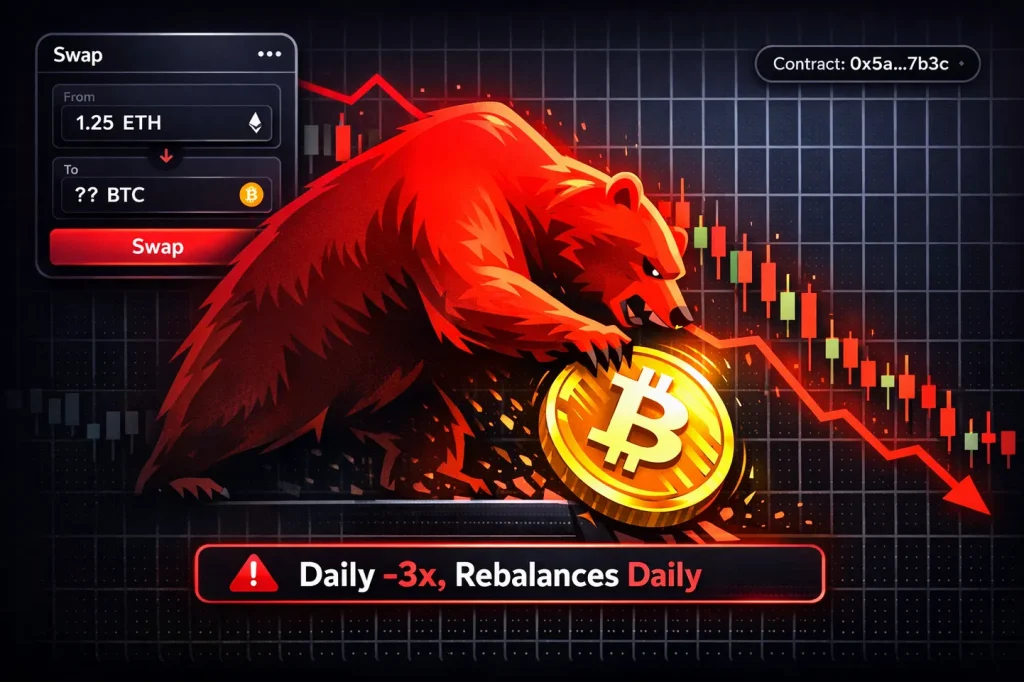
If you’ve ever wished you could short Bitcoin without opening a margin or futures account, you’ve probably stumbled on BEAR — the 3X Short Bitcoin Token. In this deep dive, I’ll explain exactly what BEAR is, how it aims to deliver -3x daily BTC performance, the real-world risks that catch many traders off guard, and practical, current ways to acquire exposure in 2026. I’ll also show a safe workflow using Binance for funding and custody, plus alternatives you should consider before you click “buy.”
Quick definition: What is BEAR (3X Short Bitcoin Token)?
- BEAR is an ERC‑20 token designed to seek the inverse of Bitcoin’s daily return, amplified at approximately -3x. Put simply: if BTC falls 1% in a day, BEAR targets a +3% move; if BTC rises 1%, BEAR targets a -3% move. The canonical token contract on Ethereum is 0x016ee7373248a80BDe1fD6bAA001311d233b3CFa, and Etherscan summarizes its goal as “-3 times the daily return of Bitcoin.” (etherscan.io)
- BEAR belongs to a family of “leveraged tokens” that package a managed futures position into a spot-tradable asset. Historically, these tokens were issued by FTX and listed on a number of exchanges; Poloniex’s documentation still notes FTX as the issuer and describes BEAR as a 3x short BTC token. (support.poloniex.com)
How leveraged tokens like BEAR actually work (and why that matters)
Leveraged tokens maintain a target leverage through daily rebalancing. In practice, that means the token’s underlying derivatives position is adjusted around 00:02 UTC to pull the effective leverage back toward -3x for the next day. Over a single day, the movement can track the target leverage relatively closely; over multiple days, compounding and “path dependence” cause results to diverge from a naive -3x expectation. This is why these products can outperform in strong, trending moves but underperform in choppy, mean‑reverting markets. (support.poloniex.com)
Key takeaways you should internalize before buying any leveraged token:
- Daily rebalancing means performance depends on the path of prices, not just the net change. In sideways/whipsaw markets, value can “decay.”
- There’s no margin call on the token itself (it’s spot), but in extreme moves where the token can’t rebalance intraday, NAV can approach zero.
- Price can deviate from NAV on secondary markets, especially when liquidity is thin; arbitrage (create/redeem) historically helped keep it in line.
A 2026 reality check about BEAR’s lineage and availability
- Origin and issuer: The BEAR family of leveraged tokens was created and issued by FTX. After FTX’s collapse and Chapter 11 filing on November 11, 2022, issuance/redemption operations and listings were widely disrupted — which is one reason you’ll often find fragmented or illiquid markets today.
- Binance’s product shift: Binance introduced its own leveraged tokens years ago, and later scaled some back. In early 2024 it announced the suspension and delisting of several Bitcoin/Ether/BNB leveraged tokens (e.g., BTCUP/BTCDOWN and others), underlining how dynamic availability can be across jurisdictions and over time. Always check current listings where you trade. (cointelegraph.com)
Is BEAR freely transferable?
The BEAR contract implements whitelist controls (functions like isWhitelisted and setWhitelist are exposed), and historical versions enforced “onlyWhitelisted” modifiers on transfers. Practically, that has meant transfers and some on‑chain trading routes could be restricted unless a counterparty and/or venue is whitelisted. This is yet another reason liquidity can be patchy. Verify transferability on your venue before you buy.
How to buy BEAR (3X Short Bitcoin Token) in 2026
Because centralized listings have changed since 2022, the most reliable process is to source liquidity where it exists and protect yourself with pre‑trade checks. Here’s a battle‑tested, step‑by‑step approach.
Route A — Use a DEX if there’s working liquidity
1) Verify the real contract: 0x016ee7373248a80BDe1fD6bAA001311d233b3CFa on Ethereum. Bookmark it on Etherscan so you don’t get phished by look‑alikes.
2) Check actual pool depth and fees: Tools like GeckoTerminal will show if there’s currently a BEAR/USDT or BEAR/ETH pool, its liquidity, and even non‑standard fee tiers. For example, a recent Uniswap v4 BEAR/USDT pool had extremely low liquidity and a very high fee tier (70%), which can make swaps impractical. Always refresh these dashboards before trading. (geckoterminal.com)
3) Acquire the base asset (usually ETH or USDT) on a liquid exchange (see Route B) and send to your self‑custody wallet.
4) Import the verified token into your DEX interface by contract address and simulate a small swap first. If allowances or transfers fail, abandon the trade — whitelist rules or paused contracts can block transfers.
5) Use extreme slippage caution. If the pool depth is a few hundred dollars, even a few hundred‑dollar trade can cause huge price impact. Consider limit‑order DEXs or simply avoid if you can’t get fair execution.
Route B — Use a major exchange for funding, custody, and alternatives
Even if BEAR itself isn’t listed on the exchange you use, you can still leverage a reliable on‑ramp, low fees, and security — then bridge to on‑chain venues.
- Create your account with Binance using this referral for ongoing perks: Sign up on Binance with code CRYPTONEWER. Per the promo, you can get a 20% fee discount plus up to $10,000 in benefits; always confirm current terms in‑app.
- Buy ETH or USDT via card, P2P, or bank transfer.
- Withdraw to your self‑custody wallet (Ledger, Trezor, etc.). Double‑check the network (Ethereum mainnet for the legacy BEAR token) and test with a small amount first.
- Swap on a DEX only if you verified viable BEAR liquidity in Route A.
Pro tip: If your actual goal is simply to short BTC with leverage, evaluate Binance Futures or regionally available inverse instruments instead of BEAR; they can offer clearer execution and risk controls. Binance historically adjusted its leveraged‑token lineup and delisted several pairs in 2024, so alternatives like futures may be more dependable — subject to your jurisdiction, KYC, and risk tolerance. (crypto.news)
Due diligence checklist before you buy BEAR
- Contract authenticity: Match the contract address from a top‑tier source (Etherscan) and avoid tokens with similar names.
- Transferability: Test a tiny transfer; whitelist or pause switches can exist in leveraged‑token contracts.
- Liquidity and fees: Inspect live pool depth and fee tier; a 70% fee pool is a red flag for real‑world usability.
- Issuer and redemption: Post‑FTX, you should not rely on token issuance/redemption mechanisms working as they did historically.
- Market regime: Leveraged tokens are momentum‑friendly and chop‑hostile. If BTC is range‑bound, expect potential decay.
Fees, funding, and the hidden cost of “-3x”
Beyond visible trading fees and gas, leveraged tokens embed rebalancing and management mechanics that impact performance over time. Because the token strives to keep leverage around -3x each day, it must buy/sell underlying perpetuals when markets move, which tends to help in strong trends but hurt when prices whipsaw. That “path dependence” is why holding BEAR for long stretches through sideways markets can quietly bleed value even if BTC finishes near where it started. Poloniex’s explainer gives worked examples with +3x tokens; the same math flips sign for shorts.
A safer operational workflow (step‑by‑step)
1) On‑ramp: Open and verify your account on Binance (referral code: CRYPTONEWER) for up to 20% trading fee discounts and up to $10,000 in benefits. Keep 2FA and withdrawal whitelists enabled.
2) Capital preparation: Buy USDT or ETH on Binance for best depth, then withdraw to your self‑custody wallet on Ethereum mainnet.
3) Pre‑trade checks: Confirm BEAR pool depth and fee tier; if the available liquidity is <$5,000, reconsider — your slippage may exceed any reasonable thesis.
4) Micro‑fill: If you proceed, start with a test swap (e.g., $10) and confirm receipt. If transfers fail, do not escalate size — you might be facing whitelist/transfer restrictions in the BEAR contract.
5) Risk framing: Define a stop or invalidation for your BTC thesis. Leveraged tokens aren’t magic — if BTC rips higher, BEAR compounds losses quickly.
Alternatives to buying BEAR outright
- Exchange‑listed inverse/short products: Depending on your region, exchanges may offer inverse BTC‑linked tokens or ETFs. Their availability changes; Binance adjusted its own leveraged‑token lineup in 2024, so check what’s currently live in your jurisdiction. (es.cointelegraph.com)
- Perpetual futures: If you’re comfortable with margin and position management, a straight BTC perp short can provide cleaner exposure than a path‑dependent token. Use strict risk controls and be mindful of funding rates.
- Options: Bearish exposure via long puts or put spreads offers convex protection without path‑dependent rebalancing.
FAQ
- Is BEAR the same as shorting BTC with -3x leverage? Not exactly. Over a single day, the token aims to move roughly -3x, but compounding and daily rebalancing make multi‑day outcomes diverge from a fixed -3x short.
- Can BEAR go to zero? In extreme gap scenarios where the token can’t rebalance in time, NAV can approach zero. This is rare but explicitly acknowledged in leveraged‑token docs.
- Why is BEAR liquidity so thin now? The historical issuer was FTX, which filed for bankruptcy on November 11, 2022; post‑collapse, many venues delisted or saw liquidity dry up.
- Is BEAR listed on Binance? Binance does not list BEAR. In early 2024 it suspended and later delisted several leveraged tokens of its own; check the current product catalog for your region and consider alternatives (futures, options) if you want inverse BTC exposure.
Final reminders for 2026 buyers
- Use only the verified BEAR contract and avoid look‑alike tickers.
- Expect changing availability: leveraged tokens are often added/removed by exchanges as policies evolve.
- If your real objective is simply “short BTC,” consider using liquid instruments with transparent margining and risk controls rather than an illiquid, path‑dependent token.
Ready to set up your on‑ramp and keep fees low? Start here: Join Binance with code CRYPTONEWER for a 20% trading fee discount and up to $10,000 in benefits, then follow the DEX route only if you verify healthy BEAR liquidity on the day you trade.