
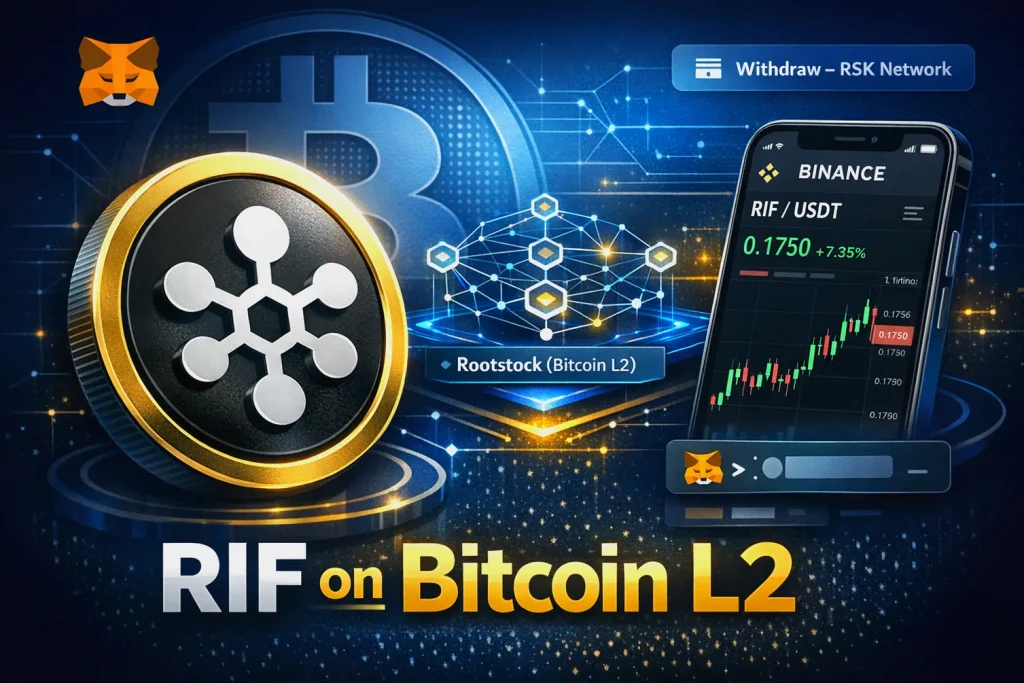
If you typed “What is the $RIF(Rifampicin) Coin, and how to buy” you’re not alone. Many newcomers mix up RIF with the antibiotic rifampicin. In crypto, RIF does not refer to medicine. It stands for Rootstock Infrastructure Framework — the utility token of Rootstock, a Bitcoin Layer 2 network for smart contracts. Think of RIF as the token that powers services and incentives in Bitcoin’s DeFi ecosystem via Rootstock. (academy.binance.com)
Before we go further, here’s the date context to avoid confusion: today is April 10, 2026. Details below (like availability on exchanges or on-chain stats) reflect sources available up to this date. Always double‑check the latest info inside your exchange account.
The quick answer: what is RIF?
- RIF is the native utility token for the Rootstock Infrastructure Framework (often shortened to “Rootstock” or historically “RSK”), a Bitcoin Layer 2 designed to bring EVM-compatible smart contracts to Bitcoin. Rootstock inherits Bitcoin’s security via merge‑mining with a large share of BTC hash power. (academy.binance.com)
- RIF fuels services and incentives across the ecosystem and can be staked to obtain stRIF for DAO governance and rewards through RootstockCollective. (academy.binance.com)
- RIF is available on top exchanges like Binance, making it straightforward to acquire for most users. (academy.binance.com)
Why people say “Rifampicin coin” — and why that’s wrong
Rifampicin is a well‑known antibiotic. The crypto ticker RIF is unrelated. In blockchain, RIF expands to “Rootstock Infrastructure Token” and belongs to the Rootstock ecosystem that scales Bitcoin’s capabilities with smart contracts, DeFi, and more. When in doubt, confirm you’re looking at “Rootstock Infrastructure Framework” or “RIF” within crypto resources, not medical references. (academy.binance.com)
How RIF fits into Bitcoin’s Layer 2 story
Rootstock is a smart‑contract Layer 2 anchored to Bitcoin. It’s EVM‑compatible (so familiar to Ethereum builders and MetaMask users) and secured by Bitcoin miners through merge‑mining. Users can bridge BTC to Rootstock and receive rBTC (a 1:1 BTC‑pegged token) for on‑chain transactions. By March 2025, more than 2,500 BTC had been bridged, underscoring growing activity. (academy.binance.com)
Real utilities for RIF
- Identity and usability: RIF powers RNS (RIF Name Service), which replaces long wallet strings with human‑readable names; RNS fees are denominated in RIF. (docs.rifos.org)
- Stablecoin and payments: USDRIF (RIF US Dollar) is a censorship‑resistant stablecoin within Rootstock’s ecosystem, visible on the Rootstock explorer. (explorer.rootstock.io)
- Governance and incentives: stake RIF to get stRIF and participate in RootstockCollective governance and rewards (paid in BTC and/or RIF). (coinmarketcap.com)
Token basics and smart‑contract standards
- Contract address (Rootstock mainnet): 0x2aCc95758f8b5F583470bA265Eb685a8f45fC9D5 (verify on the official Rootstock explorer). Total supply shows 1,000,000,000 RIF. (explorer.rootstock.io)
- Standard: the RIF token on Rootstock implements ERC‑20 plus ERC‑677 functionality on the Rootstock EVM chain. (explorer.rootstock.io)
Tip: Always verify token details on the official explorer before withdrawals or swaps.
How to buy RIF on Binance — a practical, step‑by‑step walkthrough
Below is a simple guide you can follow today (April 10, 2026). Binance has supported RIF trading and explicitly references RIF within its Academy, which notes availability on top exchanges like Binance. Still, pairs may vary by region and change over time, so search “RIF” inside Binance first. (academy.binance.com)
1) Create your Binance account
– Use this partner link for perks: Binance. Enter referral code CRYPTONEWER if prompted. New users can typically access a 20% trading fee discount and up to $10,000 in benefits via ongoing promotions associated with this code. Terms vary by region and time.
2) Verify identity (KYC)
– Complete the standard verification. This unlocks fiat deposits/withdrawals and higher limits.
3) Add funds
– Choose a method: bank card, bank transfer, or P2P. If your region supports it, you can buy crypto directly with card/transfer in the “Buy Crypto” section.
4) Find the RIF market
– In the Spot trading interface, type “RIF” in the search box and pick the pair available to you (e.g., RIF/USDT). If you don’t see a direct RIF pair in your region, buy USDT first, then swap to RIF on the spot market.
5) Place your order
– Market order for immediate execution, or limit order to set your price. Consider dollar‑cost averaging rather than going all‑in at once.
6) Reduce fees
– With code CRYPTONEWER on registration, you get a 20% fee discount; check your fee tier and discounts under your profile after sign‑up. Also consider enabling BNB fee deductions if it’s advantageous in your region.
7) Secure your account
– Enable 2FA (app‑based), anti‑phishing codes, and withdrawal whitelists. This matters before any on‑chain withdrawals.
8) Optional: withdraw RIF to self‑custody on Rootstock
– If you plan to use RIF in DeFi on Rootstock, withdraw to a self‑custody wallet. MetaMask works after adding the Rootstock network (Chain ID 30). (academy.binance.com)
– On the Binance withdrawal page, select the “RSK/Rootstock” network when sending RIF to Rootstock; do not choose Ethereum or another chain for this specific token. Double‑check the recipient address and network.
– You’ll need a tiny amount of rBTC for gas on Rootstock. Acquire rBTC by bridging BTC to Rootstock or using supported on‑ramps. (academy.binance.com)
Pro tips for a smooth first purchase
- Confirm the ticker and token: Search “Rootstock Infrastructure Framework (RIF)” in the Binance app/site. If you’re unsure, cross‑verify on the Rootstock explorer, which lists the official RIF contract address. (explorer.rootstock.io)
- Test with a small amount: Send a small RIF withdrawal first to confirm your wallet setup and network selection.
- Keep some rBTC for gas: Even simple transfers on Rootstock require a fraction of rBTC. Plan ahead so you’re not stuck. (academy.binance.com)
- Safeguard seed phrases: If you self‑custody, store seed phrases offline and never share them.
Where RIF is used in practice (and why that matters)
- Names, payments, identity: RNS fees are paid in RIF, letting apps replace unreadable addresses with names and enabling identity‑related flows. That’s usability progress for mainstream users. (docs.rifos.org)
- Stable-value flows: USDRIF shows how the ecosystem uses RIF as a core unit around stablecoin and payments utilities on Rootstock. View the token contract on the explorer for on‑chain transparency. (explorer.rootstock.io)
- Governance and incentives: With stRIF, community members help direct grants and priorities in RootstockCollective, and can earn rewards in BTC and/or RIF based on participation. This aligns incentives for builders and backers within the Rootstock economy. (rootstockcollective.xyz)
Storage and wallet setup snapshot
- MetaMask, Ledger, Trezor can be used to hold RIF/rBTC when configured for Rootstock. Rootstock is EVM‑compatible, so adding the network is as simple as entering RPC, chain ID, and symbol (RBTC) — once set, you can add the RIF token by contract. (academy.binance.com)
- Official Rootstock explorer lists the canonical RIF token entry and verifies its ERC‑20/677 implementation, which helps you avoid contract‑spoofing. (explorer.rootstock.io)
Key facts to remember
- RIF = Rootstock Infrastructure Framework token, not rifampicin. (academy.binance.com)
- Rootstock is Bitcoin’s smart‑contract Layer 2, merge‑mined and EVM‑compatible. (academy.binance.com)
- RIF is tradable on top exchanges like Binance, and can be used for RNS, stablecoins like USDRIF, and DAO governance via stRIF. (academy.binance.com)
Not financial advice. Crypto involves risk. DYOR, start small, and only commit what you can afford to lose.
Ready to try it with fee savings? Register here: Binance and use code CRYPTONEWER for a 20% fee discount and up to $10,000 in benefits (subject to Binance terms in your region).
Related posts:
 What is the $PAAL(PAAL AI) Coin and how to buy — Actionable 2026 Guide
 What is Ethereum(ETH) Essential Guide to Smart Contracts, Gas, Staking, and Layer 2
 What is Bitcoin(BTC) — Essential Breakdown for Curious Minds and First‑Time Buyers
 What is Blockchain? A Beginner-Friendly Explanation with Smart, Practical Examples