
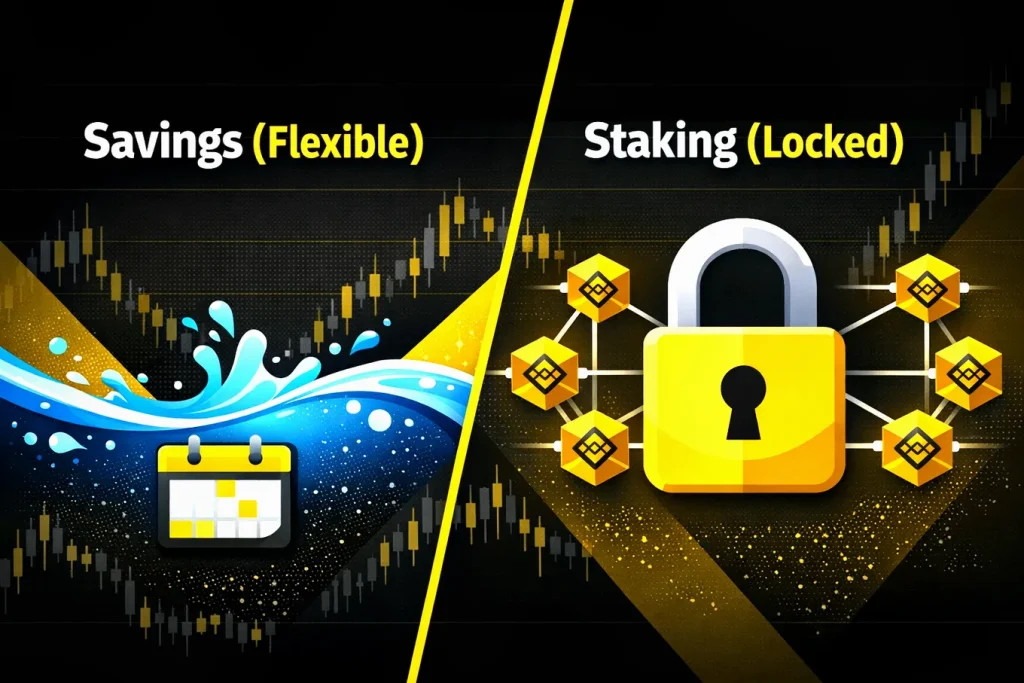
When you’re trying to earn passive income on idle crypto, the first fork in the road on Binance is simple but important: Binance staking vs savings. Both can boost your holdings over time, but they differ in liquidity, risk, reward mechanics, and what’s actually happening behind the scenes. If you’ve wondered which choice fits your strategy—or how to combine them—this no-nonsense guide gives you the practical details you need.

- 20% trading fee discount
- $100 signup bonus
- $10,000 futures bonus

- 20% fee cashback
- $60,000 futures bonus

- 20% fee cashback
- $8,000 bonus

- 50% trading fee discount
- 20% fee cashback
- $6,200 futures bonus

- 20% trading fee discount
- $30,050 signup bonus

- 20% fee cashback
- $10,000 bonus
Quick note on naming: what many still call “Binance Savings” now largely lives under Binance Simple Earn. You’ll see “Flexible” and “Locked” options there. Staking on Binance can include ETH Staking, BNB-related programs, DeFi Staking, and other validator-backed or third‑party products.
What each one really is
-
Binance Savings (now Simple Earn – Flexible):
- Flexible subscription with daily accruals on many coins.
- You can redeem at any time with minimal friction (some assets may have a short redemption window).
- Yields are typically lower vs locked products, reflecting the premium for liquidity.
-
Binance Staking (including ETH Staking, DeFi Staking, and validator-based options):
- Often “locked” for set periods or subject to unbonding periods based on the network (e.g., some PoS chains have 3–21+ day unbonding).
- Potentially higher yields than flexible savings, because funds help secure networks or are deployed to specialized strategies.
- May carry protocol-specific risks like slashing on certain chains (though Binance often manages validator ops and abstracts complexity).
The core differences that actually matter
-
Liquidity and access to funds
- Savings/Flexible: Redeem on demand (or near-immediate). Great for short-term needs.
- Staking/Locked: Funds are committed. Early redemption may be delayed, limited, or not possible, depending on the product.
-
Yield engine
- Savings: Primarily generated via internal treasury strategies, lending/borrowing markets, and market-making. Lower volatility in rates.
- Staking: Comes from blockchain inflation (staking rewards), network fees, or DeFi strategies. Rates can be higher but also more variable.
-
Risk profile
- Savings: Lower risk within exchange custody context; no validator slashing exposure. Still subject to exchange and market risks.
- Staking: Includes protocol risks (e.g., slashing, smart contract risk in DeFi Staking), potential unbonding delays, and reward variability.
-
Reward assets and compounding
- Savings: Rewards generally paid in the same asset. Some products auto-subscribe to keep compounding.
- Staking: Rewards typically paid in the staked asset or an equivalent representation (e.g., BETH for ETH staking), sometimes with separate redemption mechanics.
-
Transparency and on-chain exposure
- Savings: More like a custodial yield product; abstracted from on-chain validator details.
- Staking: Often represents authentic participation in network consensus, even if Binance handles the validator layer for you.
When to choose Savings vs Staking
Choose Savings (Simple Earn – Flexible) if you:
– Want fast access to funds, an emergency cushion, or are timing a trade.
– Prefer smoother, typically lower but steadier rates.
– Are testing the waters with smaller balances and want minimal friction.
Choose Staking if you:
– Can live without the capital for a defined period.
– Want potentially higher APR/APY tied to network issuance and validator rewards.
– Understand protocol-specific risks and redemption timelines.
Many investors blend both—keeping a flexible buffer for agility while staking a core long-term position for higher potential returns.
Real-world scenarios
-
Active trader’s buffer:
- Keep 20–40% of your portfolio in Savings for quick trades or market events. Stake the rest in assets you plan to hold for months.
-
Long-term believer in a PoS chain:
- Lock stake your main position to capture validator rewards and compounding, while parking a small share in Savings for cost averaging or dips.
-
Yield optimizer with a safety net:
- Use Savings for stablecoins or assets you regularly deploy. Stake blue-chip PoS coins where you accept unbonding periods.
Understanding rate displays, APR vs APY
- APR: Annual percentage rate excluding compounding. If rewards are auto-reinvested, your effective APY is higher.
- APY: Annual percentage yield including compounding. Be mindful of how often rewards are added.
- “Estimated” yields: Always variable. Network conditions, supply/demand, and program capacity can adjust rates.
Tip: If you see a big headline rate, drill down to minimum lock durations, capacity caps, and early redemption rules.
Risks to keep on your radar
- Exchange and custodial risk: Any off-chain product depends on platform solvency and security.
- Protocol risk in staking: Validator slashing, smart contract risk (for DeFi Staking), and governance changes.
- Liquidity risk: Locked positions might have unbonding periods or redemption queues.
- Market risk: Price volatility can outweigh yield if your asset drops significantly.
- Auto-subscribe surprises: Ensure you understand whether rewards or matured positions automatically roll over.
Practical guardrails:
– Diversify by asset, product type, and lock term.
– Keep an emergency portion in Savings.
– Read product pages carefully, especially redemption timelines and any penalties.
– Periodically rebalance based on your time horizon.
Binance product landscape in plain English
- Simple Earn – Flexible (aka Savings): Everyday yield with fast redemption.
- Simple Earn – Locked: Higher yields for locking periods (not the same as network staking, but similar trade-off: time for yield).
- ETH Staking and BETH: Stake ETH, receive BETH as a representation in some programs. Redemptions and conversions have specific rules.
- DeFi Staking: Binance routes funds into third-party protocols. Yields may be higher but add smart contract/protocol risk.
- Launchpool and promos: Short-term earning opportunities with new tokens. Limited windows and allocation caps.
If you’re optimizing for convenience and liquidity, Savings leads. If you’re optimizing for potentially higher returns and can tolerate extra complexity and timeline risk, Staking can shine.
A simple decision flow
1) Do you need access to the funds within days or weeks?
– Yes → Savings/Flexible.
– No → Consider Staking/Locked.
2) Are you comfortable with potential on-chain risks?
– No → Start with Savings or Simple Earn – Locked from reputable assets.
– Yes → Explore validator-based staking or DeFi Staking.
3) Do you plan to DCA or trade actively?
– Yes → Keep a portion in Savings for agility.
– No → Lean more into staking or longer locks.
4) Will you monitor positions monthly?
– Yes → You can pursue promos and rotating yields.
– No → Prefer set-and-forget products with auto-compounding.
Smart combinations you can copy
-
Laddered locks:
- Split a position across 30, 60, 90 days (or network unlock cycles). Every month something matures, balancing yield with periodic liquidity.
-
Core-stake + flexible satellite:
- Stake 70–80% of your long-term coin. Keep 20–30% in Savings to average into dips or cover opportunities.
-
Stablecoin reserve + chain conviction:
- Earn with Savings on stablecoins you use for trading. Stake your conviction assets (e.g., ETH, BNB, SOL equivalents where supported).
Common misconceptions
- “Savings is risk-free” — No yield product is. It’s relatively lower risk but still exposed to platform and market dynamics.
- “Staking rates are guaranteed” — They’re not. Network conditions and validator performance matter.
- “Locked means I can’t get out at all” — Read the product page; some have early redemption or unbonding, but timelines vary.
- “Higher APY always wins” — Only if it fits your time horizon and risk tolerance. Liquidity can be more valuable than a few extra points.
Fees, promos, and getting started fast
- Fees for subscribing/redeeming are typically minimal in Savings. Staking may involve network-level nuances, but Binance usually streamlines the UX.
- Capacity caps: Popular products sometimes fill quickly. Check back or set reminders when promos refresh.
- Auto-subscribe: Great for compounding, but turn it off if you might need funds on a specific date.
Want a head start setting this up? You can reduce trading costs and unlock perks when you sign up.
- New to Binance or creating a secondary account for yield-only funds? Use this link and code:
- Join Binance with code CRYPTONEWER
- Benefits: 20% fee discount and up to $10,000 in benefits via Binance’s latest promotions and welcome packages (subject to availability and terms).
If you already have an account, you can still apply the mindset above: keep a flexible pool for agility and stake what you won’t touch for a while.
Quick setup checklist
- Define your time horizon per asset (weeks, months, or a year+).
- Decide the liquidity split (e.g., 30% Savings, 70% Staking/Locked for long-term holds).
- Enable or disable auto-subscribe based on your calendar.
- Mark unbonding or maturity dates in your planner.
- Reassess monthly; rotate into promos only if they suit your risk profile.
FAQs that save you time
-
Can I lose principal in Savings?
- Savings is designed to be lower risk, but not risk-free. Platform and market risks exist. Stick to assets you understand.
-
What about slashing in Staking?
- Some networks penalize validators for downtime/misbehavior. Binance generally manages validator ops, but protocol risk isn’t zero. Read product notes.
-
How fast is redemption?
- Savings often redeems same day or next, with exceptions. Staking depends on the chain or lock rules—expect days to weeks for some.
-
Why did my APY change?
- Supply/demand, promos ending, capacity shifts, and chain conditions can all move rates.
-
Can I combine both on the same coin?
- Yes. Keep a flexible tranche for quick moves and stake the rest for potentially higher yield.
Ready to implement your plan? Open your account here for reduced costs and promo access: Join Binance with code CRYPTONEWER. Lower fees matter when you rebalance, compound, or rotate between Savings and Staking over time.
Disclaimer: This content is for educational purposes only and not financial advice. Crypto products carry risk, including potential loss of principal. Always review official Binance product pages and terms before subscribing.
Related posts:
 Is Blockchain Really Secure? Proven Insights and Real-World Threats Revealed
 What is the MANTRA (MANTRA) Coin, and how to buy: Essential guide with step‑by‑step Binance walkthrough
 What is Bitcoin(BTC) — Essential Breakdown for Curious Minds and First‑Time Buyers
 Proven 2026 Crypto Futures Trading Tips That Sharpen Your Edge